After a wildfire, a forest can look completely destroyed. Blackened trunks stand against the sky, the ground is covered in ash, and the familiar green landscape appears lifeless.
Yet beneath this seemingly devastated environment, nature may already be preparing for recovery.
Some trees survive beneath their scorched bark. Underground roots remain alive, dormant seeds begin germinating, and insects quickly return to burned areas.
Forest recovery after wildfires is a remarkable natural process that can take years, decades, or even centuries.
But an important question remains: should humans actively restore burned forests, or is it sometimes better to allow nature to recover independently?
The answer depends on the ecosystem, fire severity, climate, and the condition of the surrounding landscape.
What Happens Immediately After a Forest Fire?
A wildfire dramatically changes the physical and biological environment.
Vegetation may burn, tree canopies disappear, and the forest floor becomes covered with charcoal and ash.
However, fire does not necessarily destroy everything.
Many roots, seeds, microorganisms, and small animals survive underground, particularly where the heat does not penetrate deeply.
Ash can temporarily increase the availability of certain mineral nutrients, including calcium and potassium.
At the same time, intense fires may damage soil structure, reduce organic matter, and kill organisms near the surface.
The severity of the fire, rather than the appearance of the burned landscape alone, strongly influences how quickly a forest can recover.
The First Signs of Life After Fire
Recovery can begin surprisingly quickly.
In some ecosystems, green shoots emerge within weeks of a fire, especially when rainfall follows the disturbance.
Grasses and herbaceous plants often appear before young trees.
These early colonizers help cover exposed ground, provide food for wildlife, and begin rebuilding vegetation.
This gradual replacement and development of plant communities is known as ecological succession.
However, forest succession is not always a simple progression from grassland to mature woodland.
The process varies depending on which organisms survive, which seeds are available, and how environmental conditions change.
Trees That Are Naturally Adapted to Fire
Some forests have evolved under recurring wildfire conditions for thousands of years.
Their trees possess specialized survival strategies.
These are commonly called fire-adapted species.
For example, mature ponderosa pines often develop thick bark that protects their living tissues from relatively low-intensity surface fires.
Some eucalyptus species in Australia can produce new shoots from protected epicormic buds beneath their bark after their foliage has been damaged.
Certain lodgepole pine populations possess serotinous cones that remain closed until heat helps release their seeds.
These adaptations allow some trees to survive fire or establish new generations afterward.
In fire-dependent ecosystems, the complete exclusion of natural fire can sometimes disrupt important ecological processes.
How Seeds Bring a Burned Forest Back to Life
Seeds are central to forest regeneration.
Some survive underground in a soil seed bank, remaining dormant until environmental conditions favor germination.
Others arrive from nearby unburned vegetation through wind, water, or animals.
Fire can also stimulate germination in certain species by exposing seeds to heat or smoke-related chemical signals.
In California’s chaparral ecosystems, several shrub species demonstrate specialized fire-related germination strategies.
However, not all forests contain sufficient surviving seeds.
If severe fires destroy large areas and eliminate mature seed-producing trees, natural regeneration may become difficult.
The distance from surviving forests can significantly influence how quickly new trees establish.
The Hidden Role of Fungi and Soil Organisms
A recovering forest depends on much more than visible plants.
Underground ecosystems contain bacteria, fungi, insects, and other organisms that help recycle nutrients.
Particularly important are mycorrhizal fungi, which form beneficial relationships with plant roots.
These fungi help many trees absorb water and mineral nutrients from the soil.
In exchange, plants supply them with carbohydrates produced through photosynthesis.
Some fungal networks survive wildfire, while others must gradually recover as vegetation returns.
Severe heating can damage these biological communities and slow the rebuilding of healthy forest soil.
Wildlife Returns to Burned Forests
Burned forests are not necessarily empty landscapes.
Some animals benefit from the changes created by wildfire.
Woodpeckers may forage in dead trees containing wood-boring insect larvae.
Open ground can attract certain birds, while new vegetation provides food for grazing mammals.
Standing dead trees, known as snags, offer nesting and shelter opportunities for numerous species.
Over time, recovering vegetation creates additional habitats.
However, wildlife responses differ greatly.
Animals dependent on dense, mature forests may lose suitable habitat for many years.
A recovering forest supports changing communities of animals as its vegetation develops.
Yellowstone: A Famous Example of Natural Forest Recovery
The massive Yellowstone fires of 1988 burned approximately 36% of Yellowstone National Park in the United States.
At the time, the destruction appeared overwhelming.
Yet subsequent years revealed extensive natural regeneration.
Young lodgepole pines established across many burned areas, often growing from seeds released by fire-affected cones.
Grasses, wildflowers, and shrubs also returned.
Scientists studying Yellowstone have documented how forest regeneration varies according to fire severity, seed availability, and local environmental conditions.
Ecologist Monica Turner, whose research focuses on landscape ecology and wildfire, has demonstrated the importance of fire frequency in determining forest recovery.
Her work highlights that repeated severe fires over short intervals can reduce the ability of young forests to regenerate, particularly when trees have not yet produced sufficient seeds.
When Forests Cannot Recover Easily
Not every burned forest returns to its original condition.
Recovery becomes especially difficult when several environmental pressures occur together.
These include:
- Repeated severe wildfires
- Prolonged drought
- Rising temperatures
- Severe soil erosion
- Loss of nearby seed sources
- Invasive plant species
- Extensive previous deforestation
In some regions, repeated fires may cause forests to transition toward shrublands or grasslands.
Such changes are not always temporary.
For example, researchers in parts of western North America have documented areas where postfire tree regeneration is limited by increasingly hot and dry conditions.
Climate conditions after a wildfire can be just as important as the fire itself.
Why Soil Erosion Becomes a Serious Problem
After severe fires, the disappearance of vegetation exposes soil to rainfall and wind.
On steep slopes, heavy rain can transport large quantities of loose sediment into rivers and streams.
Some intense fires also contribute to the formation of hydrophobic soil, which temporarily repels water and increases surface runoff.
This can raise the risk of flooding and debris flows.
Recovery projects sometimes focus on stabilizing vulnerable slopes and protecting waterways rather than immediately planting trees.
These measures can be especially valuable near communities, roads, and reservoirs.
When Should Humans Help Restore a Forest?
Human intervention is most useful when natural regeneration is unlikely to succeed or when urgent environmental risks need attention.
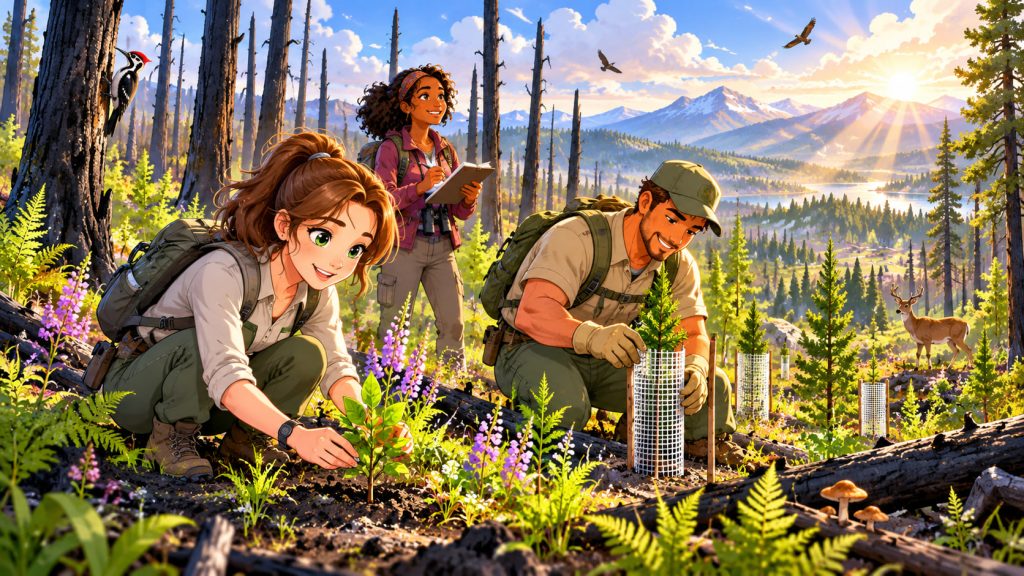
Restoration activities may involve controlling invasive species, protecting surviving seedlings, reducing erosion, and planting native trees where seed sources are insufficient.
However, large-scale tree planting is not automatically beneficial.
Planting unsuitable species or trees at excessive densities can create future problems.
In naturally recovering forests, unnecessary planting may disturb existing vegetation and soil communities.
Similarly, removing every dead tree can reduce wildlife habitat and eliminate important ecological structures.
Effective forest restoration begins with understanding what the ecosystem actually needs.
Can Controlled Fire Help Prevent Future Disasters?
In certain forest types, carefully managed fire can reduce accumulated vegetation that contributes to dangerous wildfire behavior.
This practice is called prescribed burning.
Fire specialists conduct planned burns under selected weather conditions and established safety procedures.
In suitable ecosystems, these fires can help maintain ecological processes and reduce surface fuel loads.
Indigenous communities in several parts of the world have also practiced cultural burning for generations, applying detailed local ecological knowledge.
However, prescribed fire is not appropriate everywhere and cannot eliminate all wildfire risks.
Its effectiveness depends on vegetation, climate, terrain, and professional planning.
How Long Does a Forest Take to Recover?
There is no universal recovery timeline.
Early vegetation may return within weeks or months.
Young trees can establish within several growing seasons where suitable conditions and seeds are available.
Developing a recognizable forest canopy may take decades.
Restoring the complex structure of an old-growth forest, including large trees, deadwood, specialized habitats, and mature soil communities, can require centuries.
These differences explain why measuring forest recovery only by the number of newly planted trees provides an incomplete picture.
True ecological recovery involves rebuilding relationships among plants, animals, fungi, soil, water, and climate.
Interesting Facts
- The 1988 Yellowstone fires burned approximately 793,000 acres within the national park.
- Some lodgepole pine cones remain closed for years until sufficient heat causes them to open.
- Many eucalyptus species can regenerate foliage from protected buds after fire damage.
- Certain woodpeckers benefit from recently burned forests because dead trees attract insects.
- Not all wildfires sterilize the soil; many underground organisms survive fires of low or moderate severity.
- Some plants produce their most successful generations shortly after fires because competition for sunlight decreases.
- A forest can become green again long before it recovers the biodiversity and structure of a mature ecosystem.
- Standing dead trees can remain ecologically valuable for decades after a wildfire.
Glossary
- Ecological Succession — The gradual development and change of biological communities following a disturbance or the creation of new habitat.
- Fire-Adapted — Describes species possessing characteristics that help them survive or reproduce in environments with recurring fire.
- Epicormic Buds — Dormant or protected buds on tree trunks and branches that can produce new shoots after damage.
- Serotinous Cones — Seed-bearing cones that retain seeds until an environmental trigger, often heat, causes them to open.
- Soil Seed Bank — The collection of viable seeds naturally stored in the soil.
- Mycorrhizal Fungi — Fungi that form beneficial associations with plant roots and assist with nutrient and water absorption.
- Hydrophobic Soil — Soil that repels water, sometimes after intense heating during wildfires.
- Prescribed Burning — The planned application of fire under controlled conditions to achieve ecological or land-management objectives.