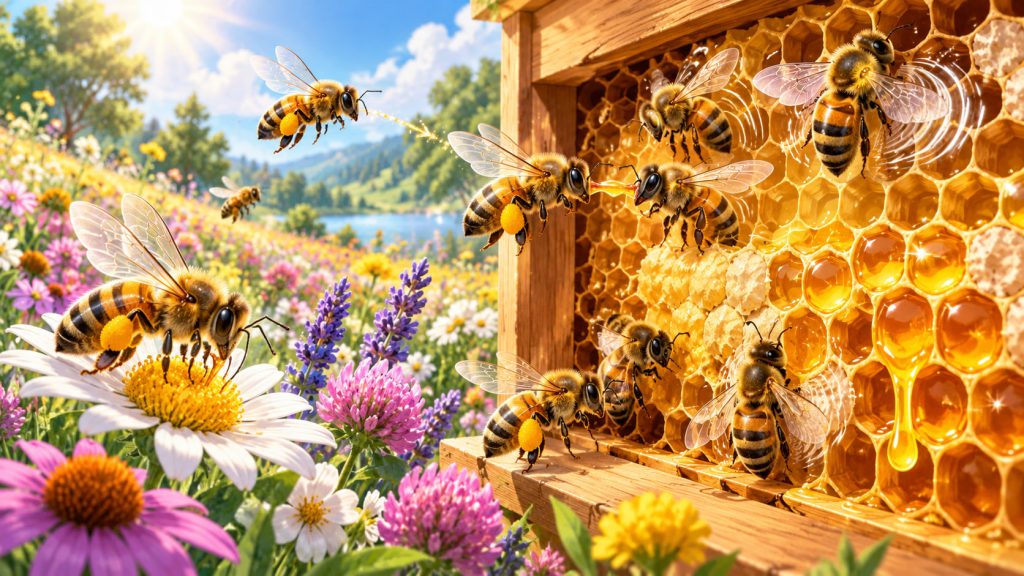
Honey is one of nature’s most remarkable foods. Sweet, aromatic, and capable of remaining edible for extraordinarily long periods under suitable conditions, it is created through a complex biological process involving flowers, bees, enzymes, and carefully controlled moisture.
But honey does not exist inside flowers in its finished form.
What bees collect is a watery, sugar-rich liquid that must undergo several transformations before becoming the thick golden substance familiar to humans.
Honey production is a coordinated process in which thousands of bees work together to collect, transform, dry, and store food for their colony.
Understanding how honey is made reveals an extraordinary example of cooperation between insects and flowering plants.
It All Begins With Flower Nectar
The journey of honey begins inside a flower.
Many flowering plants produce a sweet liquid called nectar, which attracts bees and other pollinating animals.
Nectar primarily contains water and dissolved sugars, including sucrose, glucose, and fructose.
Its sugar concentration varies considerably between plant species and environmental conditions.
Some flowers produce relatively dilute nectar, while others offer more concentrated solutions.
For bees, nectar is an important energy source.
For plants, it acts as a reward that encourages pollinators to visit flowers and transfer pollen.
This relationship benefits both organisms: bees obtain food, while flowering plants gain opportunities for reproduction.
How Bees Collect Nectar From Flowers
Worker honeybees responsible for gathering food are known as foragers.
When a forager lands on a suitable flower, it extends its proboscis, a specialized feeding structure used to take up liquid food.
The nectar travels into a storage organ called the honey stomach, also known as the crop.
Despite its name, this structure is different from the digestive stomach.
It temporarily holds collected nectar while the bee travels between flowers and returns to the colony.
A foraging bee may visit numerous flowers during a single trip.
The amount collected depends on flower availability, nectar concentration, weather, and the distance from the nest.
The First Chemical Transformation
Honey production begins before the foraging bee reaches home.
While nectar is being transported, enzymes introduced by the bee begin altering its chemical composition.
One important enzyme is invertase.
It helps break down sucrose, a common sugar in flower nectar, into two simpler sugars:
- Glucose
- Fructose
These sugars become major components of mature honey.
Additional enzymatic processes contribute to honey’s chemical characteristics.
For example, glucose oxidase can help produce gluconic acid, contributing to honey’s acidity.
Honey is therefore not simply concentrated flower nectar. It is a biologically processed food created through the activity of bees.
How Bees Transfer Nectar Inside the Hive
When a forager returns to its colony, the collected nectar is often transferred to another worker bee.
This mouth-to-mouth exchange of liquid food is called trophallaxis.
During this process, nectar can pass between several workers before being deposited into honeycomb cells.
The transfers help distribute collected food throughout the colony and can contribute to its processing.
Worker bees may repeatedly manipulate small droplets of nectar, increasing their exposure to air.
This prepares the liquid for the next essential stage: removing excess water.
How Nectar Becomes Thick Honey
Fresh nectar usually contains much more water than finished honey.
Depending on the plant, nectar may contain approximately 60–80% water or sometimes even more.
Mature honey generally contains around 17–20% water, although its exact composition varies.
Removing this moisture is essential.
Bees spread nectar within the honeycomb and expose it to moving air.
Worker bees can also fan their wings to support ventilation inside the nest.
Through evaporation, much of the water gradually disappears.
As the moisture content decreases, the sugar concentration increases.
The liquid becomes thicker, more viscous, and less favorable for microbial growth.
This carefully managed dehydration is one of the main reasons honey can remain stable for long periods.
Why Honeycomb Cells Have a Hexagonal Shape
Bees store developing honey inside structures made from beeswax.
The familiar hexagonal honeycomb is remarkably efficient.
Its repeating six-sided cells provide substantial storage capacity while using wax economically.
Worker honeybees produce wax through specialized glands and manipulate it to construct the comb.
These cells serve several purposes.
They hold developing bees, stored pollen, and honey.
Once honey reaches a suitable state of maturity, workers commonly seal the filled cells with a thin layer of wax.
This process is called capping.
The wax covering helps protect the stored honey from moisture and contamination.
Why Honey Does Not Spoil Easily
Honey possesses several natural characteristics that discourage the growth of many microorganisms.
Its high sugar concentration creates an environment with very little water available for microbial activity.
Honey is also hygroscopic, meaning it readily absorbs moisture from its surroundings.
If exposed to humid air, its water content can increase, potentially making fermentation more likely.
Its acidity and certain antimicrobial compounds provide additional protective effects.
Together, these properties explain honey’s remarkable storage stability.
However, honey is not sterile.
It may contain naturally occurring microorganisms and bacterial spores.
For this reason, honey should never be given to children younger than 12 months because of the risk of infant botulism.
Do Bees Make Honey Only From Flowers?
Most familiar honey is produced from floral nectar.
However, some honey comes from a different sugary substance.
Honeydew is a sweet liquid released by certain sap-feeding insects, including aphids and scale insects.
These insects feed on plant fluids and excrete sugar-containing droplets.
Honeybees sometimes collect these droplets and process them into honey.
Honeydew honey is produced in several forested regions, particularly where suitable trees and sap-feeding insects are abundant.
It often has a darker color and a distinctive mineral-rich flavor profile.
This demonstrates that honey production is not restricted entirely to flower nectar.
Why Different Types of Honey Taste Different
Honey can vary enormously in appearance, aroma, and flavor.
The most important influence is the botanical origin of the collected nectar.
For example:
- Acacia honey is often pale, mild, and slow to crystallize.
- Buckwheat honey is usually dark, with a strong and distinctive flavor.
- Orange blossom honey commonly has delicate floral and citrus-like aromas.
- Heather honey is known for its distinctive texture and pronounced flavor.
These differences reflect variations in sugar composition, plant-derived aromatic compounds, organic acids, and other minor constituents.
Some honey naturally undergoes crystallization as glucose separates into solid crystals.
This process does not automatically indicate spoilage.
It is a normal physical change influenced by temperature, sugar composition, and other factors.
How Bees Find the Best Flowers
Finding sufficient nectar requires more than random searching.
Honeybees possess sophisticated sensory abilities and communication systems.
Successful foragers can communicate information about profitable food locations through a behavior called the waggle dance.
The direction and duration of the dance provide information about the location of a food source relative to the sun and the colony.
Biologist Thomas D. Seeley, whose research has extensively explored honeybee behavior, has demonstrated how individual foragers and communication allow colonies to exploit changing food resources.
His work illustrates that honey production depends on decentralized cooperation rather than instructions from a single leader.
The queen does not direct individual bees toward flowers.
Instead, workers respond to environmental information and signals from other colony members.
Why Do Bees Produce So Much Honey?
Honey is not produced for humans.
It is an energy reserve that allows honeybee colonies to survive when fresh nectar becomes scarce.
During cold seasons, prolonged rain, or periods without flowering plants, bees consume stored honey to fuel their activities.
In temperate climates, a colony may need substantial reserves to survive winter.
Honey provides carbohydrates, while stored pollen supplies much of the protein and other nutrients needed for raising young bees.
Beekeepers harvest honey from managed colonies, but wild honeybee colonies create and store honey without any human assistance.
Humans are simply beneficiaries of a food-storage system that evolved to support bee survival.
Interesting Facts
- Honeybees have two functionally distinct stomach regions: a crop for transporting food and a digestive stomach for processing nutrients.
- A single worker bee can make many foraging trips in one day when weather and flower availability are favorable.
- Honeycomb cells are hexagonal, allowing efficient use of space and wax.
- Mature honey contains much less water than the nectar from which it originates.
- The darker color of certain honey varieties often reflects differences in botanical origin and chemical composition.
- Honey naturally changes texture over time, and crystallized honey can remain perfectly edible.
- Honeybees use the position of the sun as an important reference during foraging and communication.
- Wild honeybee colonies can store enough honey to support thousands of bees during periods when flowers are unavailable.
Glossary
- Nectar — A sugar-rich liquid produced by plants, often to attract pollinating animals.
- Proboscis — A specialized feeding structure that bees use to take up nectar and other liquids.
- Honey Stomach — A storage organ in a honeybee that temporarily holds nectar before it is transferred or processed.
- Invertase — An enzyme that breaks down sucrose into glucose and fructose.
- Trophallaxis — The transfer of liquid food between insects, commonly through mouth-to-mouth exchange.
- Evaporation — The process through which liquid water changes into vapor, helping concentrate nectar into honey.
- Capping — The process of sealing mature honey inside honeycomb cells with wax.
- Hygroscopic — Describes a substance that absorbs moisture from the surrounding environment.
- Honeydew — A sugary substance excreted by certain sap-feeding insects and sometimes collected by honeybees.
- Crystallization — The natural formation of solid sugar crystals within honey.
- Waggle Dance — A communication behavior through which honeybee foragers convey information about the location of food sources.