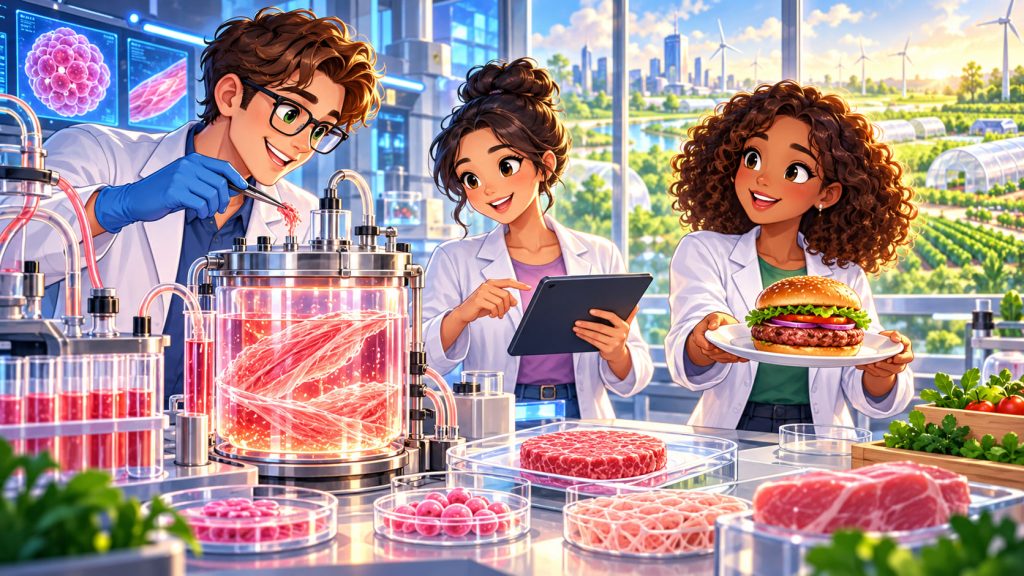
Imagine enjoying a chicken burger or a juicy steak without raising or slaughtering an animal. The meat has the familiar taste and texture of conventional meat, but it was grown from animal cells inside a controlled production facility.
This is the promise of lab-grown meat, one of the most ambitious developments in modern food technology.
As the global population grows, demand for protein continues to increase. Traditional livestock farming faces challenges involving land use, water consumption, greenhouse gas emissions, and animal welfare.
Lab-grown meat could become an important part of the future food system, but can it genuinely help solve global hunger and food insecurity?
The answer depends on how successfully scientists and companies overcome several major technological and economic obstacles.
What Exactly Is Lab-Grown Meat?
Lab-grown meat, also called cultivated meat or cell-cultured meat, is produced by growing animal cells outside the animal’s body.
Unlike plant-based meat alternatives, cultivated meat consists of actual animal cells.
Scientists can produce muscle and fat cells derived from chickens, cattle, pigs, fish, and other animals.
The technology relies on cell culture, a method that allows living cells to multiply under carefully controlled conditions.
The goal is to create edible animal tissue without the conventional process of raising livestock.
Cultivated meat is neither genetically modified plant protein nor an artificial imitation of meat. It is real animal tissue produced through a different process.
How Is Meat Grown in a Laboratory?
The production process begins with a small sample of animal cells.
Researchers select cells capable of multiplying and developing into the tissues needed for meat production.
These may include specialized stem cells or other cells suitable for cultivation.
The cells are placed into a nutrient-rich liquid called a growth medium.
This mixture supplies amino acids, sugars, vitamins, minerals, and growth factors.
The cells multiply inside controlled vessels known as bioreactors, where temperature, oxygen, acidity, and other conditions are regulated.
To create structured meat, researchers may use a scaffold that supports the development and arrangement of cells.
Once sufficient tissue has formed, the resulting material can be harvested and processed into food products.
Why Scientists Are Developing Cultivated Meat
Conventional meat production requires considerable agricultural resources.
Animals need feed, water, land, housing, and veterinary care throughout their lives.
Cattle also produce methane during digestion, contributing to greenhouse gas emissions.
Cultivated meat production could reduce dependence on some of these resources.
Potential advantages include:
- Reduced need for grazing land
- Lower dependence on raising and slaughtering livestock
- More controlled production conditions
- Opportunities to reduce certain environmental impacts
- Production facilities located closer to consumers
However, these potential advantages depend on how the technology operates at commercial scale.
Could Lab-Grown Meat Reduce Environmental Damage?
One of the strongest arguments for cultivated meat concerns environmental sustainability.
Traditional livestock production contributes to deforestation, agricultural land conversion, and greenhouse gas emissions.
Cell-based production could significantly reduce land requirements because it does not need large herds of animals.
However, growing cells requires electricity, heating, cooling, purification, and specialized equipment.
Researchers use life-cycle assessment to evaluate environmental impacts across the entire production process.
Environmental scientist Hanna Tuomisto, whose research has examined the environmental impacts of cultured meat, has highlighted the importance of production technology and energy sources when evaluating its sustainability.
Cultivated meat made using low-carbon energy could offer substantial environmental advantages, while energy-intensive production may reduce those benefits.
Can Cultivated Meat Help Feed a Growing Population?
The world’s population is expected to reach approximately 9.7 billion by 2050.
Meeting future nutritional needs will require efficient food production systems.
Cultivated meat could eventually provide animal protein without expanding livestock farming at the same rate as demand.
Production facilities might also operate in regions where conventional livestock farming is difficult.
However, global food security depends on more than producing enough food.
Poverty, armed conflict, transportation problems, food waste, and unequal distribution contribute significantly to hunger.
Lab-grown meat cannot solve these social and economic problems on its own.
It could become one component of a broader strategy involving sustainable agriculture, better distribution, and improved access to nutritious food.
The Biggest Challenge: Production Costs
Growing meat from animal cells remains technologically demanding.
Production requires specialized equipment, clean facilities, suitable nutrients, and precise environmental control.
Some growth-medium ingredients are particularly expensive.
Scientists are developing cheaper formulations that reduce reliance on costly pharmaceutical-grade materials.
Another challenge is scaling up production from experimental equipment to large industrial facilities.
Cells must remain healthy while receiving enough oxygen and nutrients.
This becomes increasingly complicated as production volumes grow.
For cultivated meat to compete with conventional meat, manufacturers must achieve reliable production at much lower costs.
Will Cultivated Meat Taste Like Ordinary Meat?
Flavor and texture are essential for consumer acceptance.
Meat contains muscle fibers, fat, connective tissue, water, and numerous flavor-producing compounds.
Reproducing these features requires more than simply multiplying cells.
Ground meat products are generally easier to manufacture than thick steaks because they do not require the same complex internal structure.
Researchers are also exploring hybrid products that combine cultivated animal cells with plant-based ingredients.
These combinations may reduce costs while improving flavor and texture.
The most commercially practical products may initially be burgers, meatballs, sausages, and other processed foods rather than whole steaks.
Is Lab-Grown Meat Safe to Eat?
Cultivated meat must meet food safety requirements before reaching consumers.
Controlled production environments may reduce exposure to some hazards associated with conventional animal farming.
However, cell-based manufacturing introduces its own safety considerations.
These include microbial contamination, growth-medium ingredients, and changes that may occur during extended cell cultivation.
Food safety authorities therefore evaluate production methods, ingredients, and manufacturing controls.
In 2023, the United States allowed the commercial sale of certain cultivated chicken products following regulatory reviews.
Safety depends on the specific product and manufacturing process, not simply on whether meat is produced in a laboratory.
Which Countries Have Already Approved Cultivated Meat?
Singapore became the first country to authorize the commercial sale of cultivated meat in 2020.
The initial approval involved cultivated chicken produced by Eat Just’s GOOD Meat division.
In 2023, the United States became another major market to permit sales of certain cultivated chicken products.
These developments demonstrated that cultivated meat could move beyond laboratory experiments and into regulated food markets.
Nevertheless, commercial production remained limited compared with conventional meat industries.
Regulatory requirements, manufacturing capacity, and production costs continue to influence how quickly the industry develops.
Could Cultivated Meat Replace Traditional Farming?
A complete replacement of conventional livestock farming is unlikely in the near future.
Traditional agriculture supports millions of livelihoods and produces numerous products beyond meat.
Livestock also play important roles in some agricultural systems, including manure production and the use of grazing land unsuitable for growing crops.
Cultivated meat may instead become an additional protein source alongside conventional meat, legumes, and plant-based alternatives.
The most effective food systems may combine several production methods.
The future of meat could involve greater diversity rather than the disappearance of traditional agriculture.
Interesting Facts
- The first publicly presented cultivated beef burger was produced in 2013 by a team led by Dutch scientist Mark Post.
- Singapore approved the commercial sale of cultivated chicken in 2020.
- Cultivated meat is produced from animal cells rather than being assembled entirely from plant proteins.
- Scientists can grow different animal cell types, including muscle and fat cells.
- Producing structured steaks is generally more difficult than producing ground meat.
- Cultivated meat facilities require carefully controlled conditions similar to those used in other advanced biotechnology industries.
- Researchers are investigating ways to replace expensive growth-medium ingredients with more affordable alternatives.
Glossary
- Cultivated Meat — Real animal meat produced by growing animal cells outside the body.
- Cell Culture — The controlled growth and multiplication of living cells outside an organism.
- Stem Cells — Cells capable of producing additional cells and, in suitable conditions, developing into specialized cell types.
- Growth Medium — A nutrient-containing liquid that supports the survival and multiplication of cultured cells.
- Bioreactors — Controlled vessels used to grow biological materials, including animal cells, under regulated conditions.
- Scaffold — A supporting structure that helps cells develop into organized tissues.
- Life-Cycle Assessment — A method used to evaluate environmental impacts across the stages of a product’s production and use.
- Food Security — A condition in which people have reliable access to sufficient, safe, and nutritious food.
- Scaling Up — Expanding a production process from small experimental quantities to larger commercial volumes.
- Hybrid Products — Foods that combine cultivated animal cells with other ingredients, such as plant-based proteins.