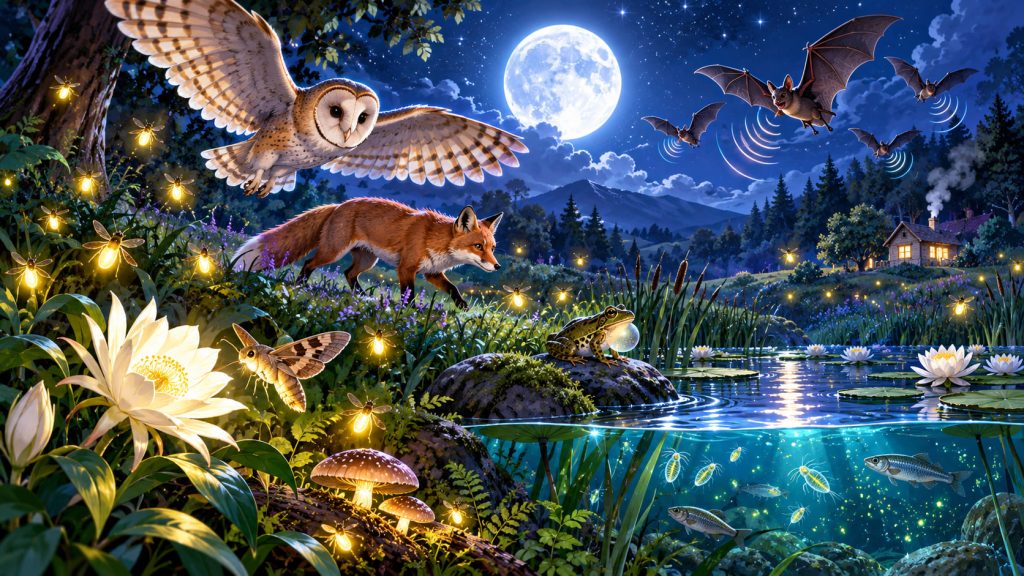
When the sun disappears below the horizon, forests become darker, birds grow quieter, and many familiar animals retreat into their shelters.
To human observers, nature may appear to be falling asleep.
But the natural world is far from inactive.
Across forests, deserts, wetlands, and oceans, countless organisms begin their most important activities after sunset. Predators search for food, flowers attract nighttime pollinators, and millions of marine creatures travel through the darkness.
Some plants even change the way they exchange gases with the atmosphere.
Night is not simply a period of rest in nature. It is a separate ecological world governed by darkness, temperature, biological rhythms, and specialized adaptations.
Understanding what happens in nature at night reveals an extraordinary hidden side of life on Earth.
Why Some Animals Become Active After Dark
Animals have evolved different schedules to avoid competition, regulate body temperature, and reduce exposure to predators.
Species that are primarily active at night are described as nocturnal.
Others are crepuscular, meaning they are most active around sunrise and sunset.
These activity patterns are regulated partly by an internal biological timing system called the circadian rhythm.
This approximately 24-hour cycle influences sleep, hormone production, metabolism, feeding behavior, and other physiological processes.
Environmental signals, especially changes in light, help synchronize biological clocks.
For nocturnal animals, darkness can provide opportunities that daylight does not.
Forest Predators Begin Their Nightly Hunts
As evening approaches, many forest predators become increasingly active.
Owls leave their resting places to hunt small mammals, insects, and other prey.
Their exceptional hearing helps them locate animals moving through vegetation.
Some owl species also possess specialized feather structures that reduce flight noise, allowing them to approach prey with minimal sound.
Foxes may search for rodents, rabbits, and other food sources during nighttime hours, although their activity varies according to habitat and human disturbance.
Bats emerge to hunt flying insects.
Many insect-eating bats use echolocation, producing high-frequency sounds and interpreting the returning echoes.
This biological system allows them to navigate and detect prey in darkness.
A bat can locate an insect without relying primarily on visible light.
Flowers That Bloom for Nighttime Visitors
Not all flowers depend on butterflies or daytime bees.
Some plants have evolved to attract moths, bats, and other nocturnal pollinators.
This ecological relationship is known as nocturnal pollination.
Night-blooming flowers often have characteristics that help attract visitors in low-light conditions.
These may include:
- Pale or white petals
- Strong evening fragrances
- Nectar production during nighttime hours
- Flower shapes adapted to particular pollinators
Certain hawkmoths use their long feeding structures to reach nectar inside deep flowers.
In tropical environments, some bats pollinate flowers while feeding on nectar.
The relationship benefits both organisms.
Animals obtain food, while plants transfer pollen between flowers.
Nighttime pollination is an important component of biodiversity and plant reproduction.
The Secret World of Fireflies
On warm evenings, some landscapes become illuminated by tiny flashes of light.
Fireflies produce this glow through bioluminescence, a chemical process that generates light inside living organisms.
Their light-producing reactions involve specialized compounds, enzymes, and oxygen.
In many firefly species, flashing patterns help individuals identify potential mates.
Different species can produce distinctive rhythms.
The light is remarkably efficient because relatively little energy is released as heat.
However, not every firefly species produces conspicuous flashes as an adult.
Some communicate using other signals.
Firefly populations can also be affected by habitat loss, pesticides, and artificial lighting.
What Happens to Plants After Sunset?
Plants do not simply stop functioning when darkness arrives.
Most plants depend on sunlight for photosynthesis, so their production of sugars through this process largely stops at night.
However, cellular respiration continues.
Plants use stored carbohydrates to support maintenance, growth, and other essential activities.
Water transport, hormone signaling, and tissue development can also continue during darkness.
Certain desert plants demonstrate an especially fascinating adaptation.
Many cacti and other succulents use CAM photosynthesis, opening their stomata mainly at night to absorb carbon dioxide.
They store this carbon dioxide in organic acids and use it during daylight photosynthesis.
This strategy helps conserve water in hot, dry environments.
The Soil Becomes a Busy Underground Ecosystem
Beneath the forest floor, an enormous biological community remains active.
Earthworms, insects, mites, bacteria, and fungi participate in decomposition, breaking down dead organic material.
Moist nighttime conditions can encourage some soil-dwelling animals to approach the surface.
Earthworms may emerge to feed on decaying plant material or move through damp environments.
Fungi and microorganisms continue breaking down leaves, wood, and other organic matter.
These processes release nutrients that can eventually become available to plants.
Although decomposition occurs throughout the day, nighttime moisture and temperature can influence the activity of particular organisms.
The recycling of nutrients never stops simply because sunlight disappears.
Frogs and Insects Create the Nighttime Soundscape
The sounds of a summer night are produced by many different animals.
Male frogs often call to attract mates, particularly during breeding seasons.
Crickets create characteristic sounds by rubbing specialized body structures together.
This process is called stridulation.
Different insect species produce recognizable patterns of sound.
Temperature can also influence calling behavior.
For some cricket species, the frequency of chirping increases as the surrounding temperature rises.
These sounds are not random background noise.
They are important signals used for reproduction, territorial behavior, and communication.
Birds Travel Thousands of Miles Under Cover of Darkness
Many migratory birds travel at night rather than during daylight.
Songbirds such as thrushes and warblers often perform substantial portions of their seasonal journeys after sunset.
Nighttime flight can offer advantages, including cooler temperatures and reduced exposure to some daytime predators.
Birds also use several navigational cues.
These include Earth’s magnetic field, celestial information, and environmental landmarks.
Migration researcher Martin Wikelski has helped advance scientific understanding of animal movements through tracking technologies.
Research into nighttime migration reveals that the sky above apparently sleeping landscapes may contain enormous numbers of traveling birds.
However, artificial lighting can disorient migrating birds and increase the risk of collisions with buildings.
One of Earth’s Largest Migrations Happens Every Night in the Ocean
The most extraordinary nighttime movement may occur underwater.
Many small marine organisms spend daylight hours in deeper water, where they are less exposed to visual predators.
After sunset, they move upward toward the surface to feed.
This behavior is called diel vertical migration.
It involves zooplankton, small fish, and other marine animals.
When daylight returns, many descend into darker waters.
This enormous daily movement also influences ocean food webs and the transport of carbon through the water column.
Scientists regard it as one of the largest recurring animal migrations on Earth by biomass.
The entire process happens largely unnoticed by people on land.
Why Darkness Is Essential for Healthy Ecosystems
Natural darkness plays an important role in maintaining ecological relationships.
Artificial lighting can interfere with animal navigation, reproduction, hunting, and feeding.
This growing environmental problem is known as light pollution.
Streetlights and illuminated buildings can attract insects away from their natural habitats.
Artificial coastal lighting may disorient newly hatched sea turtles that normally use natural brightness cues to orient toward the ocean.
Nighttime lighting can also alter predator-prey interactions and disrupt biological clocks.
Ecologist Travis Longcore, who has extensively studied the ecological effects of artificial night lighting, has emphasized its ability to change wildlife behavior and relationships between species.
Reducing unnecessary outdoor lighting can therefore benefit both energy conservation and biodiversity.
Interesting Facts
- Some owls can locate prey using sound even when the animal is hidden beneath vegetation or snow.
- Insect-eating bats can detect flying prey using ultrasonic echoes.
- Certain flowers release their strongest fragrances after sunset to attract nighttime pollinators.
- Fireflies produce biological light through chemical reactions rather than high-temperature combustion.
- Many desert succulents absorb much of their carbon dioxide at night to reduce water loss.
- Migratory songbirds frequently travel at night, sometimes covering hundreds of kilometers during a single journey.
- Vast numbers of marine organisms rise toward the ocean surface after sunset and descend again around dawn.
- Male crickets and frogs use acoustic signals to communicate with potential mates.
- Artificial lighting near nesting beaches can interfere with the natural orientation of newly hatched sea turtles.
Glossary
- Nocturnal — Describes animals that are primarily active during the night.
- Crepuscular — Describes organisms most active around dawn and dusk.
- Circadian Rhythm — An internal biological cycle lasting approximately 24 hours that regulates physiological and behavioral processes.
- Echolocation — A biological navigation and detection system that uses emitted sounds and their returning echoes.
- Nocturnal Pollination — The transfer of pollen between flowers by animals active during nighttime hours.
- Bioluminescence — The production of light through chemical reactions inside living organisms.
- Cellular Respiration — The process by which cells release usable energy from organic molecules.
- CAM Photosynthesis — A water-saving photosynthetic adaptation in which plants primarily absorb carbon dioxide at night.
- Decomposition — The biological breakdown of dead organic material into simpler substances.
- Stridulation — The production of sound by rubbing specialized body structures together.
- Diel Vertical Migration — The regular daily movement of aquatic organisms between different water depths.
- Light Pollution — Excessive or inappropriate artificial lighting that disrupts natural darkness and can affect ecosystems.