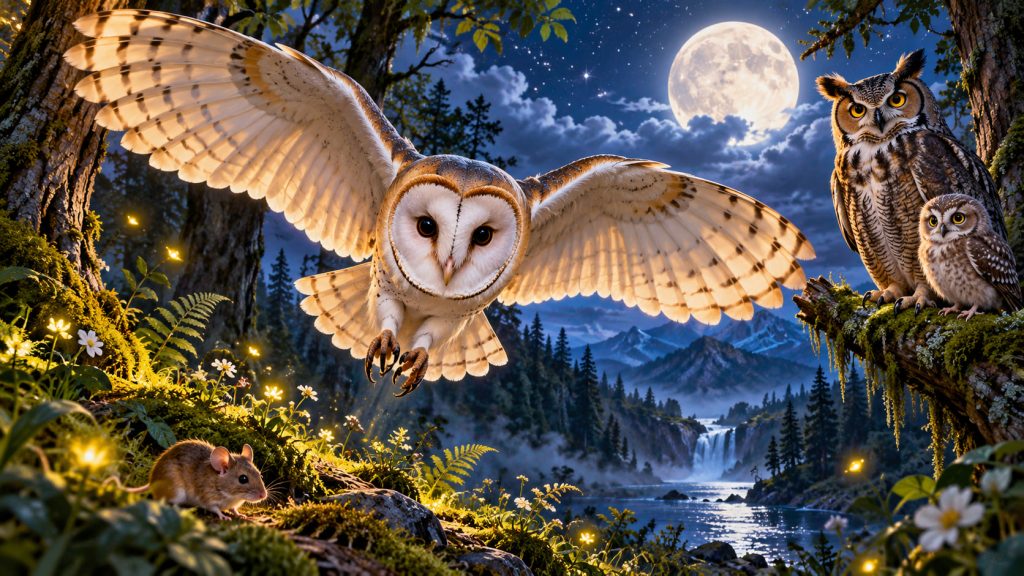
Owls are among the most mysterious and fascinating birds on Earth. With their enormous eyes, unusually flexible necks, powerful talons, and nearly silent flight, they seem perfectly designed for life in darkness.
For thousands of years, humans have associated owls with wisdom, mystery, and supernatural powers.
Yet the real biology of these remarkable birds is even more impressive than the legends surrounding them.
Owls can detect tiny movements in near darkness, locate hidden prey through sound, and fly with remarkably little noise.
These extraordinary abilities make owls some of the most specialized predators in the bird world.
But not all owls live or hunt in the same way. Some inhabit tropical rainforests, others survive in Arctic environments, and several species remain active during daylight.
What Makes Owls Different From Other Birds?
Owls belong to the order Strigiformes, which includes more than 200 recognized species worldwide.
They are traditionally divided into two families: typical owls and barn owls.
Most species possess large forward-facing eyes, broad heads, powerful feet, and specialized feathers.
Their appearance reflects an evolutionary history closely associated with predatory behavior.
Unlike many birds, owls have eyes positioned toward the front of their heads.
This provides overlapping visual fields and excellent binocular vision, allowing them to judge distances accurately.
Such precision is essential when approaching prey.
Why Do Owls Have Such Large Eyes?
An owl’s eyes are unusually large relative to its skull.
These eyes help gather available light, making them extremely effective in dim conditions.
Unlike human eyes, owl eyes are more elongated and are held relatively firmly in their sockets.
As a result, owls cannot move their eyes as freely as humans do.
Instead, they compensate by turning their heads.
Their retinas contain many rod photoreceptor cells, which are highly sensitive to low light.
Owls can see exceptionally well in darkness, but they still require some light to form images.
They cannot see in complete darkness without any available light.
How Can Owls Turn Their Heads So Far?
One of the most famous owl abilities is extreme head rotation.
Many owls can rotate their heads approximately 270 degrees in either direction.
This is possible because their necks contain 14 cervical vertebrae, compared with seven in humans.
Their blood vessels and surrounding anatomical structures also possess adaptations that help maintain circulation during substantial head movements.
However, the popular claim that owls can rotate their heads through a complete circle is incorrect.
Owls cannot turn their heads 360 degrees.
Their exceptional neck mobility compensates for their relatively fixed eyes.
Their Hearing Is Almost Like a Biological Radar
Owls are famous for locating prey through sound.
Many species possess a specialized arrangement of feathers surrounding the face called a facial disc.
This structure helps direct sound toward the ears.
Some owls also possess asymmetrical ears, with openings positioned at different heights or having different shapes.
These differences help the brain determine the direction and elevation of sounds.
Barn owls are especially skilled auditory hunters.
They can locate small mammals by listening to movements in vegetation, even when their prey is difficult to see.
This makes hearing one of their most important hunting tools.
Why Can Owls Fly Almost Silently?
The remarkably quiet flight of many owl species results from specialized feather structures.
Their flight feathers often possess soft surfaces and fringed edges that reduce aerodynamic noise.
The leading edges of certain wing feathers have comb-like structures that help modify airflow.
These adaptations reduce the sounds produced during flight.
Quiet flight allows owls to approach prey without attracting attention.
It also helps prevent wing noise from interfering with their own hearing.
Not every owl species has equally specialized silent-flight adaptations.
Owls that hunt fish, for example, may depend less on extremely quiet flight than species hunting small mammals in darkness.
What Do Owls Eat?
Owls are carnivorous predators with diets that vary depending on species and habitat.
Their prey may include:
- Mice, voles, and other small mammals
- Insects and large arthropods
- Small birds
- Frogs and reptiles
- Fish
- Occasionally larger mammals or birds
Their powerful feet possess sharp talons designed for capturing and gripping prey.
Many owls have a reversible outer toe that can point forward or backward, improving their ability to grasp different objects.
Small owls often specialize in insects and rodents, while larger species can capture considerably bigger prey.
The Eurasian eagle-owl, for example, is capable of hunting rabbits and various birds.
Are All Owls Nocturnal?
Although owls are strongly associated with nighttime hunting, their activity patterns differ.
Many species are primarily nocturnal.
Others are active around dawn and dusk.
Some hunt regularly in daylight.
The snowy owl, which inhabits Arctic tundra, may remain active during long summer days when darkness is limited or absent.
Burrowing owls also frequently hunt during daylight hours.
An owl’s hunting schedule depends on its species, habitat, available prey, and environmental conditions.
Where Do Owls Live?
Owls inhabit nearly every continent except Antarctica.
They occupy forests, deserts, mountains, grasslands, wetlands, and agricultural landscapes.
Their appearance and behavior reflect these diverse environments.
Snowy owls have dense plumage that provides insulation in cold northern regions.
Burrowing owls live in open habitats and frequently use underground burrows created by other animals.
Blakiston’s fish owl inhabits forested river valleys in northeastern Asia and depends heavily on aquatic prey.
Some woodland species rely on large trees containing nest cavities, which provide protected locations for raising young.
How Do Owls Raise Their Young?
Most owls do not construct elaborate nests.
Depending on the species, they may use tree cavities, abandoned nests built by other birds, cliffs, buildings, or ground sites.
Female owls generally perform most egg incubation, while males often help provide food.
Owlets hatch with limited mobility and require extensive parental care.
Their eyes are initially closed, and their bodies are covered with soft down.
As they grow, the young birds gradually develop flight feathers and become increasingly independent.
In many species, young owls leave the nest before becoming fully skilled flyers.
Parents may continue feeding them during this vulnerable period.
Why Do Owls Regurgitate Pellets?
Owls often swallow small prey whole or consume substantial portions of it.
However, their digestive systems cannot completely break down fur, feathers, and bones.
These materials are compacted into masses known as owl pellets.
The bird later regurgitates the pellets through its mouth.
Scientists can examine their contents to identify prey species.
This provides valuable information about feeding habits and local small-mammal populations.
Pellet analysis is therefore an important research method in ornithology and ecology.
Why Owls Matter to Ecosystems
Owls play important roles in natural food webs.
Many species help regulate populations of rodents and other small animals.
In agricultural landscapes, this predation can contribute to natural pest control.
Owls are also part of larger ecological relationships involving prey availability, habitat structure, and competition with other predators.
Wildlife biologist Jonathan Slaght has extensively studied Blakiston’s fish owls in northeastern Asia.
His research demonstrates the importance of protecting mature riverside forests, where large trees provide nesting opportunities and nearby waterways support feeding.
Protecting an owl species often means protecting the entire habitat on which it depends.
What Threatens Owls Today?
Owls face several conservation challenges.
Forest clearing, expanding infrastructure, and habitat fragmentation can reduce suitable nesting and hunting areas.
Road collisions and accidental contact with electrical infrastructure also threaten certain species.
Another problem is secondary poisoning, which occurs when predators consume animals that have been exposed to toxic substances such as certain rodenticides.
Because owls frequently hunt rodents, they can be vulnerable to these chemicals.
Conservation efforts include protecting nesting habitats, reducing harmful pesticide use, and maintaining healthy populations of prey animals.
Interesting Facts
- Many owls can rotate their heads approximately 270 degrees, but not through a complete circle.
- Owl eyes are relatively fixed in their sockets, making neck movement especially important.
- A barn owl’s heart-shaped facial disc helps direct sound toward its ears.
- Some owl species can locate prey through hearing even when visual information is extremely limited.
- Snowy owls can hunt during daylight in Arctic summer conditions.
- Owl pellets contain bones, fur, and other undigested material that scientists use to study their diets.
- The elf owl is among the world’s smallest owl species, measuring approximately 13–15 centimeters in length.
- Blakiston’s fish owl is among the largest living owls and depends on forested waterways for hunting and nesting.
- The tufts on the heads of species such as long-eared owls are feathers, not external ears.
Glossary
- Strigiformes — The scientific order containing all living owl species.
- Binocular Vision — Vision created by overlapping visual fields from both eyes, allowing improved depth perception.
- Facial Disc — A specialized arrangement of facial feathers that helps direct sound toward an owl’s ears.
- Asymmetrical Ears — Ear openings with differences in position or structure that improve the ability to locate sounds.
- Flight Feathers — Specialized wing feathers that provide lift, control, and stability during flight.
- Reversible Outer Toe — An adaptable outer toe that can point forward or backward to improve gripping ability.
- Nest Cavities — Natural or previously created hollow spaces used by birds for nesting.
- Owl Pellets — Compact masses of undigested prey remains that owls regurgitate.
- Habitat Fragmentation — The division of continuous natural habitats into smaller, separated areas.
- Secondary Poisoning — Poisoning that occurs when a predator consumes prey containing toxic substances.