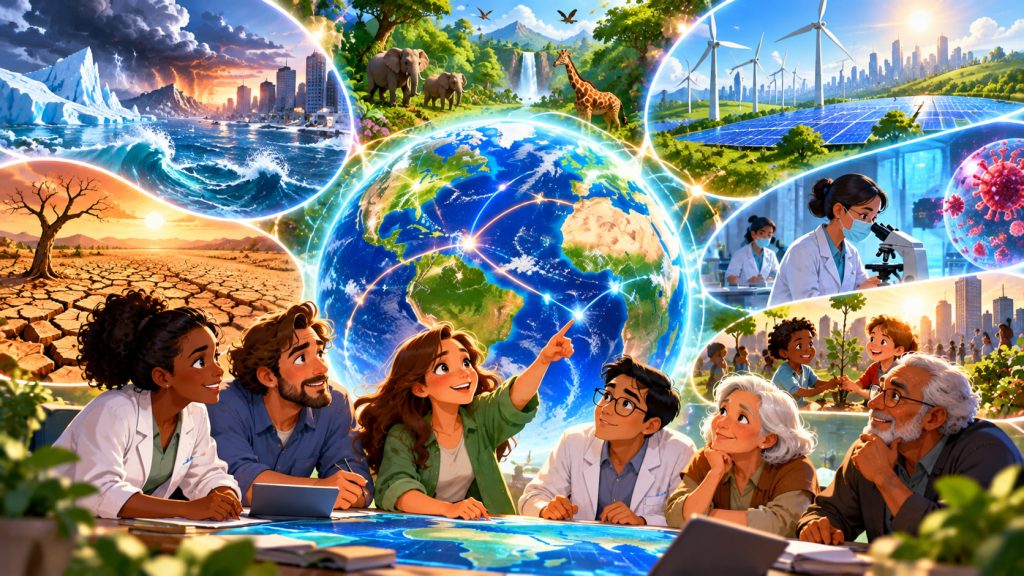
Human civilization has achieved extraordinary progress in medicine, technology, agriculture, and communication. Yet the modern world faces a growing collection of interconnected threats that could undermine these achievements.
Climate change, armed conflicts, poverty, environmental destruction, food insecurity, and emerging technological risks are placing enormous pressure on societies.
The challenge is not simply identifying these problems. It is deciding which require the most urgent attention.
Some global crises threaten millions of lives today, while others could cause irreversible damage to civilization and the planet over decades.
Understanding their connections is essential for building a safer, more sustainable future.
How Should Humanity Set Global Priorities?
Not every global problem can be addressed with equal resources at the same time.
A useful approach is systems thinking, which examines how different problems influence one another.
For example, climate change can intensify water shortages. Water shortages can reduce agricultural production. Rising food prices can increase poverty and political instability.
Priorities should therefore consider several factors:
- The number of lives at risk.
- The urgency of intervention.
- The possibility of irreversible damage.
- The availability of effective solutions.
- The wider benefits of solving the problem.
The most valuable interventions often address several global challenges simultaneously.
Priority One: Prevent Wars and Catastrophic Conflicts
Armed conflicts cause immediate deaths, displacement, infrastructure destruction, and long-lasting economic damage.
A particularly serious concern is existential risk, the possibility of an event permanently destroying humanity’s future or causing an irreversible civilizational catastrophe.
Large-scale nuclear conflict belongs among the most dangerous scenarios because its consequences could extend far beyond the countries directly involved.
Modern societies also depend on interconnected energy, communication, financial, and transportation systems that can be disrupted by conflict.
Strengthening diplomacy, crisis communication, arms control, and international cooperation can reduce these dangers.
Preventing catastrophic conflict is fundamental because major destruction can undermine progress in every other area.
Priority Two: Stabilize the Global Climate
Climate change is already influencing weather patterns, sea levels, ecosystems, agriculture, and public health.
The World Meteorological Organization reported that 2025 was among the three warmest years ever recorded, approximately 1.43°C above the 1850–1900 average.
Rising temperatures increase the risks associated with extreme heat, heavy rainfall, drought, and coastal flooding.
Climate mitigation involves reducing greenhouse gas emissions and strengthening natural carbon sinks.
Climate adaptation involves preparing communities for environmental changes that are already occurring.
Expanding clean electricity, improving energy efficiency, and protecting vulnerable infrastructure are important measures.
Climate action is especially urgent because some consequences of warming persist for centuries.
Priority Three: Guarantee Clean Water and Food Security
Access to drinking water and nutritious food remains a fundamental challenge.
According to international estimates, approximately 2.1 billion people lacked safely managed drinking water in 2024.
During the same year, around 673 million people experienced hunger.
Food insecurity describes unreliable access to sufficient, safe, and nutritious food.
The causes include poverty, conflict, environmental shocks, disrupted supply chains, and inadequate agricultural infrastructure.
Solutions require investment in water treatment, irrigation efficiency, sustainable agriculture, food storage, and affordable nutrition.
Reducing food waste also matters because significant quantities of edible food never reach consumers.
Protecting water and food systems saves lives while strengthening economic and social stability.
Priority Four: Improve Global Public Health
Preventable disease remains a major source of suffering and premature death.
The World Health Organization estimates that household and outdoor air pollution together contribute to approximately 6.7 million premature deaths annually.
Access to vaccination, sanitation, essential medicines, and primary healthcare can substantially reduce preventable illness.
Another priority is biosecurity, the prevention and management of serious biological threats, including dangerous infectious disease outbreaks.
Early-warning systems, laboratory surveillance, and effective healthcare institutions help societies respond before outbreaks become widespread.
Antibiotic resistance also requires coordinated action because resistant infections can make ordinary medical procedures more dangerous.
Strong public health systems protect lives every day and help societies withstand future emergencies.
Priority Five: Reduce Poverty and Extreme Inequality
Economic development has improved living standards for billions of people, but severe deprivation persists.
World Bank estimates indicate that approximately 847 million people lived in extreme poverty in 2024 under its updated international threshold of $3 per day, adjusted for purchasing power.
Poverty limits access to education, nutrition, healthcare, electricity, and safe housing.
It also reduces people’s ability to recover from disasters or unexpected economic shocks.
Improving basic infrastructure, education, employment opportunities, and financial inclusion can create long-term benefits.
Investments in childhood nutrition and education are especially valuable because their effects can continue throughout a person’s life.
Priority Six: Protect Biodiversity and Natural Ecosystems
Human civilization depends on functioning forests, oceans, soils, rivers, and other natural systems.
These environments support agriculture, regulate water cycles, store carbon, and provide essential resources.
Biodiversity describes the variety of living organisms, genetic characteristics, and ecosystems.
Scientists use the concept of planetary boundaries to identify major environmental processes that help maintain Earth’s stability.
The 2026 Planetary Health Check assessment found that seven of nine assessed boundaries had been crossed.
This indicates increasing pressure on essential Earth systems.
Restoring forests, protecting habitats, reducing pollution, and improving land management can help preserve nature’s capacity to support human life.
Priority Seven: Manage Artificial Intelligence and Emerging Technologies
Artificial intelligence, biotechnology, and advanced digital systems can provide enormous benefits.
They may accelerate medical research, improve energy efficiency, and support scientific discoveries.
However, these technologies also introduce challenges involving cybersecurity, misinformation, privacy, and the misuse of powerful tools.
Effective AI governance involves establishing safeguards, accountability, and oversight for the development and deployment of artificial intelligence.
International cooperation is particularly important because digital systems operate across national borders.
Technological progress creates the greatest benefits when innovation develops alongside safety, transparency, and responsible oversight.
Expert Perspective: Protecting Earth’s Life-Support Systems
Environmental scientist Johan Rockström, director of the Potsdam Institute for Climate Impact Research, has emphasized the importance of maintaining Earth’s essential environmental systems within scientifically identified boundaries.
His research demonstrates how climate, biodiversity, freshwater, land use, and other planetary processes interact.
This perspective highlights a fundamental challenge: solving one environmental problem while allowing other systems to deteriorate may undermine long-term progress.
The broader lesson is that human prosperity depends on maintaining the natural systems that make economic activity and healthy societies possible.
How Can Civilization Address Multiple Crises Together?
The most effective policies often deliver several benefits simultaneously.
Expanding reliable low-emission electricity can reduce pollution, improve health, and support economic development.
Better education can improve employment opportunities, health outcomes, and people’s capacity to adapt to technological change.
Sustainable agriculture can protect ecosystems while supporting food production and rural incomes.
An essential concept is resilience, the ability of communities and systems to withstand disruption and recover effectively.
Building resilience requires strong institutions, reliable infrastructure, scientific cooperation, and effective emergency preparation.
Humanity does not need to solve every problem sequentially. It needs coordinated strategies that address immediate suffering while preventing irreversible future damage.
Interesting Facts
- The years 2015–2025 were the eleven warmest years in the instrumental global temperature record.
- Approximately one in four people worldwide lacked safely managed drinking water in 2024.
- An estimated 673 million people experienced hunger in 2024.
- Air pollution is associated with millions of premature deaths annually.
- Seven of nine assessed planetary boundaries have been exceeded.
- Protecting forests can support biodiversity, water regulation, and carbon storage simultaneously.
- Early-warning systems can reduce the human impact of extreme weather events.
- Investments in clean energy can improve public health by reducing air pollution from fossil fuel combustion.
Glossary
- Systems Thinking — An approach that examines how different components of a system interact and influence one another.
- Existential Risk — The possibility of an event that could permanently destroy humanity’s future or cause an irreversible catastrophe.
- Climate Mitigation — Actions aimed at reducing greenhouse gas emissions or increasing their removal from the atmosphere.
- Climate Adaptation — Adjustments that help communities and ecosystems manage the effects of climate change.
- Food Insecurity — A condition involving unreliable access to sufficient, safe, and nutritious food.
- Biosecurity — Measures designed to prevent, detect, and manage biological threats.
- Biodiversity — The variety of living organisms, genes, and ecosystems on Earth.
- Planetary Boundaries — Scientific thresholds used to assess pressures on major Earth-system processes.
- AI Governance — Policies, institutions, and safeguards guiding the responsible development and use of artificial intelligence.
- Resilience — The capacity of a system or community to withstand disturbances and recover while maintaining essential functions.