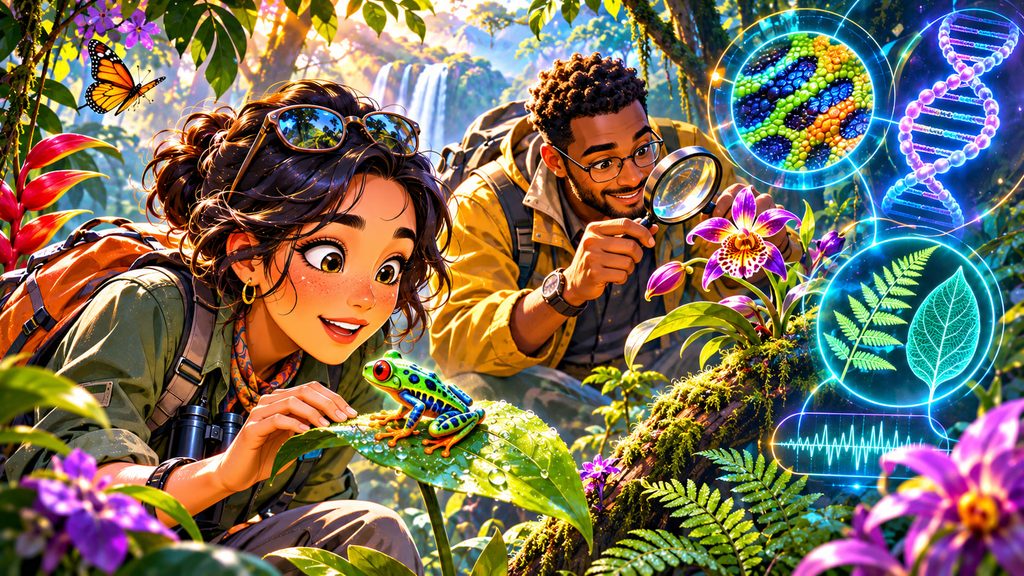
Deep in a rainforest, a biologist hears a frog call that sounds unlike anything recorded before. Elsewhere, a botanist notices an unusual preserved flower. Either observation could lead to the discovery of an entirely new species.
Documenting Earth’s living diversity combines field expeditions with microscopy, genetics, and artificial intelligence. Discovering a new species means showing that an organism is distinct from those already known to science, not that the organism has suddenly appeared on Earth.
Where Do Scientists Search for Unknown Species?
Tropical forests, deep oceans, mountain valleys, and isolated islands are promising places to investigate. Some habitats are remote; others contain easily overlooked organisms. Even familiar places can hide undescribed organisms.
Researchers plan surveys around seasons, flowering periods, animal activity, and local ecological knowledge. They photograph organisms, record their locations, and document their habitat. Field notes help distinguish a discovery from a known species.
How Can Scientists Tell Whether a Species Is New?
Finding an unfamiliar animal is only the beginning. Specialists in taxonomy, the science of identifying and classifying organisms, compare it with published descriptions and existing collections. They study morphology, including body shape, reproductive structures, leaf arrangements, flowers, and other diagnostic features.
A young animal may look different from an adult, while males and females of the same species can appear surprisingly unlike one another. Plants also change dramatically with age and growing conditions. Researchers therefore look for consistent differences across multiple observations, rather than relying on one unusual color or shape.
Can a New Animal Be Hiding in a Museum?
Absolutely. Museums and herbaria preserve specimens that can be examined decades or even centuries after collection. An animal labeled as familiar may belong to a different evolutionary lineage.
The olinguito provides a memorable example. In 2013, Smithsonian zoologist Kristofer Helgen and colleagues described this small, furry mammal from the cloud forests of Colombia and Ecuador after extensive work with museum specimens, genetics, and field observations. Some specimens were over a century old. Its discovery demonstrated that a scientific breakthrough can begin in a storage cabinet rather than a remote jungle.
How Does DNA Reveal Species That Look Identical?
Not all biodiversity is visible to the human eye. Cryptic species can look almost identical while representing distinct evolutionary lineages. Scientists compare genetic differences with anatomy, geography, and behavior.
One tool is DNA barcoding, which compares a standardized section of genetic material against reference sequences. An unexpected result may reveal an overlooked species. However, a genetic difference alone does not automatically establish a new species; scientists must interpret it within the organism’s evolutionary history.
Can Scientists Find Animals Without Seeing Them?
Organisms leave microscopic traces behind. Fish shed cells into water, animals deposit biological material in soil, and many organisms release genetic fragments into their surroundings. Researchers analyze environmental DNA (eDNA) in samples to detect organisms that may have been present.
This can reveal elusive creatures without a sighting. Yet DNA fragments may travel from their original source, and results depend on reliable reference databases. An unfamiliar DNA sequence is an important clue, not necessarily enough for a formal species description.
What Can Animal Sounds and Hidden Cameras Reveal?
Some species are easier to hear than to see. Scientists use bioacoustics to record frogs, birds, bats, and other animals, then compare their calls. Distinctive vocalizations can help reveal differences between otherwise similar populations.
Motion-triggered and underwater cameras document elusive animals. Software can sort large recordings and image collections, allowing researchers to focus on unusual observations. Technology speeds up discovery, but expert examination remains essential.
What Have Scientists Discovered Recently?
In 2025, researchers associated with the California Academy of Sciences described 72 new species of animals, plants, and fungi. Among them was a tiny flowering plant nicknamed the woolly devil, found in the Chihuahuan Desert. Discoveries extend well beyond tropical rainforests.
In 2026, researchers described Adenomera varcena, a frog from seasonally flooded forests of the western Amazon. Its identification combined DNA, physical characteristics, habitat observations, and recordings of its calls. This is how modern species research often works: several independent clues combine to build a convincing biological identification.
How Does a Newly Discovered Species Get Its Name?
Once researchers establish a species’ distinguishing characteristics, they prepare a scientific description. This usually explains how it differs from relatives, where it was found, and how it can be recognized. For many organisms, an archived reference specimen, often called a holotype, anchors the scientific name.
Scientific names follow binomial nomenclature, typically combining a genus name with a species epithet. Zoologists and botanists follow different international naming codes, which establish rules for valid publication and reference material. Naming a species makes it easier for scientists everywhere to discuss the same organism accurately.
Why Does Discovering New Species Matter?
Every documented species adds another piece to our understanding of biodiversity and ecosystem relationships. A newly identified plant could have specialized pollinators, while an overlooked amphibian might depend on a small wetland threatened by development. Recognizing these organisms helps conservationists identify what needs protection.
A 2023 assessment by researchers at the Royal Botanic Gardens, Kew estimated that approximately 77% of still-undescribed vascular plant species may already be threatened with extinction. This estimate highlights the urgency of identifying life before habitats disappear. These discoveries can influence conservation decisions.
Some of Earth’s greatest biological surprises may still be hidden beneath leaves, inside museum drawers, or within a drop of river water. Where would you most like scientists to discover an unknown species: the deep ocean, a rainforest, or a remote mountain? Share your thoughts in the comments.
Interesting Facts
- Researchers associated with the California Academy of Sciences described 72 new species in 2025.
- The olinguito was formally described in 2013, although some museum specimens were more than a century old.
- Scientists can detect traces of aquatic animals by testing water for environmental DNA.
- Some frogs that look nearly identical can be distinguished by their calls and genetic characteristics.
- Museums and herbaria may preserve undiscovered species for decades before researchers recognize them.
- A 2023 scientific assessment estimated that 77% of undescribed vascular plant species could be threatened with extinction.
Glossary
- Habitat — The natural environment in which an organism lives.
- Taxonomy — The science of identifying, describing, naming, and classifying organisms.
- Morphology — The study of an organism’s form and physical structures.
- Herbarium — A scientific collection of preserved plant specimens used for research.
- Cryptic Species — Distinct species that are difficult to distinguish by outward appearance alone.
- DNA Barcoding — Identification using a standardized genetic sequence compared with reference data.
- Environmental DNA (eDNA) — Genetic material collected from surroundings such as water or soil.
- Bioacoustics — The study of sounds produced and received by living organisms.
- Holotype — The single specimen formally designated as the name-bearing reference for a newly described species.
- Binomial Nomenclature — The system of naming species with a genus name and species epithet.
- Biodiversity — The variety of living organisms, genetic differences, and ecosystems.