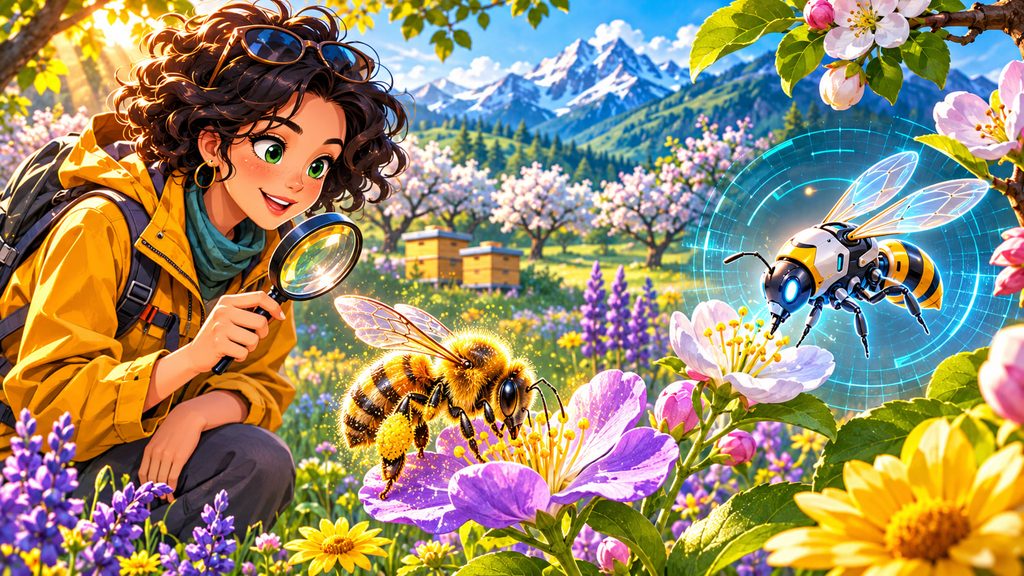
Imagine walking through an orchard where tiny flying machines visit blossoms instead of bees. Cameras identify flowers, miniature tools deliver pollen, and every movement follows a computer’s instructions. It sounds like an ingenious answer to declining pollinators. But it also raises an uncomfortable question: why build artificial bees when protecting the living ones might do so much more?
Robotic pollination is no longer pure science fiction. Researchers have demonstrated pollen-carrying drones and automated systems capable of pollinating crops. Yet their achievements reveal why technology is assistance, not replacement.
Why Pollination Matters Far Beyond Honey
Pollination occurs when pollen reaches the receptive part of a flower, allowing fertilization and, in many plants, the production of seeds or fruit. Bees make this transfer while gathering nectar and pollen for food. Their small daily journeys support orchards, vegetable fields, meadows, and forests.
More than three-quarters of the world’s leading food crop types benefit to some extent from animal pollination, including many fruits, nuts, and vegetables. Crops that depend at least partly on pollinators account for approximately 35% of global crop production by volume. This highlights pollination’s importance to dietary diversity, not an inevitable loss of one-third of food.
How Do Robot Bees Actually Work?
The phrase robot bee covers different inventions. Some are tiny experimental flying robots inspired by insect wings, while others are ordinary drones fitted with pollen-delivery devices. Greenhouse machines may use cameras and robotic arms rather than fly at all.
In 2017, a team led by materials scientist Eijiro Miyako demonstrated a small remote-controlled drone with animal hairs coated in a sticky ionic liquid gel. The device could pick up and transfer pollen between lily flowers. It was not an autonomous insect tending whole landscapes.
Can Artificial Pollination Work on Real Farms?
Recent research shows that targeted systems can help with particular crops. In 2026, researchers tested an autonomous drone that used electrostatic pollination to deliver charged pollen to Japanese pear flowers. The treatment achieved a fruit-set rate of 62.1%, compared with 61.9% for manual pollination in the same study.
This is promising where growers rely on hand pollination. One successful crop trial cannot demonstrate universal replacement. Weather, uneven terrain, battery life, equipment costs, and the delicate timing of flowering still present challenges.
Why a Living Bee Is So Difficult to Replace
A bee is far more than a pollen-delivery device. It navigates changing landscapes, locates suitable flowers, collects food, avoids obstacles, and responds to weather without needing a charging station or remote operator. Bee species specialize in different flowers, creating relationships no machine replicates.
Bumblebees, for example, perform buzz pollination by vibrating certain flowers to release pollen. That technique is especially useful for plants such as tomatoes. Other wild bees visit flowers that honeybees handle less efficiently or operate under different conditions.
Are Bees Really Disappearing?
The answer depends on which bees and where. Managed honeybee colonies are maintained by beekeepers, while many wild bee populations face serious pressures. In 2025, updated European assessments identified nearly 100 additional wild bee species as threatened, underscoring conservation concerns.
The main threats include habitat fragmentation, pesticide exposure, climate change, diseases, and shortages of suitable flowers or nesting places. A neatly mowed landscape may look attractive to humans but provide very little for insects. Protection means improving habitats, not simply adding hives.
Why Honeybees Cannot Replace Every Wild Pollinator
Many people associate pollination with honeybees. Yet scientists recognize more than 20,000 bee species worldwide, and many live alone rather than in colonies. Some are tiny, others metallic green, and some specialize in a narrow group of plants.
Pollinator diversity matters because species differ in when, where, and how they forage. A farm served by several pollinator groups may be less vulnerable when weather or disease affects one species. Introducing more managed honeybees is not automatically helpful in habitats where they could compete with wild bees for scarce flowers.
Where Robots Could Be Genuinely Useful
Artificial pollination can provide targeted assistance in greenhouses, specialized orchards, and situations where natural pollination is limited. It may deliver pollen precisely during short flowering windows. Robots can also support scientists studying flower recognition and crop management.
The sensible goal is not to replace ecosystems with machinery but to use machinery where it solves a specific farming problem. A drone may be useful for a particular pear orchard. It cannot replace the many thousands of interactions that sustain flowering plants across mountains, wetlands, and forests.
What Would Actually Help Living Bees?
The basic ingredients are surprisingly straightforward: abundant flowers, suitable nesting sites, and reduced exposure to harmful chemicals. Farmers can establish hedgerows, protect field margins, diversify flowering plants, and use integrated pest management to reduce unnecessary pesticide applications. Connected habitats help bees reach food.
Gardens can contribute too. Choose locally native flowering plants that bloom at different times, avoid spraying open flowers, and leave some areas less manicured. Many wild bees nest underground, so patches of undisturbed soil can matter just as much as colorful flowers.
Do We Need More Technology or Better Habitats?
Technology and conservation solve different problems. A mechanical pollinator might improve fruit set in a carefully managed crop. Wild bees support farming and ecosystems that machines cannot rebuild.
A meadow filled with diverse bees is already a sophisticated, self-renewing pollination system. Protecting it requires thoughtful land management rather than a laboratory breakthrough. If we can design remarkable robotic bees, shouldn’t we also make room for the real ones? What changes would you most like to see in farms, gardens, or city parks? Share your thoughts in the comments.
Interesting Facts
- More than 20,000 bee species are known worldwide; honeybees represent only a small part of that diversity.
- Nearly 90% of wild flowering plant species depend at least partly on animal pollination.
- A 2017 experiment used sticky gel and animal hairs to help a drone pollinate lily flowers.
- In a 2026 pear-orchard trial, electrostatic drone pollination produced fruit-set rates comparable to manual pollination.
- Roughly 70% of wild bee species nest in the ground rather than in hives.
- Bumblebees can shake pollen loose through rapid vibrations called buzz pollination.
Glossary
- Pollination — Transfer of pollen to a flower’s receptive reproductive structure, enabling fertilization in many plants.
- Robot Bee — An engineered device designed to imitate or assist some pollination functions of insects.
- Ionic Liquid Gel — A gel containing ionic liquid, used experimentally to make a surface collect and release pollen.
- Electrostatic Pollination — Use of electrical charge to help pollen adhere to target flowers.
- Buzz Pollination — Release of pollen through vibrations produced by certain bees.
- Habitat Fragmentation — Division of continuous natural habitat into smaller, separated areas.
- Pollinator Diversity — Variety of animal species that transfer pollen among flowers.
- Integrated Pest Management — A pest-control approach combining monitoring, prevention, and targeted treatments to reduce unnecessary chemical use.