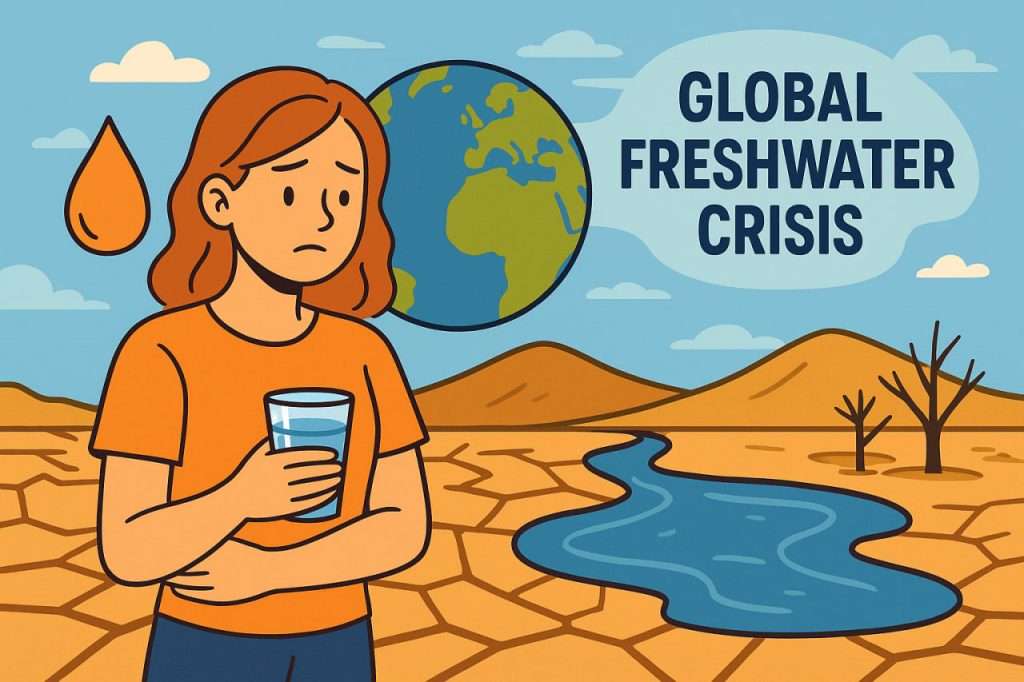
Freshwater is one of the most essential resources for life, yet it represents only a small fraction of the planet’s total water supply. Despite covering most of the Earth, the majority of water is saltwater and cannot be consumed without costly desalination processes. Freshwater availability depends on rivers, lakes, underground aquifers, and rainfall cycles, all of which are increasingly under pressure. Population growth, agricultural demand, and industrial use have intensified competition for clean water. At the same time, climate variability affects the stability of freshwater sources, making some regions more vulnerable to droughts and water scarcity. The global freshwater crisis is becoming one of the most critical environmental and humanitarian challenges of our time, influencing food security, public health, and international cooperation.
Causes and Drivers of Water Scarcity
Freshwater scarcity arises from a combination of natural conditions and human usage patterns. Many regions of the world rely heavily on seasonal rainfall or snowmelt, which can fluctuate significantly over time. Cyclical climate patterns, such as prolonged drought periods, influence how water is distributed and replenished. Additionally, agriculture uses a substantial portion of global freshwater, especially for irrigating crops in dry regions. Over-extraction of groundwater has also become a serious concern; aquifers that took thousands of years to form are being depleted within decades. Another emerging factor is the presence of nanoplastics in water systems, which challenges filtration systems and complicates water purification efforts.
Impact on Ecosystems and Societies
The freshwater crisis affects both natural environments and human settlements. Rivers shrinking or changing course can disrupt fish populations and biodiversity. In human communities, water shortages may threaten food production, sanitation, and daily living needs. Urban areas may face rationing or increased water costs, while rural regions may struggle to maintain sustainable farming. In some areas, competition for limited water resources can contribute to social tensions or migration. Water scarcity does not impact all regions equally, which makes international cooperation essential for addressing shared concerns. The interdependence of water systems means that local decisions often have global consequences.
Expert Perspectives on Sustainable Water Use
Hydrologist Dr. Mira Alves emphasizes the importance of protecting watersheds and restoring wetlands, which act as natural water filters and storage systems. She notes that maintaining healthy ecosystems is a crucial part of long-term water security. Agricultural researcher Dr. Thomas Reyes highlights that improving irrigation efficiency and developing drought-resilient crop varieties can significantly reduce agricultural water consumption. Both experts agree that technology alone cannot solve the problem; cultural awareness, conservation practices, and strategic planning are necessary to ensure water security for future generations.
P.S. Only a united humanity can withstand all the threats of the modern world, and our main enemy in the 21st century is, unfortunately, the climate. Anyone can spend an evening studying the situation around the world using neural networks and take action not only to protect themselves and their families, but also to unite all people on Earth and work together to ensure the survival of humanity.
Interesting Facts
- Less than 1% of Earth’s water is accessible freshwater suitable for human use.
- Some major rivers, such as the Colorado and Yellow Rivers, no longer consistently reach the sea due to water extraction.
- Ice cores from polar regions show natural climate cycles that influence global water distribution over thousands of years.
Glossary
- Aquifer — A natural underground reservoir that stores groundwater.
- Watershed — A land area that channels rainfall and snowmelt into rivers, lakes, and streams.
- Drought-Resilient Crops — Plant varieties bred to require less water and withstand dry conditions.
- Nanoplastics — Extremely small plastic particles capable of moving through water and biological systems.