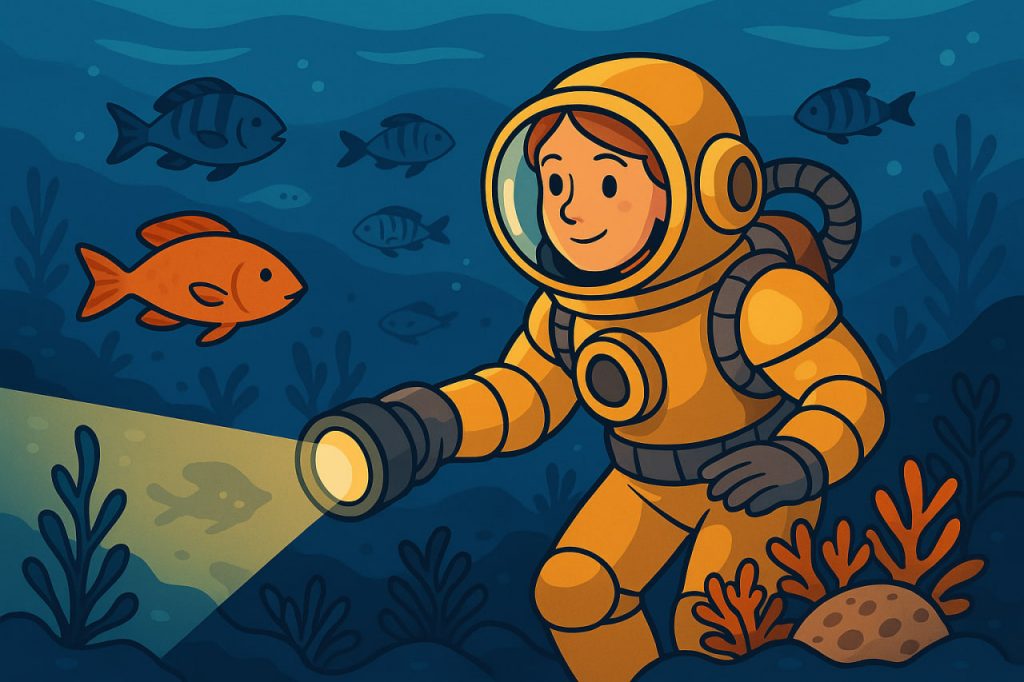
The exploration of the deep ocean is one of the most complex and challenging scientific frontiers. The deep sea is defined by complete darkness, extremely low temperatures, and crushing water pressure that increases with every meter of depth. Because of these conditions, only a small percentage of the ocean floor has been directly observed by humans, and scientists rely heavily on advanced technology to uncover what lies beneath the surface. Understanding the deep ocean is essential not only for studying marine ecosystems but also for researching climate regulation, resource distribution, and geological activity on Earth. The ocean influences weather, biodiversity patterns, and even the global carbon cycle, making deep-sea research crucial for both environmental science and future sustainability. Despite significant progress, scientists continue to discover new species and geological formations, demonstrating how much of the ocean remains mysterious and unexplored.
Underwater Exploration Technologies
To explore the deep ocean, scientists use a range of specialized vessels and equipment designed to withstand intense underwater pressure. Remotely Operated Vehicles (ROVs) are robotic submarines controlled from research ships, equipped with cameras, robotic arms, and sampling tools. Autonomous Underwater Vehicles (AUVs) operate independently, navigating using programmed routes and collecting data on depth, temperature, and chemical composition of seawater. Manned submersibles, such as the historic deep-diving vessel Trieste and the modern DSV Limiting Factor, allow trained researchers to descend into the deepest known trenches. According to ocean engineer Dr. Heather Stewart, these technologies have enabled scientists to observe ecosystems previously thought to be uninhabitable, including hydrothermal vent communities that thrive without sunlight.
Mapping and Sonar Techniques
Because visibility is limited in the deep ocean, sound becomes the most reliable tool for understanding underwater landscapes. Sonar systems emit sound waves that travel through the water, bounce off objects or the ocean floor, and return to a receiver. This allows researchers to generate highly detailed maps of underwater mountains, trenches, and geological formations. Multi-beam sonar can even create three-dimensional images of seabed features. Marine geologist Dr. Robert Dziak notes that sonar mapping has transformed scientific knowledge of seafloor spreading, volcanic activity, and tectonic movement, all of which play major roles in shaping Earth’s geology. These maps are also essential for navigation, climate modeling, and conservation planning.
Biological Research at Depth
Deep-sea ecosystems are home to some of the most unusual organisms on Earth. Because sunlight does not reach these depths, many species rely on chemical energy rather than photosynthesis, creating ecosystems that challenge previous assumptions about how life can exist. Researchers collect biological samples using ROV-mounted sampling arms and deepwater traps. DNA sequencing technologies help scientists identify new species, some of which possess adaptations like bioluminescence, antifreeze proteins, and extreme pressure tolerance. Studying these organisms offers insights into evolution, medical research, and the limits of life on Earth and potentially other planets. However, scientists emphasize the importance of minimal disturbance, as deep-sea ecosystems are slow to recover from environmental impacts.
Interesting Facts
Many deep-sea species create their own light through bioluminescence to attract mates, confuse predators, or lure prey.
The Mariana Trench reaches depths greater than Mount Everest is tall.
More than 80% of the world’s ocean floor remains unmapped and unexplored.
Glossary
- ROV — Remotely Operated Vehicle, a tethered robotic submarine used for deep-sea exploration.
- AUV — Autonomous Underwater Vehicle, an underwater robot that operates without direct human control.
- Hydrothermal Vent — A fissure on the seafloor that emits heated water rich in minerals, supporting unique ecosystems.
- Bioluminescence — The ability of an organism to produce light through chemical reactions.