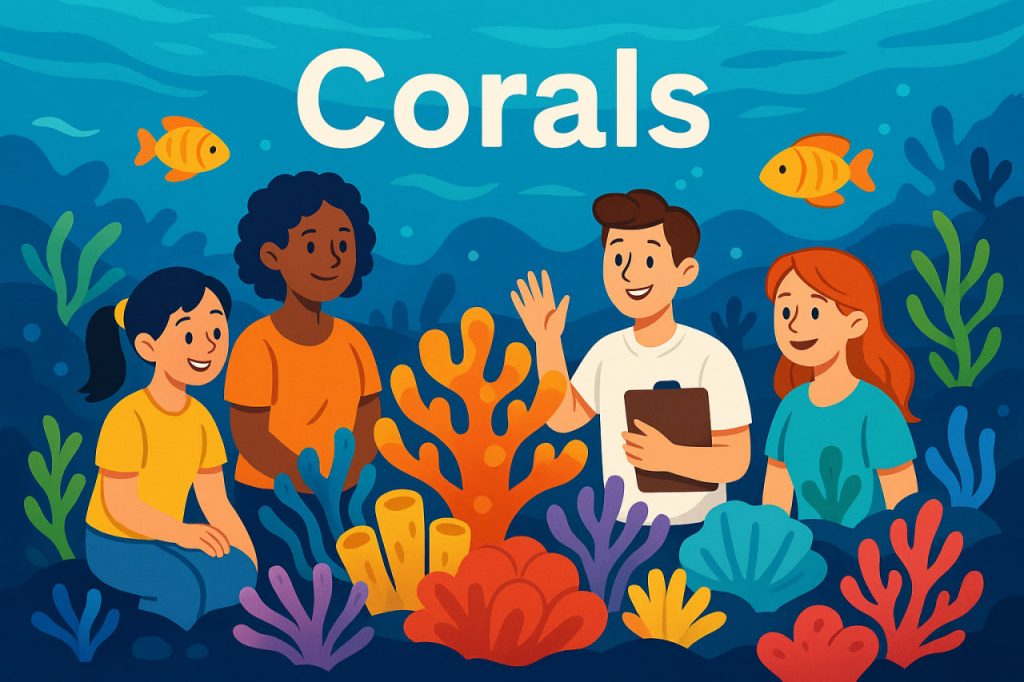
Corals are marine organisms that form some of the most biodiverse and visually stunning ecosystems on Earth: coral reefs. Although corals may appear to be colorful underwater plants or rocks, they are actually colonies of tiny animals called polyps. These polyps build calcium carbonate skeletons that accumulate over centuries, forming vast reef structures. Coral reefs support an extraordinary variety of marine life, providing shelter, breeding grounds, and food sources for thousands of species. They are essential not only for ocean ecology, but also for coastal protection, fishing industries, and global biodiversity. The health of coral reefs is therefore closely connected to the stability of marine ecosystems and human livelihoods.
Coral Biology and Reef Formation
Each coral polyp is a small, soft-bodied organism that lives symbiotically with microscopic algae known as zooxanthellae. These algae provide corals with energy through photosynthesis and contribute to their brilliant coloration. Over time, as generations of polyps build upon previous skeletal layers, coral reefs gradually grow in size. However, coral growth is slow—some reefs develop only a few millimeters per year—making them extremely vulnerable to rapid environmental changes. Coral reefs typically thrive in warm, shallow, and sunlit waters where photosynthesis can occur efficiently.
Expert Insight (Marine Ecology):
“Coral reefs are living ecosystems that depend on a delicate balance of water temperature, light, and chemistry. Even small changes can impact their survival.”
Ecological Importance of Coral Reefs
Coral reefs are among the most biodiverse ecosystems on the planet, often referred to as the rainforests of the sea. They provide habitat for fish, crustaceans, mollusks, sea turtles, sea stars, and countless microorganisms. Many marine species rely on reefs for shelter, feeding, and reproduction. Healthy coral reefs also help protect coastlines by absorbing wave energy, reducing erosion and storm damage. In addition, they play a significant role in carbon cycling and maintaining ocean chemistry. Without coral reefs, the balance of marine food webs would be dramatically disrupted.
Coral Bleaching and Environmental Threats
Corals are highly sensitive to changes in ocean temperature, pollution, and acidity. When water temperatures rise, corals expel their symbiotic algae, causing a phenomenon known as coral bleaching. Without these algae, corals lose their main energy source and often die if conditions do not return to normal. Ocean acidification, caused by increased CO₂ absorption, weakens coral skeletons and slows growth. Pollution, overfishing, and destructive coastal development further threaten reef ecosystems. Conservation efforts aim to reduce these stressors and promote coral recovery.
Human Connection and Conservation
Coral reefs support millions of people through fishing, tourism, and coastal protection. Protecting reefs requires international cooperation, sustainable ocean practices, and climate awareness. Coral restoration projects, such as coral nurseries and selective breeding for heat-resistant strains, offer promising approaches. Public awareness also plays an important role—individual habits such as reducing plastic use, choosing reef-safe sunscreens, and supporting marine conservation organizations contribute to reef protection.
Interesting Facts
- Coral reefs cover less than 1% of the ocean floor but support over 25% of all marine life.
- The Great Barrier Reef in Australia is the largest living structure on Earth, visible from space.
- Corals glow under UV light due to fluorescent proteins that help protect them from environmental stress.
Glossary
- Polyp — A small coral organism that forms part of a larger colony.
- Zooxanthellae — Symbiotic algae that live inside coral tissue and provide energy.
- Coral Bleaching — Loss of coral color and vitality caused by stress, particularly heat.