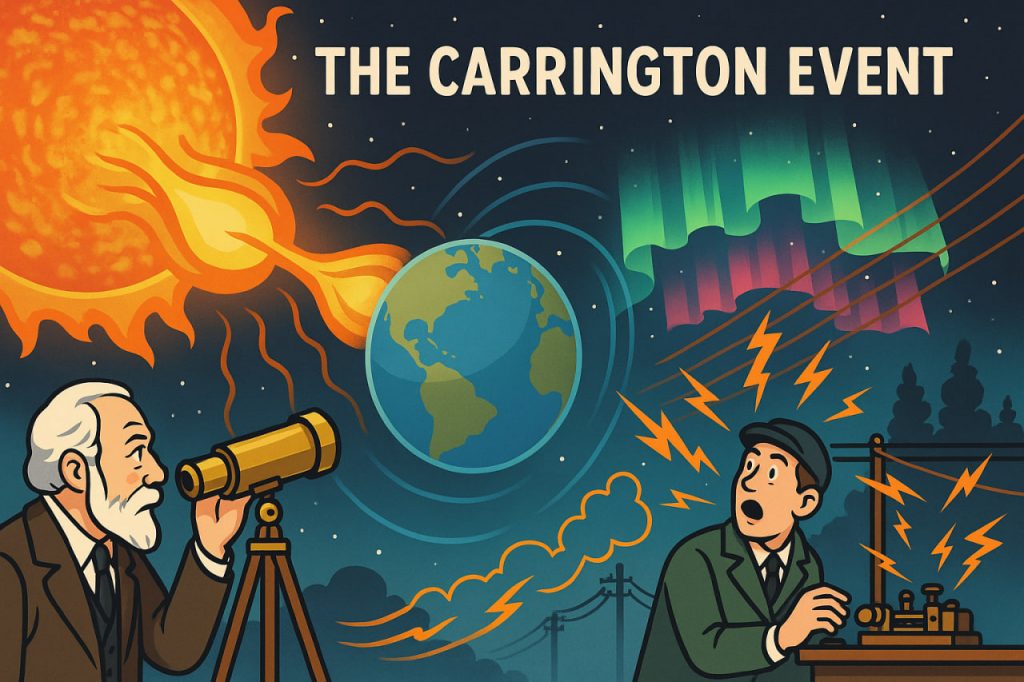
In 1859, long before satellites or smartphones existed, Earth was struck by the most powerful solar storm ever recorded — known as The Carrington Event. This extraordinary outburst of energy from the Sun caused global chaos in telegraph systems and painted the skies with auroras visible even near the equator. Today, scientists study this event not only as a fascinating chapter in space science but also as a warning of what could happen if a similar storm occurred in our modern, technology-driven world.
What Happened in 1859?
On September 1, 1859, British astronomer Richard Carrington was observing the Sun through his telescope when he noticed two bright flashes of light — the first recorded observation of a solar flare. Just 17 hours later, Earth’s magnetic field was struck by a massive coronal mass ejection (CME) — a huge burst of charged particles from the Sun.
The storm caused one of the strongest geomagnetic disturbances in history. Telegraph systems, the most advanced technology of the time, were thrown into chaos — wires sparked, equipment caught fire, and some operators even received electric shocks. Yet astonishingly, some telegraph systems continued to transmit messages without power, energized solely by the solar storm’s induced electric currents.
Astronomer Dr. Richard Carrington’s observation became a milestone in science, proving for the first time that activity on the Sun could directly affect the Earth.
Auroras Across the World
One of the most spectacular effects of the Carrington Event was the appearance of auroras — the northern and southern lights — in places where they had never been seen before.
Eyewitnesses described the sky glowing red, green, and purple as far south as Cuba, Hawaii, and northern Australia. People in the U.S. reported that the lights were so bright they could read newspapers at night.
According to a miner’s diary from the Rocky Mountains:
“The sky appeared as if on fire. Our camp was lit up so brightly that we thought morning had come.”
The Science Behind the Event
The Carrington Event was caused by a massive coronal mass ejection colliding with Earth’s magnetosphere. The energy released during the storm was equivalent to billions of nuclear bombs, sending a shockwave through Earth’s magnetic field and atmosphere.
When charged solar particles entered the upper atmosphere, they collided with oxygen and nitrogen atoms, releasing light and creating auroras. The same process induced powerful electrical currents in telegraph wires and even the ground itself.
What If It Happened Today?
If a Carrington-level storm struck today, the consequences would be far more severe. Modern society depends heavily on technology that is vulnerable to space weather, including:
- Satellites, which could be damaged or disabled.
- Power grids, where induced currents could cause massive blackouts.
- GPS and communication systems, which could fail globally.
- Aviation and space missions, exposed to dangerous radiation levels.
NASA scientists estimate that a storm of similar strength could cause trillions of dollars in economic damage and take years to fully recover from.
Space physicist Dr. Naomi Patel explains:
“The Carrington Event reminds us that our technology is fragile in the face of solar power. Preparing for space weather is as important as preparing for earthquakes or hurricanes.”
Modern Monitoring and Protection
Today, observatories like NASA’s Solar Dynamics Observatory (SDO) and ESA’s Solar Orbiter constantly monitor the Sun for warning signs of solar activity. Space weather forecasting has improved greatly, allowing scientists to issue alerts that help protect satellites and power systems.
However, experts warn that it’s not a matter of if another massive storm will occur — but when.
Interesting Facts
- The Carrington Event produced auroras visible 40° closer to the equator than normal.
- The magnetic storm caused compass needles to swing wildly, confusing navigators.
- Similar but smaller solar storms occurred in 1921, 1989, and 2003.
- The 1989 event caused a nine-hour blackout in Quebec, showing how vulnerable modern grids remain.
Glossary
- Solar flare — a sudden explosion of radiation from the Sun’s surface.
- Coronal mass ejection (CME) — a burst of solar plasma and magnetic field ejected into space.
- Geomagnetic storm — a disturbance in Earth’s magnetic field caused by solar activity.
- Aurora — natural lights in the sky caused by charged particles colliding with atmospheric gases.