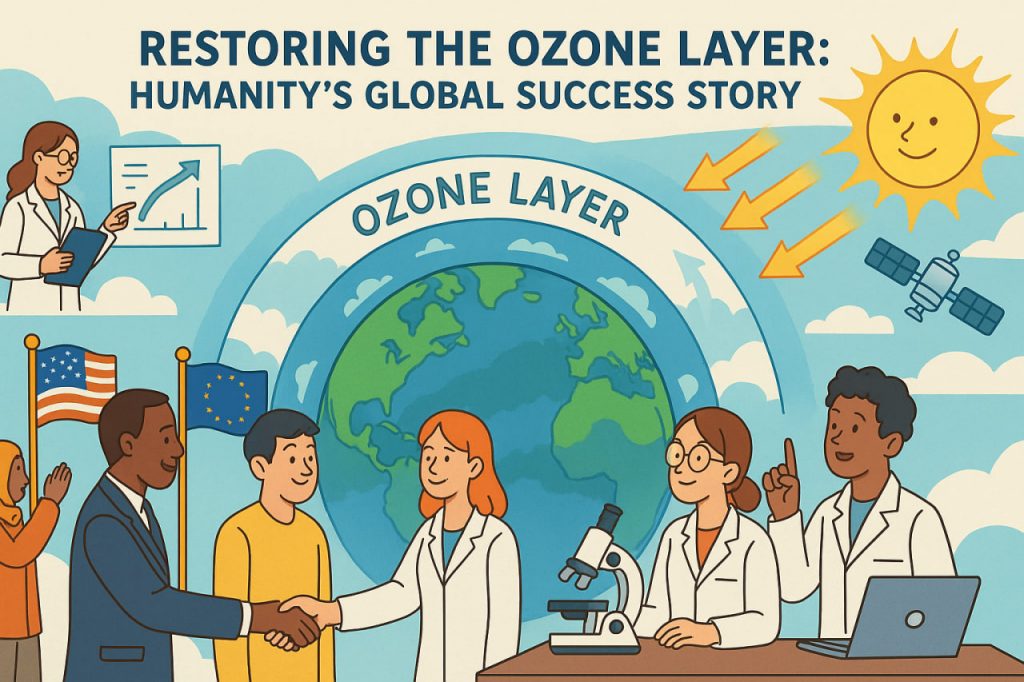
In an age of environmental crises, the recovery of the ozone layer stands as one of humanity’s most inspiring success stories. It shows that when science, governments, and people unite with purpose, even a global environmental catastrophe can be reversed. Once on the brink of disaster, the ozone layer is now healing — a triumph of collective action and scientific cooperation.
What Is the Ozone Layer?
The ozone layer is a thin region of the Earth’s atmosphere, located in the stratosphere, about 15–35 kilometers above the surface. It acts as a protective shield, absorbing most of the Sun’s harmful ultraviolet (UV) radiation. Without it, life on Earth would face higher risks of skin cancer, eye damage, and ecological harm.
Atmospheric scientist Dr. Lena Hoffman explains:
“The ozone layer is like the Earth’s sunscreen — invisible but vital. Without it, our planet would be uninhabitable for many species.”
The Crisis: How Humanity Nearly Destroyed the Shield
In the late 20th century, scientists discovered that chlorofluorocarbons (CFCs) — chemicals used in refrigerators, aerosols, and air conditioners — were breaking down ozone molecules high in the atmosphere.
By the mid-1980s, a massive “ozone hole” had appeared over Antarctica. The implications were alarming: rising UV exposure, ecosystem disruption, and a sharp increase in skin cancer risks. The discovery triggered an unprecedented global response.
The Turning Point: The Montreal Protocol
In 1987, nations around the world signed the Montreal Protocol on Substances that Deplete the Ozone Layer — a legally binding international agreement to phase out CFCs and other harmful chemicals. It remains one of the most successful environmental treaties ever created, with universal participation from all UN member states.
The protocol encouraged:
- Rapid development of eco-friendly alternatives to CFCs.
- International cooperation between scientists, industries, and governments.
- Funding mechanisms to help developing countries transition to safer technologies.
According to UN environmental expert Dr. Miguel Torres:
“The Montreal Protocol proved that environmental diplomacy works. It was a moment when science guided politics — and the world listened.”
The Results: A Planet Healing Itself
Over the decades, atmospheric monitoring has shown remarkable progress:
- The ozone layer is recovering steadily, with projections suggesting it could return to pre-1980 levels by mid-century.
- The Antarctic ozone hole, once the size of North America, has been shrinking since the early 2000s.
- The ban on CFCs also reduced greenhouse gas emissions, indirectly helping fight climate change.
Lessons for the Future
The ozone layer’s recovery is more than a scientific victory — it’s a model for solving global challenges such as climate change, biodiversity loss, and pollution. It demonstrates that when humanity acts collectively — guided by science, responsibility, and political will — even the largest crises can be overcome.
Environmental sociologist Dr. Aisha Malik summarizes it perfectly:
“The ozone recovery story reminds us that hope and cooperation are powerful forces. Global unity is not just idealistic — it’s effective.”
Interesting Facts
- The Montreal Protocol was the first UN treaty to achieve universal ratification.
- Without action, scientists estimate the ozone hole could have caused millions of additional skin cancer cases each year.
- NASA satellites continuously monitor the ozone layer’s thickness and recovery progress.
- Some substances banned under the protocol were 10,000 times more potent as greenhouse gases than carbon dioxide.
Glossary
- Ozone (O₃) — a molecule made of three oxygen atoms that absorbs ultraviolet radiation.
- CFCs (chlorofluorocarbons) — synthetic chemicals once used in cooling systems and aerosols that destroy ozone.
- Montreal Protocol — an international treaty designed to protect the ozone layer by phasing out ozone-depleting substances.
- Ultraviolet radiation (UV) — high-energy solar radiation harmful to living organisms.