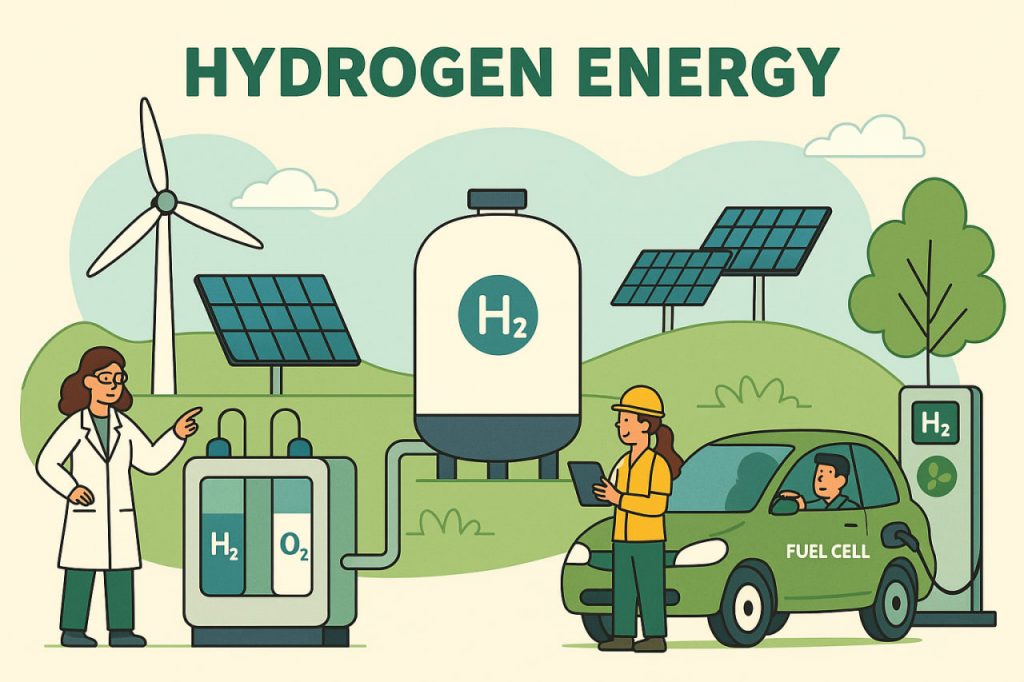
As the world transitions toward cleaner energy, hydrogen has emerged as one of the most promising alternatives to fossil fuels. Lightweight, abundant, and versatile, hydrogen can power everything from cars to entire cities — with water as its only emission. But how does hydrogen energy work, and what makes it so important for a sustainable future?
What Is Hydrogen Energy?
Hydrogen energy relies on using hydrogen gas (H₂) as a fuel. When hydrogen reacts with oxygen, it releases energy — either through combustion or in a fuel cell — producing electricity, heat, and water vapor.
This makes hydrogen a clean energy carrier, meaning it stores and delivers energy rather than being a primary source like coal or sunlight.
Energy engineer Dr. Sofia Alvarez explains:
“Hydrogen is like a battery for the planet. It can store renewable energy when the sun isn’t shining and the wind isn’t blowing — then release it on demand.”
How Hydrogen Is Produced
There are several methods to produce hydrogen, classified by color to indicate environmental impact:
- Gray hydrogen — made from natural gas; inexpensive but emits CO₂.
- Blue hydrogen — also from natural gas, but CO₂ is captured and stored using carbon capture technology.
- Green hydrogen — produced via electrolysis, splitting water into hydrogen and oxygen using electricity from renewable sources (like solar or wind). This is the cleanest and most sustainable method.
Electrolysis is key to the future of zero-emission hydrogen, allowing renewable power to be stored and transported as hydrogen fuel.
Applications of Hydrogen Energy
Hydrogen is highly versatile and can power:
- Fuel cell vehicles (FCVs) — cars, buses, and trucks that emit only water.
- Industrial processes — steel production, ammonia for fertilizers, and chemical manufacturing.
- Power generation — hydrogen turbines can supply clean electricity.
- Energy storage — excess renewable energy can be converted into hydrogen and stored for later use.
Advantages of Hydrogen Energy
- Zero emissions — when produced from renewables, hydrogen emits only water.
- Energy storage — helps stabilize grids powered by intermittent renewables.
- High energy density — more energy per kilogram than gasoline.
- Scalability — can be used in transport, industry, and residential heating.
Challenges and Limitations
Despite its potential, hydrogen faces key obstacles:
- High production costs, especially for green hydrogen.
- Storage and transport difficulties, as hydrogen is the smallest and most leak-prone molecule.
- Infrastructure gaps, such as refueling stations and pipelines.
According to energy policy expert Dr. Michael Renard:
“Hydrogen will be essential for deep decarbonization — but only if we invest now in making it green, affordable, and accessible.”
The Future of Hydrogen
Many countries are already building hydrogen economies. The European Union, Japan, and South Korea have national hydrogen strategies aiming for carbon neutrality by 2050. Advances in electrolysis efficiency and renewable integration continue to lower costs, bringing hydrogen closer to widespread adoption.
Interesting Facts
- Hydrogen is the lightest and most abundant element in the universe.
- It contains three times more energy per unit weight than gasoline.
- The first hydrogen-powered car appeared as early as 1966.
- NASA has used hydrogen fuel since the Apollo missions to power spacecraft.
Glossary
- Electrolysis — the process of splitting water into hydrogen and oxygen using electricity.
- Fuel cell — a device that converts hydrogen and oxygen into electricity with water as a byproduct.
- Carbon capture — technology that traps CO₂ emissions before they reach the atmosphere.
- Energy carrier — a substance that stores and transports energy from one place to another.