Flooding is one of nature’s most powerful and destructive forces. It can turn calm rivers into raging torrents, submerge entire neighborhoods, and reshape landscapes within hours. But how exactly does a flood occur, and why are some areas more vulnerable than others? Understanding the science behind floods can help us prepare, adapt, and protect our communities.
What Is a Flood?
A flood occurs when water overflows from its normal boundaries — such as rivers, lakes, or drainage systems — and spreads across normally dry land. This can happen gradually, as in seasonal river floods, or suddenly, in the case of flash floods caused by intense rainfall.
Hydrologist Dr. Laura Fernández defines flooding as:
“A natural process that becomes a disaster when it intersects with human settlements and infrastructure.”
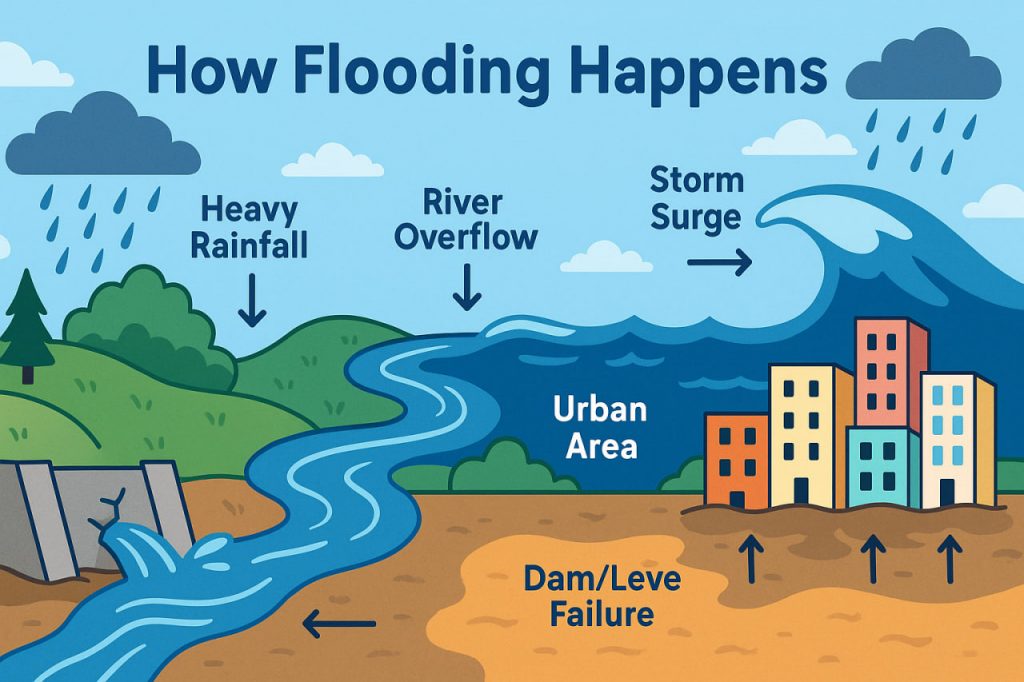
Main Causes of Flooding
- Heavy Rainfall
When rain falls faster than the ground or drainage systems can absorb it, water accumulates on the surface. Urban areas are especially vulnerable because asphalt and concrete prevent natural absorption. - River Overflow
Rivers can swell beyond their banks during prolonged rain or snowmelt, inundating nearby floodplains. - Storm Surges
Coastal floods occur when strong winds and low pressure push seawater onto land during hurricanes or cyclones. - Dam or Levee Failure
When man-made barriers break, enormous volumes of water can rush downstream, causing catastrophic damage. - Snow and Ice Melt
Rapid melting of snow or ice in spring releases large amounts of water, overwhelming rivers and lakes.
The Science Behind Flooding
Flooding is driven by the hydrological cycle — the continuous movement of water between the atmosphere, land, and oceans. When precipitation exceeds evaporation and infiltration, excess water accumulates and flows downhill. In natural ecosystems, wetlands, forests, and floodplains act as sponges that absorb and slow down this flow. But when these are replaced by cities or farmland, the land loses its ability to buffer floods.
Human Impact and Climate Change
Urbanization, deforestation, and poor water management have made floods more frequent and severe. Climate change further intensifies this by increasing extreme weather events — heavier rains, stronger storms, and rising sea levels.
Environmental scientist Dr. James Okafor explains:
“Climate change doesn’t create floods by itself — it amplifies them. Warmer air holds more moisture, meaning when it rains, it pours.”
Preventing and Managing Floods
While floods can’t always be prevented, their impacts can be reduced through smart planning:
- Building flood defenses like levees, reservoirs, and retention basins.
- Restoring wetlands and riverbanks to absorb excess water naturally.
- Improving drainage systems in urban areas.
- Using early-warning systems and satellite monitoring to predict floods.
Interesting Facts
- The largest flood in recorded history, the 1931 China Flood, killed nearly 2 million people.
- The Netherlands has one of the world’s most advanced flood control systems, protecting land below sea level.
- Floods are the most common natural disaster globally, affecting more people each year than any other hazard.
- Satellite data now allows scientists to track floods in real time from space.
Glossary
- Hydrological cycle — the continuous movement of water between the earth’s surface and atmosphere.
- Floodplain — flat land near a river that naturally floods during heavy rains.
- Storm surge — an abnormal rise of seawater during a storm.
- Infiltration — the process by which water enters the soil.