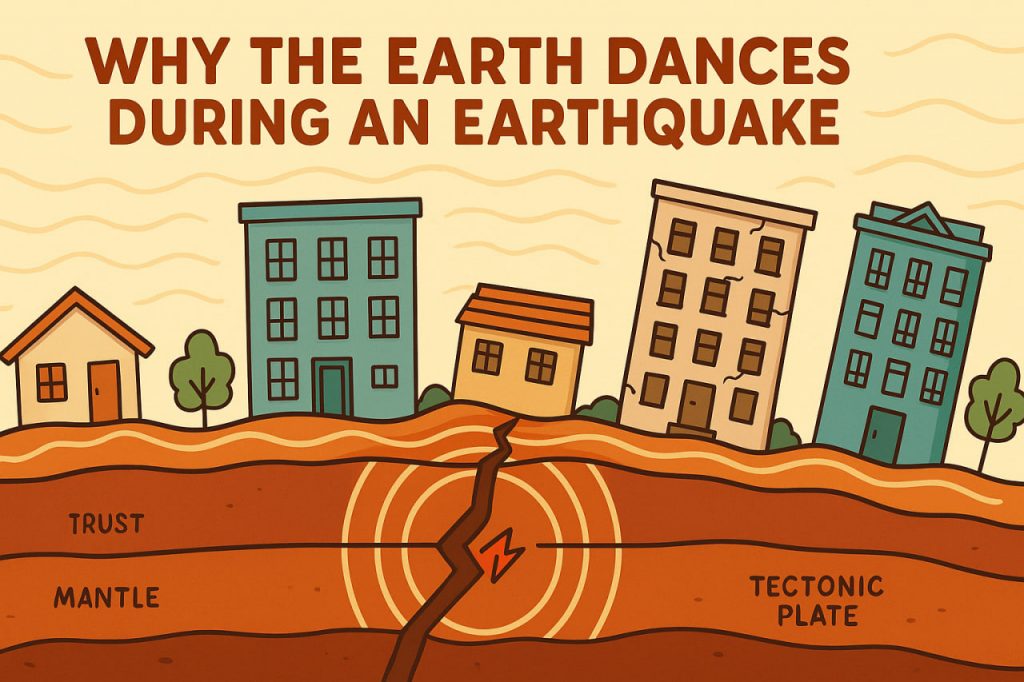
When an earthquake strikes, the ground beneath our feet can appear to move, ripple, and even dance. Streets twist, buildings sway, and the solid earth seems suddenly fluid. But why does this happen? The answer lies deep below the surface — in the incredible forces that constantly shape our planet.
The Hidden Energy Beneath the Ground
The Earth’s outer layer, or crust, is not a single solid shell. It’s made up of tectonic plates — massive slabs of rock that slowly move over the semi-fluid layer beneath called the mantle. These plates are always in motion, grinding, colliding, and sliding past one another.
When plates become locked together by friction, enormous stress builds up over time. Eventually, this stored energy releases suddenly along a fault line — producing an earthquake. The energy radiates outward in the form of seismic waves, which travel through the ground and cause it to shake.
Seismologist Dr. Anna Rodríguez explains:
“An earthquake is like pulling on a stretched rubber band until it snaps. The sudden release of energy travels through the ground — what we feel as shaking.”
How the “Dance” Happens
The Earth doesn’t actually move in one direction during an earthquake. Instead, different types of seismic waves make the ground move in complex patterns:
- P-waves (primary waves) — fast-moving compressional waves that make the ground move back and forth.
- S-waves (secondary waves) — slower waves that move the ground up and down or side to side.
- Surface waves — these travel along the Earth’s surface and cause the dramatic “rolling” motion often seen in videos.
When these waves overlap, they create oscillations that can make the Earth’s surface look as if it’s dancing, rippling, or waving, especially in soft soil areas.
When the Ground Turns Liquid
In certain conditions, especially in sandy or water-saturated ground, shaking can cause liquefaction — where the soil temporarily behaves like a liquid. This effect can make roads ripple, cars sink, and buildings tilt or collapse, even if they’re far from the earthquake’s epicenter.
Protecting Against the Planet’s Dance
Modern engineering and seismology help reduce the damage caused by earthquakes. Buildings in quake-prone areas are designed with shock absorbers, flexible foundations, and seismic isolation systems that allow structures to sway safely instead of cracking.
Geophysicist Dr. Hiroshi Tanaka notes:
“We can’t stop the Earth from moving — but we can learn to move with it. That’s the true art of earthquake-resistant design.”
Interesting Facts
- The largest recorded earthquake (Chile, 1960) reached magnitude 9.5, releasing energy equivalent to several thousand nuclear bombs.
- Dogs and other animals can often sense seismic activity before humans do.
- Seismic waves can travel through the entire planet, bouncing off its core and giving scientists clues about Earth’s inner structure.
- Japan, Chile, and Indonesia are among the most earthquake-prone countries due to their position on the Ring of Fire.
Glossary
- Tectonic plates — large sections of the Earth’s crust that move slowly over the mantle.
- Fault line — a fracture in the Earth’s crust where movement occurs during an earthquake.
- Seismic waves — energy waves produced by an earthquake.
- Liquefaction — a process where solid ground temporarily behaves like liquid due to intense shaking.