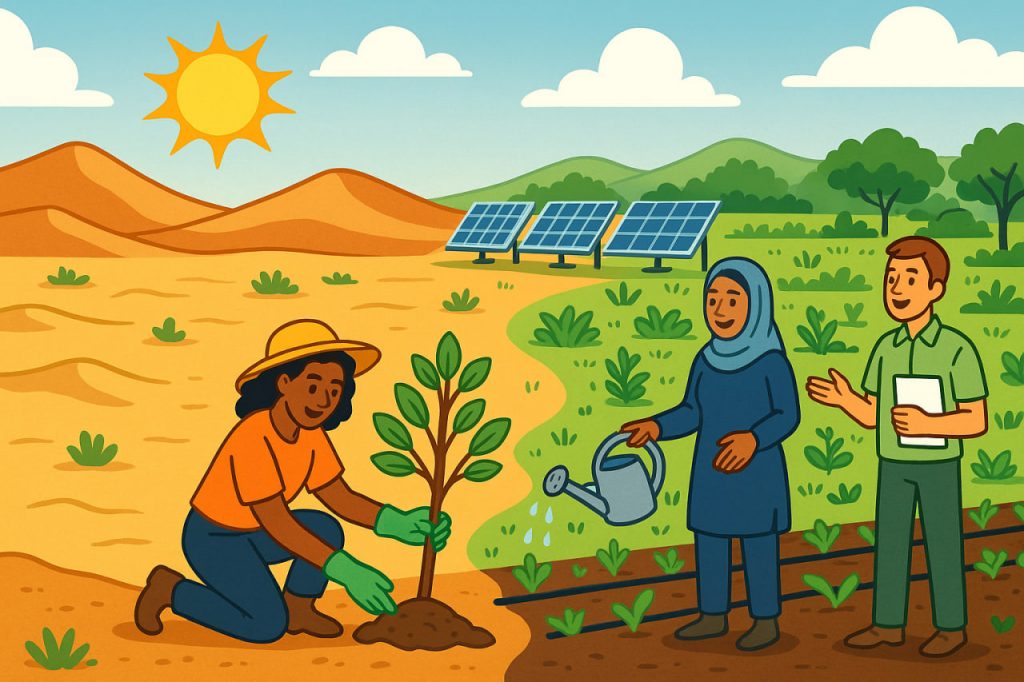
The idea of transforming a dry, barren desert into a green oasis may sound like a miracle — yet it’s a goal that science, technology, and human determination are gradually making real. Across the world, projects in countries like Israel, the United Arab Emirates, and China are proving that desert greening is possible through innovation, cooperation, and respect for nature’s limits.
The Challenge of the Desert
Deserts cover about one-third of Earth’s land, characterized by scarce rainfall, poor soil, and extreme temperatures. Vegetation struggles to survive, and water quickly evaporates. Yet, deserts are not dead lands — they’re fragile ecosystems that can bloom when given the right care.
Environmental scientist Dr. Omar Rahim explains:
“The desert isn’t empty — it’s waiting. If we understand its rhythms, we can work with nature instead of against it.”
Key Strategies for Greening the Desert
- Efficient Water Management
The first challenge is finding and conserving water. Technologies like drip irrigation, invented in Israel, deliver small, precise amounts of water directly to plant roots, minimizing waste. In coastal deserts, desalination plants turn seawater into freshwater, making agriculture possible where rainfall is almost zero. - Soil Restoration
Desert soils often lack organic matter. Adding compost, biochar, and microbial fertilizers helps retain moisture and create fertile ground for crops. Some projects use clay and polymer coatings to trap water in sandy soils. - Planting Native and Drought-Resistant Species
Instead of forcing the land to grow exotic plants, experts focus on species adapted to dry climates — like acacias, date palms, and desert grasses. These pioneer plants improve soil quality, enabling other vegetation to follow. - Harnessing Renewable Energy
Deserts receive abundant sunlight, making them ideal for solar energy farms. Solar-powered pumps and desalination systems support sustainable greening efforts without adding carbon emissions. - Using Innovative Technologies
New methods such as hydrogel farming, fog harvesting, and atmospheric water generators extract water from air or dew, providing irrigation in remote desert regions.
Global Success Stories
- Israel’s Negev Desert: Once a barren region, now produces fruits, vegetables, and even vineyards through drip irrigation and solar energy.
- The UAE’s Al Ain Project: Uses treated wastewater to grow palm forests and parks in the desert.
- China’s Kubuqi Desert: Over 6000 km² of desert land have been restored through tree planting and soil stabilization.
Ecological engineer Dr. Li Xue says:
“Every tree planted in the desert is a declaration of hope — a step toward balance between people and the planet.”
Environmental Benefits
Desert greening helps:
- Reduce dust storms and soil erosion
- Capture carbon dioxide, fighting climate change
- Create jobs and food sources for local communities
- Restore biodiversity by providing habitats for wildlife
Challenges Ahead
While the potential is huge, desert greening must be done carefully to avoid disrupting natural ecosystems or exhausting water supplies. Sustainable planning and local participation are crucial for long-term success.
Interesting Facts
- The Sahara Desert receives enough sunlight daily to power the world’s energy needs several times over.
- Some desert plants can store up to 90% of their weight in water.
- Bioengineers are developing bacteria that can transform sand into fertile soil.
- The Great Green Wall of Africa aims to restore 8,000 km of degraded land across the continent.
Glossary
- Drip irrigation — a precise watering system that delivers moisture directly to plant roots.
- Desalination — the process of removing salt from seawater to produce freshwater.
- Biochar — charcoal added to soil to improve fertility and retain water.
- Hydrogel farming — using water-absorbing materials to keep soil moist for longer periods.