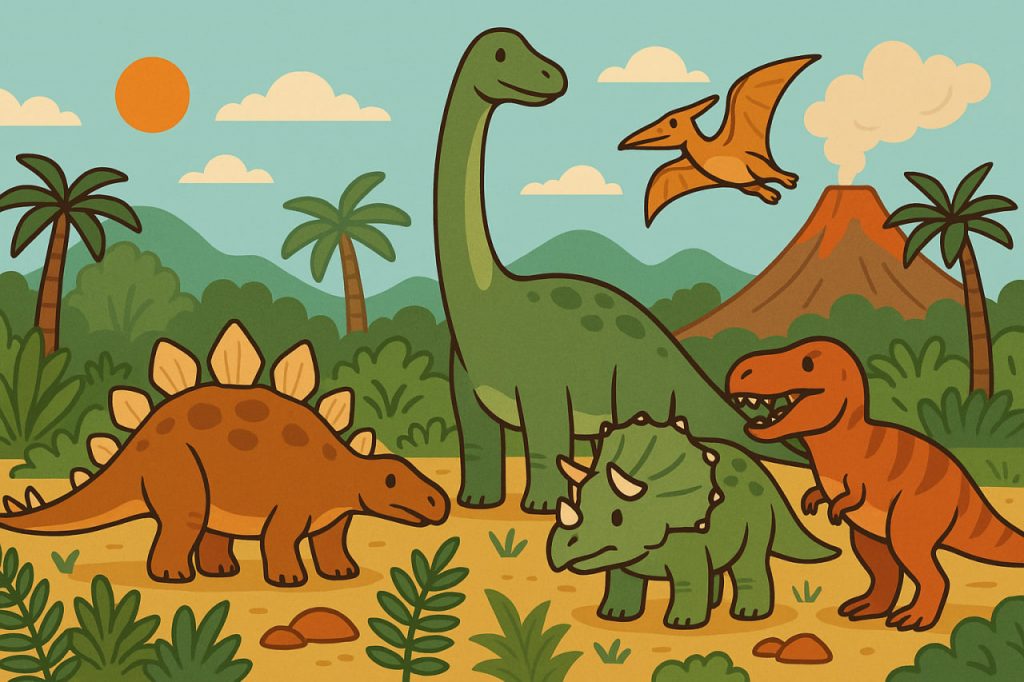
Long before humans appeared, Earth belonged to the dinosaurs — magnificent creatures that dominated land, sea, and sky for over 165 million years. From towering predators like Tyrannosaurus rex to gentle plant-eaters like Brachiosaurus, dinosaurs continue to fascinate scientists and spark the imagination of people worldwide.
The Age of Dinosaurs
Dinosaurs lived during a period known as the Mesozoic Era, which lasted from about 252 to 66 million years ago. This era is divided into three major periods:
- Triassic (252–201 million years ago) — the dawn of the dinosaurs, when the first small, two-legged species appeared.
- Jurassic (201–145 million years ago) — the rise of giants like Stegosaurus and Brachiosaurus. Lush vegetation supported large herbivores and fierce predators.
- Cretaceous (145–66 million years ago) — the peak of dinosaur diversity, featuring Triceratops, Velociraptor, and the legendary Tyrannosaurus rex.
Paleontologist Dr. Laura Kim explains:
“Dinosaurs were not just massive reptiles — they were complex, adaptable, and surprisingly intelligent for their time.”
Types of Dinosaurs
Dinosaurs came in many shapes and sizes, adapted to different environments:
- Herbivores like Triceratops, Diplodocus, and Ankylosaurus ate plants and often had horns or armor for protection.
- Carnivores like Tyrannosaurus rex and Allosaurus hunted or scavenged meat.
- Omnivores like Ornithomimus could eat both plants and small animals.
Some dinosaurs even developed feathers — early relatives of today’s birds.
How Dinosaurs Lived
Fossil evidence shows that dinosaurs were social creatures. Some traveled in herds, others cared for their young, and many built nests for their eggs. Their success was partly due to evolutionary adaptability — different species thrived in deserts, forests, and wetlands across ancient continents.
The Mysterious Extinction
About 66 million years ago, a massive asteroid impact near present-day Mexico triggered wildfires, tsunamis, and a “nuclear winter” effect that blocked sunlight. Most dinosaurs, unable to adapt, went extinct — but their smaller, feathered relatives survived and evolved into modern birds.
Astrobiologist Dr. Marcus Patel says:
“Dinosaurs didn’t truly disappear — they transformed. Every bird we see today carries the DNA of ancient giants.”
Modern Discoveries
Thanks to advanced technologies like CT scanning, 3D reconstruction, and DNA analysis, scientists continue to uncover new dinosaur species each year. Fossilized footprints, eggs, and even soft tissue samples offer deeper insight into their biology and behavior.
Interesting Facts
- The largest known dinosaur, Argentinosaurus, could reach 40 meters in length — longer than a blue whale.
- Some dinosaurs had colorful feathers used for display or camouflage.
- T. rex had one of the strongest bites in history — up to 6 tons of force.
- Birds are considered living dinosaurs, scientifically classified as avian dinosaurs.
Glossary
- Mesozoic Era — the era of Earth’s history when dinosaurs thrived.
- Fossil — the preserved remains or traces of ancient organisms.
- Herbivore — an animal that eats only plants.
- Extinction — the complete disappearance of a species from Earth.