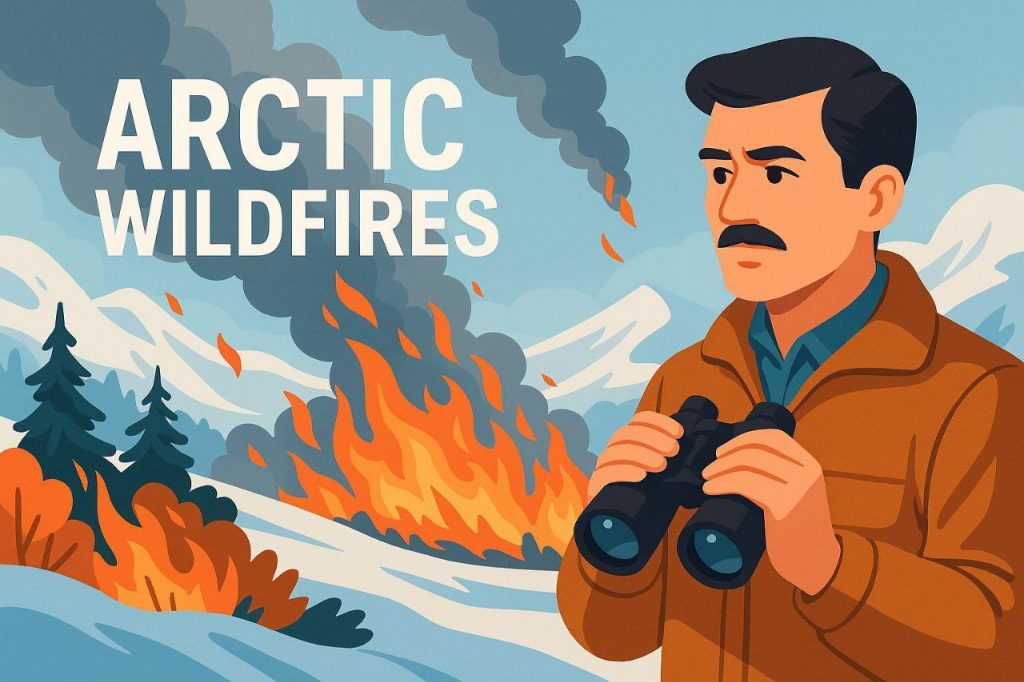
Arctic wildfires have become one of the most alarming indicators of rapid climate change in high-latitude regions. Once considered extremely rare due to cold temperatures and moisture-rich landscapes, these fires are now appearing with increasing frequency and intensity. Rising temperatures, prolonged heat waves, and declining snow cover have created conditions that allow vegetation, peat layers, and even tundra soils to ignite. These fires release massive amounts of carbon stored for centuries in frozen ground, accelerating global warming and reshaping Arctic ecosystems. Scientists monitoring these events warn that Arctic wildfires represent not only a regional environmental crisis but also a global threat with long-term climatic implications. Understanding their causes, behavior, and impact helps reveal how vulnerable the Arctic truly is in a warming world.
Why Arctic Wildfires Are Increasing
The surge in Arctic wildfires is closely linked to the region’s unprecedented warming rates, which far exceed global averages. Higher temperatures dry out vegetation and thaw peat soils, making them more flammable than in past decades. Researcher Dr. Helena Ross emphasizes that Arctic heat waves now last longer and reach temperatures that would have been unimaginable historically. She notes that lightning strikes—a major natural ignition source—are also becoming more common as the Arctic atmosphere becomes warmer and more energetic. In addition to natural triggers, human activities such as campfires, industrial operations, and transportation routes contribute to ignition risks. These combined factors create a feedback loop in which warming leads to fires, and fires in turn release carbon that accelerates further warming.
The Role of Peat and “Zombie Fires”
One of the most unique and troubling features of Arctic wildfires is the prevalence of peat fires, sometimes referred to as “zombie fires.” Peat is a thick, carbon-rich layer of partially decomposed organic material that burns slowly and intensely once ignited. In some cases, these fires continue smoldering underground throughout the winter, only to re-emerge in spring when surface layers thaw. Atmospheric scientist Dr. Marcus Edlund explains that peat fires are extremely difficult to extinguish because they can burn meters below the surface, consuming carbon that accumulated over thousands of years. These fires release high concentrations of carbon dioxide, methane, and particulate matter, significantly influencing atmospheric conditions. Their persistence makes them one of the most concerning drivers of Arctic carbon emissions.
Environmental and Ecological Consequences
Arctic wildfires have profound effects on ecosystems that evolved under cold, stable conditions. When tundra vegetation burns, soils lose their insulating layer, exposing permafrost to faster thawing. This leads to ground subsidence, thermokarst formation, and the release of trapped greenhouse gases. Wildlife habitats are also disrupted as fires reshape vegetation patterns and alter food availability. Many Arctic species—from migratory birds to small mammals—struggle to adapt to these rapid environmental changes. Smoke from large Arctic fires can travel across continents, affecting air quality in regions far from the fire zone. The combined ecological impacts illustrate how interconnected and fragile northern ecosystems are in the face of fire disturbances.
Global Climate Implications
Arctic wildfires are not only a regional issue but a major contributor to global climate dynamics. Burning peat, forests, and tundra releases vast quantities of carbon that had been locked in frozen environments for millennia. This contributes to atmospheric greenhouse gas concentrations and accelerates global warming trends. Black carbon, a soot-like particle produced by combustion, can settle on ice surfaces, reducing their reflectivity and speeding up melting. Climate modelers warn that increased Arctic burning may cross thresholds that further destabilize the global climate system. As fires intensify, they reinforce feedback loops that make the Arctic one of the fastest-changing environments on Earth. Understanding these patterns is essential for predicting future climate behavior.
Interesting Facts
Some Arctic fires burn underground all winter and reignite in spring as “zombie fires.”
The Arctic is warming about four times faster than the global average.
Smoke from Arctic wildfires can reach Europe, North America, and even the upper atmosphere.
Peatlands contain twice as much carbon as all the world’s forests combined.
Glossary
- Peat — carbon-rich organic soil formed from partially decomposed plant material.
- Thermokarst — ground collapse caused by melting ice-rich permafrost.
- Black Carbon — fine particulate matter from combustion that accelerates ice melt when deposited on snow.
- Permafrost — permanently frozen ground found in Arctic and subarctic regions.