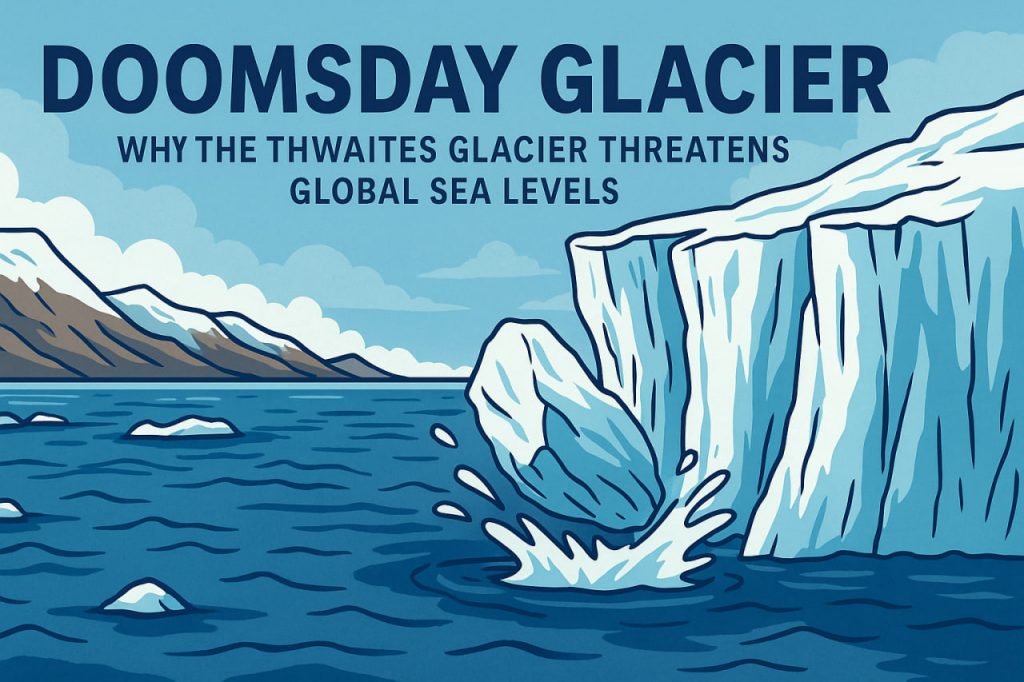
The Thwaites Glacier in West Antarctica — often called the “Doomsday Glacier” — is one of the most critical and unstable ice formations on Earth. Scientists monitor it closely because it holds enough ice to significantly raise global sea levels if it collapses. Thwaites acts as a gateway that stabilizes a much larger portion of the West Antarctic Ice Sheet. If it melts beyond a tipping point, it could trigger a chain reaction of ice loss across the region. Over the past two decades, researchers have recorded accelerating retreat, thinning ice, and rapid destabilization driven by warm ocean currents and complex interactions beneath the glacier. Understanding how and why the Thwaites Glacier is melting is essential for predicting future sea-level rise and assessing the risks faced by coastal communities worldwide.
Why the Thwaites Glacier Is Melting So Quickly
The primary driver of Thwaites’ rapid retreat is the intrusion of warm ocean water into deep channels beneath the glacier. This warm water melts the glacier from below, carving cavities and weakening the floating ice shelf that normally acts as a stabilizing “brake.” The bedrock beneath Thwaites slopes downward inland, creating a pathway for warm water to continually reach deeper sections of the glacier. This phenomenon accelerates the melting process and increases the risk of an irreversible collapse. According to polar researcher Dr. Amelia Rhodes:
“The most dangerous melting is happening where we can’t see it —
beneath the ice, where warm water is silently eating the glacier away.”
This hidden melting undermines the structural support of the glacier and contributes to its instability.
The Role of Geology and Ocean Dynamics
The physical shape of the land beneath Thwaites makes it especially vulnerable. Much of the glacier sits on a bed far below sea level, creating conditions where ocean water can flow underneath with ease. As the glacier retreats into deeper basins, it becomes increasingly unstable, picking up speed as it loses contact with stabilizing ridges. Shifts in ocean currents, wind patterns, and atmospheric temperatures also push warm water farther into Antarctic fjords, intensifying basal melt. These interconnected processes make Thwaites one of the fastest-changing glaciers in the entire world.
Potential Sea-Level Rise and Global Consequences
If the Thwaites Glacier collapses entirely, it could raise global sea levels by up to 65 centimeters on its own. However, its destabilization could also set off the collapse of adjacent glaciers, collectively contributing to over 3 meters of sea-level rise in the coming centuries. Such an increase would reshape coastlines, flood major cities, disrupt ecosystems, and force millions of people to migrate. Even partial collapse would increase the frequency of coastal flooding during storms and high tides. The future behavior of Thwaites plays a central role in long-term climate projections, making it a top priority in glaciological research.
Scientific Missions and Ongoing Research
Understanding Thwaites requires collaboration between international teams of scientists. Using autonomous underwater vehicles, radar imaging, satellite observations, and ice-core drilling, researchers are mapping the glacier from above and below. Recent missions have discovered deep cracks, rapidly expanding melt cavities, and unstable grounding zones where the glacier detaches from the bedrock. These findings reveal that Thwaites may be closer to a tipping point than previously thought. Comprehensive models continue to improve as new data emerges, allowing scientists to better estimate the timeline of potential collapse.
Climate Change and the Race Against Time
The warming atmosphere and ocean temperatures contributing to the glacier’s melt are linked to global climate change. Reducing greenhouse gas emissions is essential for slowing the rate of ocean warming and giving the glacier a chance to stabilize. While Thwaites is unlikely to recover completely, the pace of its retreat can still be influenced by human decisions today. Protecting coastlines, strengthening infrastructure, and preparing adaptation strategies depend heavily on understanding how rapidly the glacier will respond to future warming.
Interesting Facts
- Thwaites Glacier is roughly the size of Florida.
- Some regions beneath the glacier are melting at rates of 50 meters per year.
- Thwaites is responsible for about 4% of current global sea-level rise.
- Scientists discovered a network of warm-water channels directly beneath the glacier.
- The glacier could reach an irreversible collapse point within decades, not centuries.
Glossary
- Ice Shelf — a floating extension of a glacier that stabilizes the ice behind it.
- Basal Melt — melting that occurs at the bottom of a glacier due to warm water.
- Grounding Line — the point where the glacier transitions from resting on bedrock to floating.
- Fjord — a deep, narrow water-filled valley carved by glaciers.
- Tipping Point — a threshold beyond which rapid or irreversible change occurs.