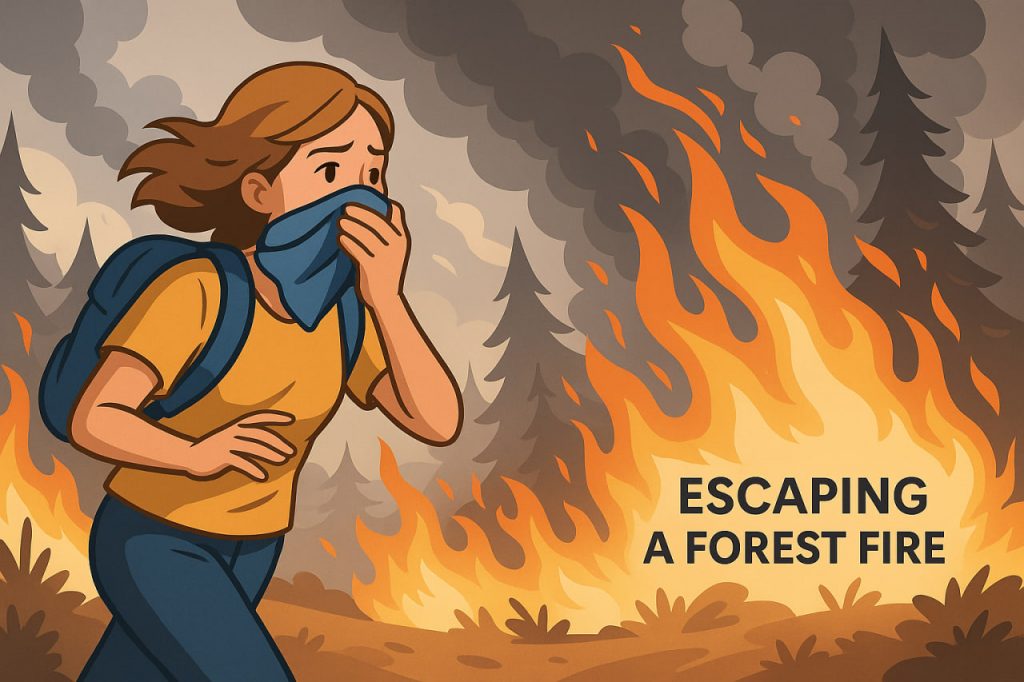
Finding yourself in a forest fire is one of the most dangerous and stressful situations a person can experience. Wildfires spread quickly, create intense heat, and fill the air with smoke that reduces visibility and makes breathing difficult. Even experienced hikers can be caught off guard by sudden wind changes or rapidly moving flames. Because of this, knowing what to do before you face such a situation is crucial for survival. Forest fire behavior is unpredictable, and understanding how to act calmly and efficiently can significantly increase your chances of escaping safely. This requires awareness of your surroundings, quick decision-making, and knowledge of how fire behaves in natural landscapes. Learning proper response techniques helps protect not only your life but also the lives of others.
Assess the Situation and Stay Calm
The first and most important step is to remain calm and evaluate the situation. Panic can lead to poor decisions or running blindly into dangerous areas. Try to determine the direction of the fire, the speed of its movement, and where the smoke is densest. If the fire is still far away, you may have more escape options. If it is close, you must act immediately. According to wilderness safety expert Dr. Samuel Reid:
“In a wildfire, calm thinking is your most valuable tool —
panic burns time faster than fire burns trees.”
By taking a moment to assess your surroundings, you can choose the safest possible direction.
Move Away From the Fire Safely
When escaping a forest fire, the goal is to move perpendicular to the fire’s front, not directly downhill or uphill toward or away from it. Fires often move faster uphill due to rising heat, while valleys can trap smoke. Choose open spaces, rocky areas, or paths with less vegetation. Avoid dense brush, dry grass, and slopes covered with leaves or pine needles. If there is a clear trail, follow it to avoid getting lost in poor visibility. If the fire surrounds you on multiple sides, look for natural firebreaks such as rivers, lakes, wide dirt paths, or recently burned-out areas.
Protect Yourself From Smoke and Heat
Smoke inhalation is one of the biggest threats during a forest fire. If you cannot avoid smoke, cover your mouth and nose with a piece of cloth — preferably damp — to reduce irritation. Stay low to the ground where the air is cooler and clearer. Keep your skin covered to protect yourself from hot air and embers. Long sleeves, scarves, and jackets act as a barrier against radiant heat. While these measures help, they cannot replace escaping the area as quickly as possible.
Use Natural Barriers and Safe Zones
If you cannot outrun the fire, your next priority is finding the safest possible spot. Natural barriers such as rivers, lakes, rocky outcrops, or large clearings can offer protection. Move to the opposite side of a large water source if possible. In areas recently burned, the fire is less likely to return. Avoid ravines and gullies because they can channel flames and smoke. If no safe zone is available, lie down in a depression or behind a large rock and cover your body as much as possible. These measures reduce your exposure until the main fire front passes.
Signal for Help and Stay Visible
If you are injured, trapped, or unable to continue moving, try to signal rescuers. Use bright clothing, reflective objects, or your phone’s flashlight if visibility is low. Move to an open area where helicopters or rescue teams can spot you more easily. If you have a mobile signal, contact emergency services and give them your location as precisely as possible. Staying visible increases your chances of being found quickly.
After Escaping the Danger Zone
Once you reach safety, continue moving away from the fire until you are certain you are out of danger. Forest fires can change direction unexpectedly. Drink water, check for burns or injuries, and rest. Smoke exposure can cause dizziness or coughing, so try to find clean air as soon as possible. Report your location to authorities if you witnessed people who may need help. Avoid returning to the burned area — fires can reignite even when they appear to be extinguished.
Interesting Facts
- Wildfires can move at speeds of up to 20 km/h, faster than many people can run.
- Most wildfire injuries happen due to smoke inhalation, not direct contact with flames.
- Running uphill during a fire is extremely dangerous because heat and flames rise rapidly.
- Animals often escape fires by moving to clearings, rivers, or rocky areas — the same places humans should seek.
- A sudden wind shift can expand a fire’s direction in less than a minute.
Glossary
- Firebreak — a natural or man-made gap in vegetation that slows or stops fire spread.
- Inhalation Hazard — danger caused by breathing smoke or toxic particles.
- Ember — a small, glowing piece of burning material that can start new fires.
- Backburning — controlled burning to remove fuel before a fire reaches an area.
- Radiant Heat — intense heat emitted by flames that can harm from a distance.