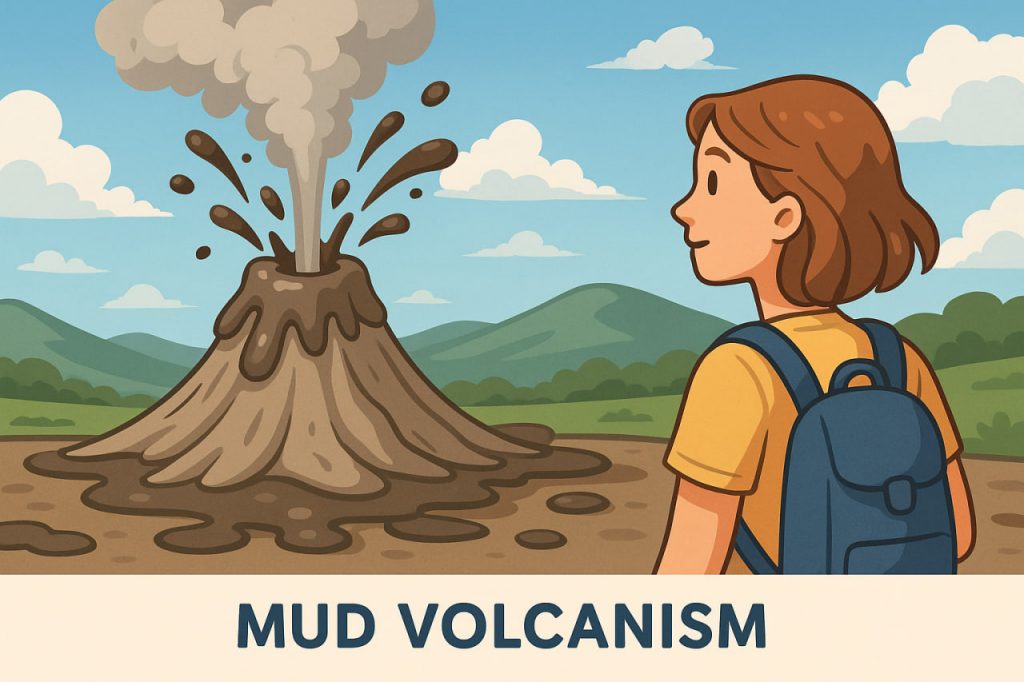
Mud volcanism is a fascinating geological process in which mixtures of water, gases, and fine sediments erupt from the Earth’s subsurface, forming structures that resemble traditional lava volcanoes — but without molten rock. These eruptions occur when underground pressure forces mud and gas upward through weak points in the crust, creating cones, pools, and bubbling vents. Mud volcanoes can range from small, short-lived features only a few meters wide to massive, long-lasting formations spanning kilometers. They are found on every continent and even on the ocean floor, making them a globally significant natural phenomenon. Studying mud volcanism helps scientists understand tectonic activity, gas emissions, sediment movement, and the dynamic structure of Earth’s crust. Although generally less dangerous than lava volcanoes, mud volcanoes can still produce sudden eruptions, ground deformation, and environmental impacts that require careful monitoring.
How Mud Volcanoes Form and What Drives Them
Mud volcanoes form when pressurized fluids — usually water, clay-rich sediments, and gases like methane — rise to the surface through fractures in the crust. Unlike magma volcanoes, which rely on molten rock, mud volcanoes are powered by deeply buried sediments and hydrocarbons. High pressure from gas accumulation or tectonic compression forces the slurry upward, sometimes erupting explosively. These eruptions can create cones, domes, and crater-like depressions filled with bubbling mud. According to geoscientist Dr. Olivia Hart:
“Mud volcanism is a window into Earth’s hidden plumbing —
it reveals how fluids and gases move beneath our feet.”
This process provides valuable information about subsurface geology, especially in regions rich in natural gas or tectonic activity.
Global Distribution and Notable Mud Volcano Regions
Mud volcanoes are most common in regions with active tectonics or substantial underground gas reserves. The Caspian Sea region, including Azerbaijan, hosts some of the largest and most active mud volcanoes in the world. Indonesia’s Lusi mud volcano is another famous example, known for its continuous eruption since 2006. The Caribbean, Mediterranean, and parts of Central Asia also contain extensive mud volcano systems. Submarine mud volcanoes — those found on the ocean floor — are equally important, releasing methane and shaping seafloor landscapes. These varied locations demonstrate how widespread and diverse mud volcanism can be.
Environmental and Geological Importance
Mud volcanoes contribute to Earth’s natural gas cycle by releasing methane into the atmosphere or water column. While methane is a potent greenhouse gas, many mud volcanoes release it slowly, and some gases are consumed by microbial communities. Mud volcano eruptions also influence surface landscapes, depositing layers of sediment that can reshape terrain. In some regions, they create nutrient-rich soils that support unique ecosystems. Mud volcanism is also linked to seismic activity: sudden increases in mud eruption frequency can signal underlying tectonic stress or shifting fault lines.
Hazards and Human Impacts
Although usually less dangerous than magma volcanism, mud volcanoes can still pose risks. Sudden eruptions may bury roads, damage buildings, or release large volumes of gas. Some mud volcanoes produce hot mud capable of causing burns, while others release flammable gases that can ignite. The Lusi mud volcano in Indonesia displaced entire communities due to continuous mud flow. In industrial regions, mud volcanoes can interfere with drilling operations and highlight instability in subsurface structures. Understanding these hazards is essential for land-use planning and disaster preparedness.
Scientific Research and Monitoring
Scientists study mud volcanoes using satellite imagery, gas sensors, seismic monitoring, and geochemical analysis. These tools help track eruption patterns, gas emissions, and underground pressure changes. Mud volcanism also plays an important role in energy exploration, as the presence of active mud volcanoes often indicates nearby hydrocarbon deposits. Modern research aims to understand how mud volcanoes respond to earthquakes, climate shifts, and human activities like drilling. Their study provides key insights into the complex interactions between geology, fluids, and Earth systems.
Interesting Facts
- The largest concentration of mud volcanoes is found around the Caspian Sea, with over 300 active structures.
- Some mud volcanoes can erupt mud at temperatures above 100°C, though many are cool.
- Submarine mud volcanoes release methane that supports unique deep-sea microbial ecosystems.
- Mud volcano eruptions can eject material hundreds of meters into the air.
- Lusi in Indonesia is one of the world’s most persistent mud eruptions, active since 2006.
Glossary
- Methane — a natural gas often released during mud volcanic activity.
- Hydrocarbon — organic compounds found underground, often associated with oil and gas.
- Sediment Slurry — a mixture of water and fine sediments pushed upward during an eruption.
- Tectonic Stress — pressure in Earth’s crust that can trigger geological activity.
- Submarine Volcano — a volcano located on the ocean floor, including mud volcano types.