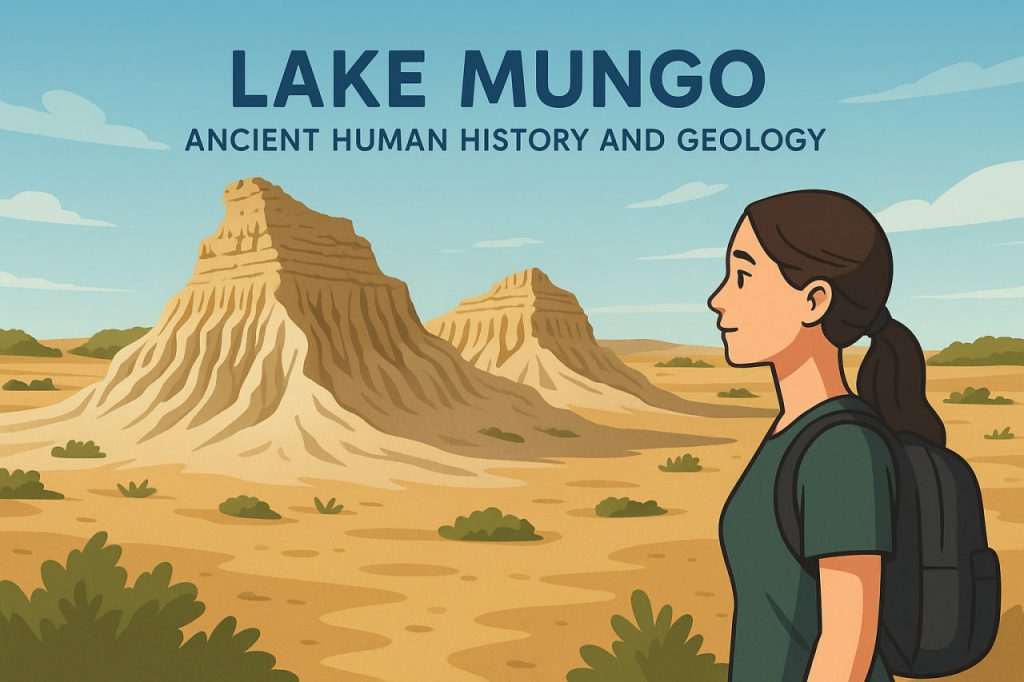
Lake Mungo is one of the most significant archaeological and geological sites in Australia, offering a rare glimpse into the deep past of human civilization. Located in New South Wales within the Willandra Lakes Region, this now-dry lakebed preserves evidence of early human life dating back more than 40,000 years. The area is famous for the discovery of Mungo Man and Mungo Lady — two of the oldest known human remains found in Australia — which reshaped scientific understanding of human migration and cultural development on the continent. Lake Mungo’s unique sediments, ancient shorelines, and dune formations create a natural archive that reveals how early humans adapted to changing climates, landscapes, and ecosystems. Today, the site remains a powerful symbol of cultural heritage for Indigenous Australian communities and a vital resource for researchers studying human evolution.
Geological Origins and Landscape of Lake Mungo
Lake Mungo once formed part of a large interconnected lake system fed by rivers and rainfall. Over thousands of years, shifts in climate gradually dried the region, leaving behind layers of sediment, dunes, and clay formations that preserve fossils and artifacts. The most iconic feature is the Walls of China, a series of eroded sand and clay ridges that expose stratified layers more than 100,000 years old. These formations provide evidence of long-term environmental cycles, helping scientists reconstruct ancient climates. According to geologist Dr. Harriet Cole:
“Lake Mungo is a natural time machine —
its layers record both human history and the shifting story of Australia’s climate.”
The landscape today is arid and windswept, but beneath its surface lies a remarkable geological archive.
Archaeological Significance and Human Remains
Lake Mungo is globally renowned for its archaeological discoveries. In 1968, scientists uncovered Mungo Lady, the world’s oldest known cremated human remains. Just a few years later, the discovery of Mungo Man, a carefully buried skeleton more than 40,000 years old, provided evidence of early human ceremonial practices. These findings revealed that ancient Indigenous Australians developed complex cultural traditions far earlier than previously believed. Additional discoveries — stone tools, hearths, animal bones, and footprints — offer insight into daily life, hunting practices, and social behavior. These remains challenge outdated narratives about human evolution and demonstrate the deep and continuous presence of Indigenous cultures in Australia.
Climate Change and Environmental Insights
The dried lakebed of Lake Mungo also serves as a valuable record of past climate fluctuations. Sediment layers reveal periods of drought, rainfall, erosion, and shifting ecosystems. These changes shaped the lives of early inhabitants, forcing them to adapt to varying water availability and environmental stress. The site provides crucial data for understanding long-term climate cycles and offers context for modern environmental challenges. The ancient story of Lake Mungo shows how humans have always been connected to — and shaped by — their surrounding environment.
Cultural Heritage and Indigenous Significance
Lake Mungo holds deep cultural meaning for the Paakantji, Ngiyampaa, and Mutthi Mutthi Peoples, who have lived in the region for tens of thousands of years. For these communities, the site is not only an archaeological treasure but a sacred place that reflects ancestral stories, identity, and spiritual connection to the land. The return and reburial of Mungo Man in 2022 after decades of scientific study marked an important moment of cultural respect and reconciliation. Indigenous custodians continue to guide conservation efforts, ensuring that Lake Mungo is protected for future generations.
Modern Research and Preservation Efforts
Scientists continue to study Lake Mungo using advanced tools such as optical dating, drone imaging, and high-resolution mapping. These methods help track erosion, identify new artifacts, and better understand the site’s long-term geological changes. However, Lake Mungo faces threats from wind erosion, tourism pressure, and climate-related shifts. Conservation programs aim to preserve this irreplaceable heritage site while balancing education, scientific research, and Indigenous stewardship. The collaborative protection of Lake Mungo ensures that its historical and cultural significance remains intact.
Interesting Facts
- Lake Mungo is home to the oldest known human cremation in the world.
- The ancient shoreline once spanned over 20 kilometers before the lake dried up.
- The “Walls of China” formations expose sediments dating back more than 100,000 years.
- Fossilized human footprints discovered at the site are the largest set of ancient footprints ever found in Australia.
- Mungo Man’s burial is one of the earliest known examples of ritual funerary practices.
Glossary
- Cremation — the practice of burning a body as part of a burial tradition.
- Sediment — particles of sand, clay, or minerals that accumulate in layers over time.
- Archaeology — the study of human history through physical remains and artifacts.
- Erosion — the natural wearing away of soil or rock by wind, water, or weather.
- Indigenous Custodians — the original inhabitants responsible for protecting and managing culturally significant lands.