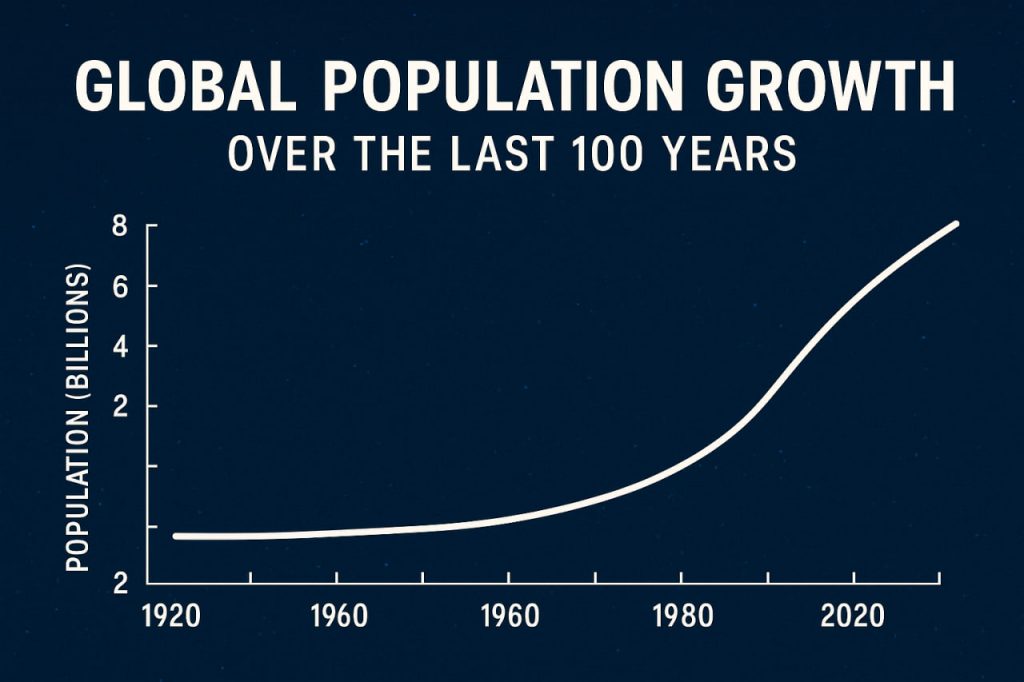
Over the past century, the global population has undergone one of the most dramatic expansions in human history. From roughly 2 billion people in 1925 to more than 8 billion today, humanity has experienced rapid and unprecedented demographic growth. This surge was driven by advances in medicine, agriculture, sanitation, and technology that dramatically reduced mortality rates and improved living conditions. The story of the last 100 years is not simply one of rising numbers but of transformation — how societies evolved, how resources were used, and how global challenges emerged as a result of expanding populations.
Population growth is not distributed evenly across the world. While some regions experienced explosive increases, others are now slowing or even shrinking. Understanding these trends helps explain modern economic shifts, environmental pressures, and global development patterns that shape our future.
Global Population Dynamics: 1925–2025
A century ago, high mortality rates limited population growth. With the introduction of vaccines, antibiotics, improved sanitation, and scientific agriculture, the world entered a new demographic era. Key milestones include:
- 1925: ~2 billion
- 1950: ~2.5 billion
- 1987: 5 billion
- 1999: 6 billion
- 2011: 7 billion
- 2022: 8 billion
This acceleration is historically unprecedented. According to demographer Dr. Samuel Pierce:
“The past century reshaped humanity — population growth has been faster, broader, and more transformative than any period before.”
The global rate of growth peaked in the 1960s but has since slowed as many countries transition toward lower birth rates.
What Caused the Population Surge?
Several factors contributed to the rapid rise:
- Medical Advances: Vaccines, antibiotics, and better healthcare dramatically reduced infant and child mortality.
- Improved Sanitation: Clean water and waste management reduced deadly infections.
- Agricultural Innovation: Mechanization and the Green Revolution expanded food supplies.
- Economic Development: Industrialization and urbanization increased life expectancy.
- Public Health Programs: Expanded access to maternal care and disease prevention.
These changes allowed more people to survive to adulthood and have children of their own.
Regional Differences in Population Growth
Population growth over the past century has varied widely:
- Africa currently has the fastest-growing population, driven by youthful demographics.
- Asia experienced massive increases in the mid-20th century; India is now the most populous country.
- Europe has entered a long-term demographic slowdown, with many countries facing aging populations.
- Latin America grew quickly in the second half of the century due to improved healthcare and reduced mortality.
- North America grew steadily through immigration and moderate birth rates.
These differences shape global economic power, migration flows, and future development.
Environmental and Social Impact
Rapid population growth has contributed to several major challenges:
- increased pressure on natural resources
- urban expansion and megacities
- greater carbon emissions and climate stress
- water and food demand
- biodiversity loss
- waste accumulation and pollution
However, population growth has also driven:
- economic innovation
- workforce expansion
- technological advances
- improvements in education and global cooperation
The relationship between population and progress is complex and multifaceted.
Is Population Still Growing?
Yes — but the pace is declining. Many countries now have fertility rates below replacement level. Scientists predict:
- global population may reach 9.7 billion by 2050
- may peak between 10.4 and 10.8 billion around 2080–2100
- then slowly stabilize or decline
This shift marks a major demographic transition as societies age and family sizes decrease.
The Future: Opportunities and Challenges
Humanity’s next century will depend on how societies manage:
- sustainable resource use
- food security
- climate resilience
- urban planning for expanding cities
- healthcare for aging populations
- technological solutions to support global needs
With thoughtful planning and innovation, countries can balance population dynamics and environmental protection.
Interesting Facts
- The global population took 200,000 years to reach 1 billion — but only 12 years to grow from 7 to 8 billion.
- More than 50% of people now live in urban areas, compared to just 15% in 1900.
- The world’s average life expectancy rose from 34 years (1913) to over 72 years today.
- India adds more people annually than all of Europe combined.
- Japan has more people over 65 than children — the reverse of global trends 100 years ago.
Glossary
- Demographic Transition — shift from high birth and death rates to low birth and death rates.
- Fertility Rate — the average number of children born per woman.
- Life Expectancy — the average number of years a person is expected to live.
- Urbanization — movement of populations from rural to urban areas.
- Megacity — a city with more than 10 million inhabitants.