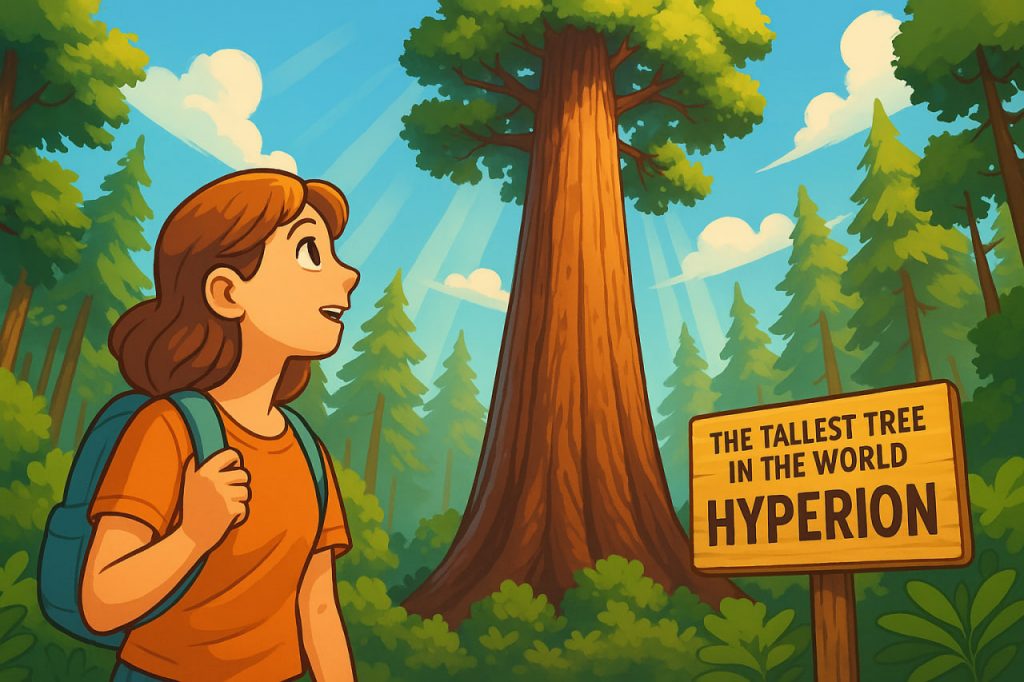
The tallest tree on Earth is a coast redwood (Sequoia sempervirens) named Hyperion, discovered in 2006 in a remote area of Redwood National Park in California. Standing at an astonishing 115.92 meters (380.3 feet), Hyperion surpasses every known tree on the planet, making it a living monument to the power and resilience of nature. Its exact location is kept secret to protect it from excessive human traffic, soil compaction, and potential environmental damage. Hyperion is not only impressive for its height but also for what it represents — the ecological importance of ancient forests and the extraordinary biological engineering that allows trees to grow to such extreme sizes.
Redwoods grow best in narrow ecological conditions: mild temperatures, abundant fog, nutrient-rich soil, and stable moisture. These trees have existed for millions of years, surviving climate changes, volcanic activity, and even ice ages. Thousands of microscopic processes work together inside each redwood, enabling it to transport water hundreds of feet upward, resist fire, and live for over 2,000 years. Hyperion’s height is the result of optimal environmental factors combined with unique genetic advantages.
How Trees Grow So Tall
Tree height depends on multiple biological systems working in harmony. Redwoods succeed because they have:
- highly efficient water-transport systems
- thick bark resistant to fire and insects
- access to moisture from coastal fog
- dense wood with strong structural stability
Water transport becomes increasingly difficult at great heights because the tree must overcome gravitational force. At around 120–130 meters, scientists believe tree height reaches a natural limit due to the physics of water tension and evaporation.
According to forest ecologist Dr. Amelia Patterson:
“Hyperion is a perfect combination of genetics and environment —
a rare tree growing under ideal conditions for centuries.”
Where Hyperion Lives and Why It Matters
Hyperion stands within a protected UNESCO World Heritage Site, surrounded by some of the oldest and tallest forests on Earth. The northern California coast offers:
- year-round humidity
- cool temperatures
- fog drip supplying additional water
- deep alluvial soils
- minimal lightning and fire frequency
These factors reduce stress on the tree and allow continuous growth — something not possible in harsher climates.
The Importance of Redwood Ecosystems
Coast redwoods are keystone species in their environment. They:
- lock enormous amounts of carbon from the atmosphere
- support diverse wildlife
- stabilize riverbanks
- create sheltered microclimates
- play a critical role in biodiversity
Their canopies host entire ecosystems, including ferns, mosses, insects, and even small trees growing high above the forest floor.
Threats Facing Hyperion and Other Giant Trees
Despite their resilience, redwoods face modern threats:
- climate change and prolonged drought
- rising temperatures affecting fog patterns
- human impact from tourism
- habitat fragmentation
- wildfires intensified by global warming
Hyperion has already suffered bark damage from visitors attempting to reach it. To protect it, rangers now discourage all visitation to its site.
Other Record-Breaking Trees
Hyperion is the tallest living tree, but other giants hold different records:
- General Sherman (giant sequoia) — largest tree by volume
- Centurion (Eucalyptus regnans) — tallest flowering plant
- Jōmon Sugi (Japanese cedar) — one of the oldest trees
- Methuselah (bristlecone pine) — oldest known tree at over 4,800 years
These trees show the incredible diversity of Earth’s forests and their evolutionary strategies.
Interesting Facts
- Hyperion is taller than the Statue of Liberty and almost as tall as a 40-story building.
- Scientists estimate it is between 600 and 800 years old — still young for a redwood.
- Redwoods can regenerate from roots even after severe damage.
- Fog provides up to one-third of their yearly water supply.
- Redwood bark can be up to 30 cm thick, protecting them from fire.
Glossary
- Coast Redwood — a species of extremely tall coniferous tree native to California.
- Fog Drip — moisture collected from fog by trees, which then drips to the ground.
- Keystone Species — a species that supports the structure of an entire ecosystem.
- Alluvial Soil — nutrient-rich soil deposited by rivers.
- Water Tension — the physical limit of pulling water upward through a tree’s vascular system.