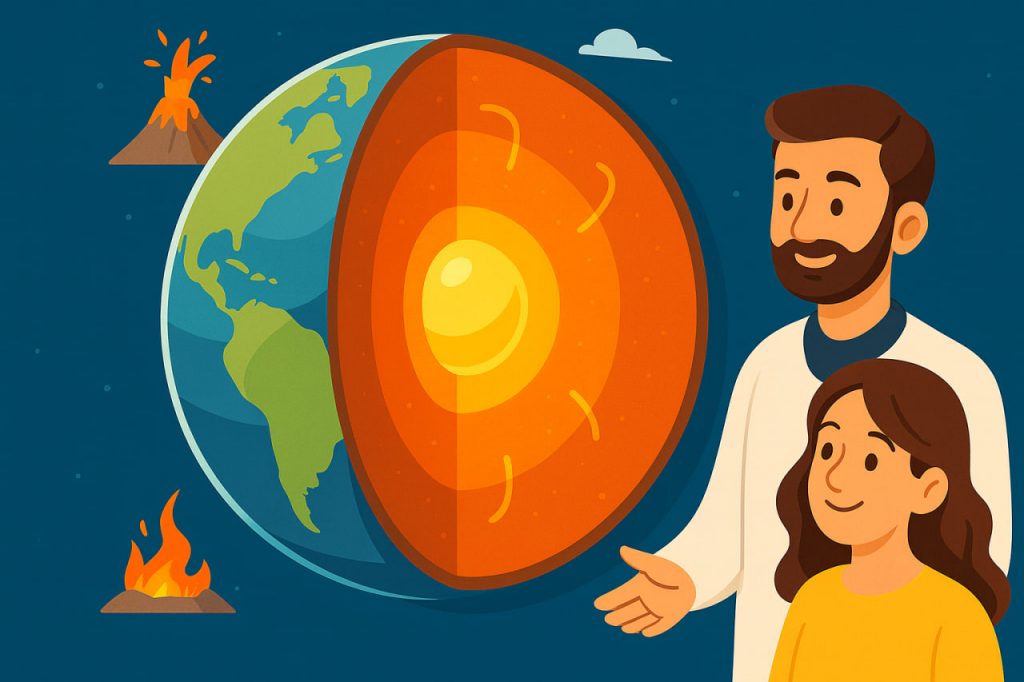
The interior of Earth is a dynamic, multilayered system filled with immense heat, pressure, and constant geological activity. Although humans cannot directly access most of the planet’s interior, scientific methods such as seismic wave analysis, laboratory simulations, and satellite measurements allow us to understand what lies beneath the surface. Earth is not a solid, static sphere — it is a living planetary engine whose internal processes shape continents, trigger earthquakes, fuel volcanoes, and generate the magnetic field that protects life from harmful cosmic radiation.
The deeper we go inside Earth, the more extreme the conditions become. Temperatures rise from the mild crust to metal-melting heat in the core, while pressure increases to millions of atmospheres. These conditions drive convection, plate tectonics, magnetic field generation, and long-term climate regulation. Understanding Earth’s interior helps scientists predict natural hazards and provides insight into the evolution of our planet and others like it.
The Layers of Earth
Earth has four main internal layers, each with distinct physical and chemical properties:
1. Crust
The crust is the planet’s thin, outermost layer, where humans live.
It comes in two forms:
- continental crust — thick, light, and ancient
- oceanic crust — thin, dense, and young
The crust is broken into tectonic plates that move due to forces from deeper layers.
2. Mantle
Beneath the crust lies the mantle, making up 84% of Earth’s volume.
It behaves like a very slow-moving fluid due to intense heat.
The mantle drives:
- plate tectonics
- volcanic activity
- mountain formation
Hot mantle material rises, cools, then sinks — a process called convection.
3. Outer Core
The outer core is a layer of molten iron and nickel.
Its constant motion generates Earth’s magnetic field through the geodynamo process.
Without this magnetic shield, solar wind would strip away the atmosphere, making life nearly impossible.
4. Inner Core
The inner core is solid despite extreme temperatures (similar to the Sun’s surface).
It remains solid due to immense pressure.
According to geophysicist Dr. Alan Whitmore:
“Earth’s inner core rotates, vibrates, and slowly grows —
it is one of the most mysterious structures in the solar system.”
Heat Sources Inside Earth
Earth’s internal heat comes from:
- leftover energy from planetary formation
- radioactive decay of elements like uranium and thorium
- frictional heating from sinking materials
- crystallization of the inner core
These energy sources power volcanoes, earthquakes, and mantle convection.
What Happens Deep Below?
Mantle Convection
Rising and sinking rock moves tectonic plates, creating earthquakes, rifts, and subduction zones.
Subduction and Melting
Oceanic plates sink into the mantle, melt, and form volcanoes.
Core Motion
The liquid outer core flows like a thick metal ocean, generating the magnetic field.
Inner Core Growth
Iron crystallizes onto the solid inner core, releasing heat and driving outer-core motion.
How Scientists Study Earth’s Interior
Because we cannot drill deeper than a few kilometers, scientists use:
- seismic waves from earthquakes
- mineral physics experiments
- computer simulations
- magnetic field measurements
- gravity mapping
Seismic waves reveal Earth’s internal structure the way ultrasound scans reveal the inside of the human body.
Why Earth’s Interior Matters
Internal processes shape the planet in fundamental ways:
- create continents and oceans
- recycle carbon and regulate climate
- generate Earth’s magnetic field
- support volcanic outgassing that formed the atmosphere
- provide geothermal energy
Earth’s interior makes the planet geologically alive — unlike the Moon or Mars, where internal heat has largely dissipated.
Interesting Facts
- The deepest hole ever drilled reached only 12.2 km, less than 0.2% of Earth’s radius.
- Earth’s core is as hot as the surface of the Sun — over 5,000°C.
- The magnetic field flips every few hundred thousand years.
- Diamonds form deep in the mantle under extreme pressure.
- The inner core may be rotating slightly faster than the rest of the planet.
Glossary
- Mantle Convection — slow, heat-driven movement of rock within the mantle.
- Subduction — the process of one tectonic plate sinking beneath another.
- Geodynamo — the mechanism generating Earth’s magnetic field through core motion.
- Seismic Waves — vibrations from earthquakes used to map Earth’s interior.
- Crystallization — solidification of molten metal inside the core.