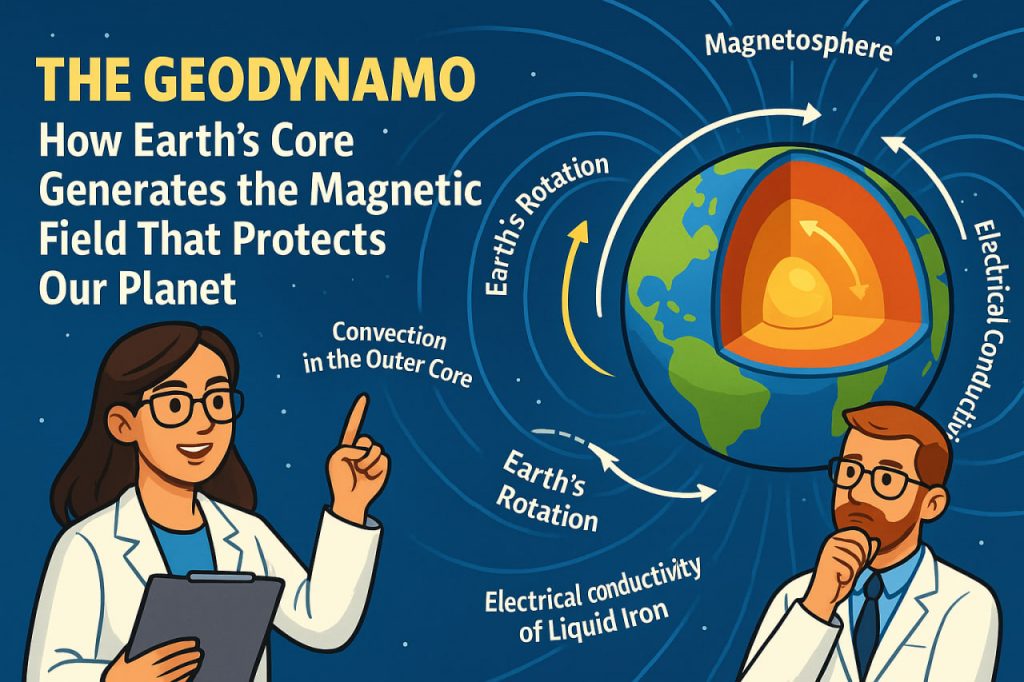
Earth’s magnetic field is one of the most important features of our planet — a protective shield that deflects harmful solar radiation, preserves our atmosphere, and enables life to thrive on the surface. This invisible but powerful field is generated deep inside our planet through a process known as the geodynamo. The geodynamo is a natural electrical generator driven by heat, motion, and the unique properties of Earth’s metallic core. Understanding how it works helps scientists explain everything from compass navigation to auroras, climate history, and the long-term evolution of Earth’s interior.
The geodynamo operates inside the outer core, a swirling layer of molten iron and nickel located about 2,900 kilometers beneath the surface. This metallic liquid moves constantly due to convection, Earth’s rotation, and the release of heat from deeper layers. As the liquid iron flows, it creates electrical currents, which in turn generate magnetic fields. These fields combine, strengthen, and self-organize into the large-scale magnetic shield surrounding Earth — the magnetosphere.
How the Geodynamo Works
The geodynamo is powered by several interconnected physical processes:
1. Convection in the Outer Core
Heat from the inner core causes molten iron to rise, cool, and sink again.
This creates large, circulating currents that transport energy outward.
2. Earth’s Rotation
The rotation of the planet twists these convection currents into spirals due to the Coriolis effect, helping to organize and stabilize the magnetic field.
3. Electrical Conductivity of Liquid Iron
Iron in the outer core conducts electricity extremely well.
Moving conductive fluid acts like the coils in a dynamo, producing electrical currents and magnetic fields.
4. Feedback Mechanism
Once a small magnetic field forms, the moving liquid iron strengthens and maintains it.
This positive feedback keeps the geodynamo running for billions of years.
According to geophysicist Dr. Julian Marks:
“The geodynamo is one of the most efficient natural engines.
It converts planetary heat into a magnetic shield that allows life to exist.”
The Importance of Earth’s Magnetic Field
The magnetic field created by the geodynamo protects Earth from:
- solar wind, a stream of charged particles from the Sun
- cosmic radiation
- atmospheric erosion
- electromagnetic disturbances
Without this shield, Earth could lose its atmosphere over time — a fate believed to have affected Mars, whose weak magnetic field allowed solar wind to strip away much of its atmosphere.
Magnetic Field Reversals
The geodynamo does not produce a constant magnetic field. Throughout Earth’s history, the magnetic poles have flipped — North becomes South and vice versa.
Key facts about reversals:
- occur irregularly every 200,000–500,000 years
- last thousands of years
- do not cause catastrophic effects
- recorded in volcanic rocks and seafloor sediments
Reversals are believed to result from temporary instabilities in the geodynamo’s flow patterns.
Inner Core Growth and the Future of the Geodynamo
The solid inner core slowly grows as molten iron crystallizes.
This process:
- releases heat
- drives convection in the outer core
- powers the geodynamo further
Eventually, billions of years from now, Earth’s interior may cool enough for the geodynamo to weaken — but this will not occur within any human timescale.
How Scientists Study the Geodynamo
Because we cannot reach Earth’s core, scientists use:
- seismic wave observations
- supercomputer simulations
- laboratory experiments using liquid metals
- paleomagnetic studies of ancient rocks
- satellite measurements of the magnetic field
These methods reveal how the magnetic field evolves and how Earth’s deep interior behaves.
Interesting Facts
- Earth’s magnetic field extends tens of thousands of kilometers into space.
- The geodynamo produces a magnetic field strong enough to move compass needles but weak enough to be influenced by solar storms.
- The magnetic field weakens during reversals but does not disappear entirely.
- Auroras form when solar particles interact with the magnetic field near the poles.
- Earth’s inner core may rotate slightly faster or slower than the planet’s surface.
Glossary
- Geodynamo — the process by which Earth’s liquid outer core generates the magnetic field.
- Magnetosphere — the region around Earth influenced by its magnetic field.
- Convection — heat-driven circulation of fluid.
- Coriolis Effect — the twisting of moving fluids caused by Earth’s rotation.
- Electrical Conductivity — the ability of a substance to carry electric current.