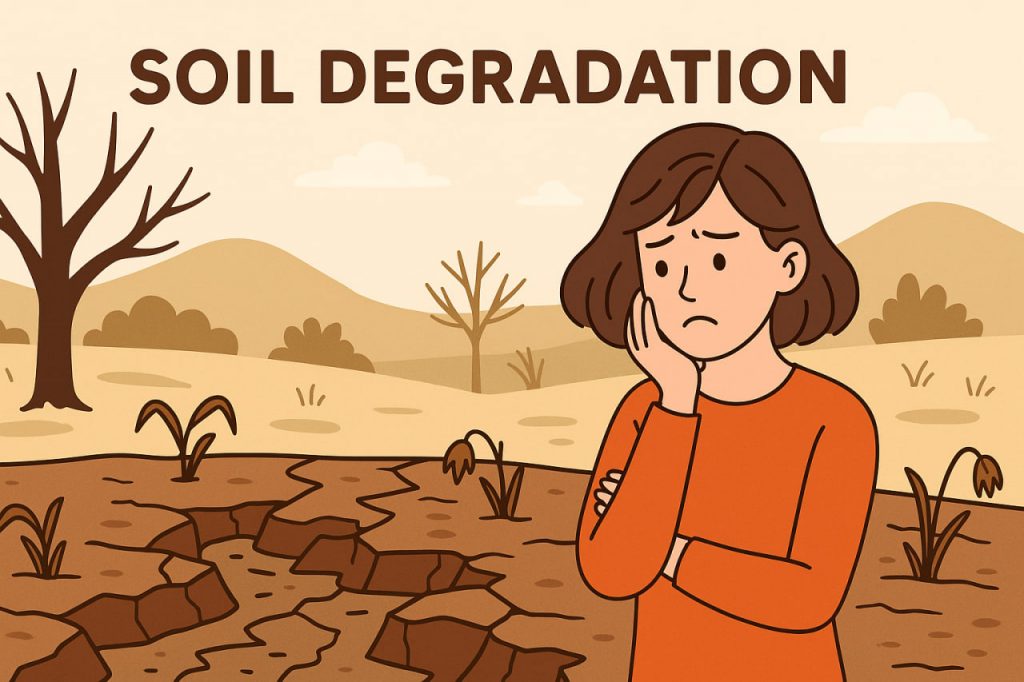
Soil degradation is one of the most critical environmental challenges of the modern world, affecting ecosystems, agriculture, water resources, and long-term sustainability. Healthy soil supports plant growth, stores carbon, filters water, and sustains biodiversity, yet millions of hectares worldwide are losing fertility due to human activity and climate change. As soil structure weakens, it becomes less able to retain nutrients and moisture, leading to reduced crop yields, increased erosion, and declining land quality. Understanding the processes behind soil degradation allows communities, farmers, and policymakers to implement effective solutions that protect natural resources and safeguard future food security. Because soil develops slowly—over hundreds or thousands of years—its degradation happens far faster than its regeneration, making awareness and prevention essential.
Major Causes of Soil Degradation
Soil degradation results from a combination of natural forces and human activities. Unsustainable farming methods, such as over-tilling, monoculture planting, and excessive use of chemical fertilizers, weaken soil structure and reduce organic matter. Deforestation removes protective vegetation, exposing land to erosion by wind and water. Industrial pollution and improper waste disposal contaminate soil with heavy metals and toxins. Climate change also accelerates degradation through extreme heat, drought, and intense rainfall events that wash away topsoil. As environmental scientist Dr. Karen Hughes explains:
“Soil degradation often starts invisibly —
by the time the damage is visible, recovery becomes far more difficult.”
Recognizing these early signs is essential for preventing long-term loss of land productivity.
Types of Soil Degradation and How They Affect Land
Degradation appears in several forms, each with different impacts. Erosion removes nutrient-rich topsoil, leaving behind poor, compacted layers that cannot support crops. Chemical degradation occurs when soil is contaminated or becomes too acidic or alkaline due to overuse of fertilizers or industrial waste. Physical degradation reduces soil’s ability to absorb water, often caused by compaction from heavy machinery or livestock. Biological degradation occurs when soil loses microorganisms, earthworms, and organic matter, diminishing its fertility. These processes weaken ecosystems and increase vulnerability to droughts and floods.
Consequences for Agriculture and Ecosystems
Declining soil quality directly affects food production, reducing yields and increasing the need for expensive fertilizers. As soil becomes less fertile, farmers may expand agricultural land into forests or grasslands, creating a cycle of further degradation. Ecosystems also suffer, as degraded soil loses its ability to support plant life, leading to biodiversity loss and disrupted habitats. Water contamination increases because degraded soil cannot filter pollutants effectively. Over time, entire landscapes may shift as erosion creates gullies, barren patches, and unstable slopes.
Strategies for Prevention and Restoration
Although soil degradation is a serious challenge, many solutions are both effective and accessible. Conservation agriculture practices such as reduced tilling, crop rotation, and cover cropping help restore soil structure and increase organic matter. Planting trees and maintaining vegetation protect land from erosion and improve water retention. Composting and organic fertilizers replenish nutrients naturally, while controlled grazing prevents compaction. Communities can also implement land-use planning and erosion-control structures to stabilize vulnerable areas. As soil restoration specialist Dr. Samuel Ortiz notes:
“Healthy soil is not just a farming tool —
it is a foundation for stable environments and resilient communities.”
Long-term commitment to sustainable practices allows damaged soils to recover gradually.
Global Importance and the Future of Soil Health
Soil degradation threatens global food security, climate regulation, and environmental resilience. As the world’s population grows, pressure on land increases, making restoration efforts even more urgent. Healthy soil absorbs carbon dioxide, helping mitigate climate change, while degraded soil releases carbon back into the atmosphere. International initiatives promote sustainable agriculture, reforestation, and soil conservation as key strategies for a stable future. Protecting soil today ensures that future generations inherit a world capable of producing food, sustaining wildlife, and maintaining ecological balance.
Interesting Facts
- Nearly one-third of the world’s farmland is already degraded.
- Soil forms extremely slowly — 1 cm of topsoil can take 100–400 years to develop.
- Earthworms can improve soil structure and fertility by aerating and enriching the ground.
- Healthy soil stores more carbon than all forests combined, playing a major role in climate regulation.
- Up to 95% of global food production depends directly on soil health.
Glossary
- Erosion — the removal of soil by wind, water, or human activity.
- Topsoil — the uppermost, nutrient-rich layer of soil essential for plant growth.
- Compaction — compression of soil that reduces its ability to absorb water and support roots.
- Organic Matter — decomposed plant and animal material that enriches soil.
- Conservation Agriculture — farming practices that protect and restore soil health.