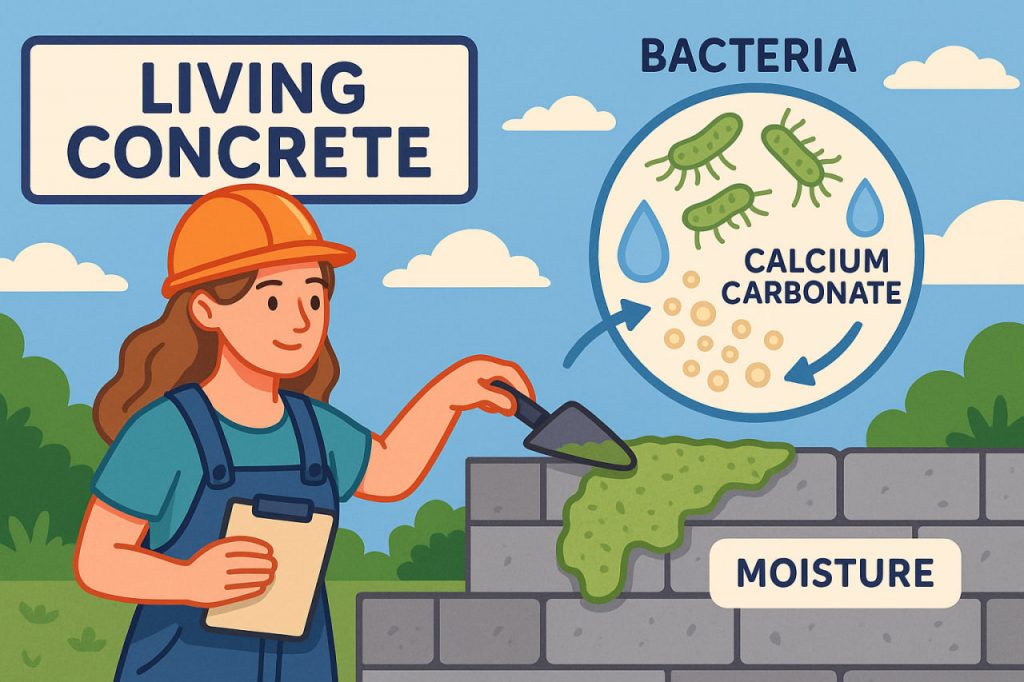
Living concrete is an emerging class of bioengineered construction materials that incorporate living microorganisms to give concrete new, remarkable abilities. Unlike traditional concrete — which is strong but prone to cracking, erosion, and environmental impact — living concrete can self-repair, grow, and in some cases even reproduce under controlled conditions. Scientists achieve this by integrating bacteria, algae, or fungi into a mineral-based matrix, creating a hybrid material that combines the durability of traditional cement with the regenerative properties of biology. The development of living concrete has the potential to transform architecture, reduce carbon emissions, and create sustainable structures that interact positively with their environment. As global demand for resilient infrastructure increases, living concrete stands out as a promising and innovative solution.
Living concrete is especially appealing because it challenges the traditional idea of buildings as static structures. Instead, future constructions may behave more like ecosystems — capable of responding to damage, adjusting to environmental changes, and reducing reliance on energy-intensive repair. This shift also supports new design opportunities for architects and engineers, who can explore forms and functions previously impossible with conventional materials. As the technology progresses, living concrete may become an essential tool for sustainable urban development and climate-resilient infrastructure.
How Living Concrete Works
Most living concrete innovations use microorganisms such as cyanobacteria or calcite-producing bacteria. These organisms are embedded into a nutrient-rich gel or mineral mixture that acts as a scaffold. When moisture and light become available, the microorganisms produce calcium carbonate — the same material found in seashells and limestone — effectively “growing” new solid mass. This process allows cracks to heal naturally over time. According to bioarchitecture researcher Dr. Selena Morris:
“Living concrete is not just a material —
it is a biological system engineered to repair and strengthen itself.”
Different formulas produce different behaviors: some versions harden quickly, others grow slowly but require less energy, and some even exhibit color changes depending on environmental conditions.
Self-Healing Properties and Structural Benefits
One of the most valuable features of living concrete is its ability to repair cracks without human intervention. When a crack forms, it allows water and air to enter the material. The embedded bacteria then activate and begin producing minerals that seal the fracture. This significantly extends the lifespan of buildings, bridges, sidewalks, and other structures. Self-healing concrete reduces maintenance costs, prevents water leakage, and improves structural integrity. It also increases safety by minimizing hidden weaknesses that normally worsen over time.
Environmental Advantages of Bioengineered Concrete
Traditional cement manufacturing is responsible for a large share of global carbon dioxide emissions. Living concrete offers several environmental benefits. Microorganisms inside the material can absorb CO₂ during growth, reducing the overall carbon footprint. In some cases, bacteria can even be engineered to capture and store carbon long-term. Living concrete also requires less energy to produce than conventional cement. Additionally, its self-repairing nature means fewer repairs, less demolition waste, and extended durability. These qualities make it an attractive option for sustainable construction strategies.
Applications in Architecture and Infrastructure
Living concrete is being explored for use in multiple settings, including sustainable housing, disaster-resistant buildings, outdoor installations, and remote construction projects where maintenance is challenging. It could be used in developing regions lacking access to conventional materials, or in extreme environments such as deserts and polar areas. Scientists are also studying whether living concrete could support extraterrestrial construction — for example, building habitats on Mars using local materials and engineered microbes. The ability to grow structures onsite reduces transportation costs and expands architectural possibilities.
Challenges and Future Research
Despite its promise, living concrete faces challenges. Maintaining the viability of microorganisms over long periods requires careful environmental control. Excessive heat, dryness, or pollution can reduce biological activity. Researchers are developing protective capsules and genetic modifications to help the microbes survive harsh conditions. Scaling production is another challenge, as living materials behave differently than static ones. As biotechnology and materials science evolve, living concrete will become more stable, versatile, and commercially viable.
Interesting Facts
- Some types of living concrete can heal cracks within 24–72 hours after exposure to moisture.
- Cyanobacteria-based concrete can absorb CO₂, making it more environmentally friendly than traditional cement.
- The U.S. Department of Defense has explored living concrete for self-repairing military structures.
- Living concrete may one day be used for off-world construction on Mars or the Moon.
- Bacteria used in living concrete are selected for their ability to precipitate calcium carbonate, similar to natural limestone formation.
Glossary
- Cyanobacteria — photosynthetic microorganisms that can produce minerals and bind materials together.
- Calcium Carbonate — a mineral formed by bacteria to repair cracks and strengthen concrete.
- Bioarchitecture — a field that merges biology and building design to create living or environmentally responsive structures.
- Self-Healing Materials — materials that can repair damage automatically using chemical or biological processes.
- Sustainable Construction — building practices that reduce environmental impact and resource consumption.