Regenerative systems represent a transformative approach to environmental design, agriculture, industry, and economics. Unlike traditional systems that extract resources and generate waste, regenerative systems aim to restore ecosystems, rebuild natural capital, and strengthen the health of communities and environments. These systems not only minimize harm but actively create positive impacts — improving soil fertility, increasing biodiversity, enhancing water cycles, and supporting long-term resilience. Regeneration shifts the focus from sustainability, which seeks to maintain the status quo, toward dynamic improvement of natural and human systems. Understanding regenerative systems is essential for addressing global challenges such as climate change, resource depletion, pollution, and food insecurity.
Core Principles of Regenerative Systems
Regenerative systems are guided by principles that prioritize ecological balance, resource renewal, and community well-being. They seek to integrate human activity into natural cycles instead of disrupting them. Key principles include restoring damaged environments, designing circular resource flows, and fostering diversity in both natural and human-made systems. As regenerative design expert Dr. Helena Strauss notes:
“Regeneration means giving back more than we take —
it transforms our role from consumers to stewards of the planet.”
This mindset marks a fundamental shift in how societies approach development, production, and long-term planning.
Regenerative Agriculture: Healing Soil and Food Systems
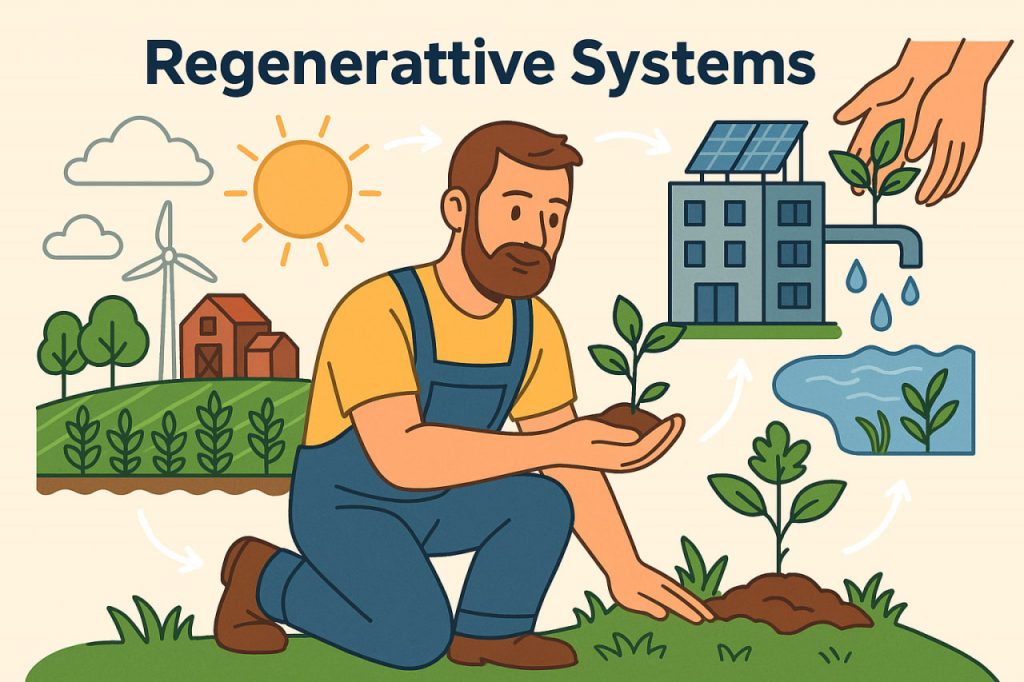
One of the most successful applications of regenerative systems is agriculture. Regenerative farming focuses on restoring soil health through practices such as crop rotation, composting, minimal tillage, agroforestry, and managed grazing. Healthy soil stores more carbon, retains water, and supports diverse microbial life. As a result, farms become more resilient to droughts, pests, and climate variability. These systems also reduce dependence on synthetic fertilizers and pesticides, lowering environmental impact while improving food quality. Many farmers worldwide are adopting regeneration as a practical response to degraded soils and changing climate conditions.
Regenerative Design in Architecture and Industry
Regenerative design aims to create buildings and products that actively improve their surroundings. Examples include green buildings that generate more energy than they consume, water systems that clean wastewater through natural processes, and materials that biodegrade or regenerate rather than pollute. Industrial systems adopt regenerative loops where waste becomes a resource, forming closed cycles similar to natural ecosystems. This approach ties closely to circular economy principles while emphasizing ecological restoration.
Regeneration in Energy and Water Systems
Regenerative systems also appear in renewable energy and water management. Renewable energy sources — such as solar, wind, and geothermal — reduce reliance on finite resources and help stabilize the climate. In regenerative water systems, natural wetlands, rain gardens, and eco-filters purify water through biological processes, restoring ecosystems while meeting human needs. These solutions reduce flood risks, improve water quality, and support wildlife habitats.
Community and Social Regeneration
Regeneration extends beyond environmental restoration — it includes strengthening communities, local economies, and cultural systems. Social regeneration focuses on education, equity, long-term well-being, and the revitalization of local resources. By empowering communities with sustainable technologies, regenerative systems create healthier environments and more resilient societies. As sustainability researcher Dr. Marcus Lee explains:
“True regeneration occurs when environmental restoration
goes hand in hand with human well-being and social resilience.”
This holistic perspective ensures that regeneration benefits both people and the planet.
Challenges and the Path Forward
Although regenerative systems offer tremendous potential, they face challenges such as limited awareness, upfront investment costs, and resistance to shifting away from established industrial models. However, as climate pressures increase and resources decline, regenerative solutions are becoming more widely recognized and adopted. Advances in technology, ecological science, and materials engineering continue to accelerate the transition toward regenerative design worldwide.
Interesting Facts
- Regenerative agriculture can store more carbon in soil than forests of the same size.
- Some regenerative buildings produce more energy and clean water than they consume.
- Mycorrhizal fungi — essential for soil regeneration — connect plant roots through vast underground networks.
- Wetlands used in regenerative water systems can remove up to 90% of pollutants naturally.
- Regenerative landscapes can increase biodiversity by 50–200%, depending on the ecosystem.
Glossary
- Regenerative Systems — solutions designed to restore and improve natural and human environments.
- Natural Capital — the world’s natural resources, including soil, water, plants, and ecosystems.
- Agroforestry — combining trees and crops to enhance soil and ecosystem health.
- Closed Loop — a system where resources circulate continuously without waste.
- Mycorrhizae — beneficial fungi that support plant growth and soil regeneration.