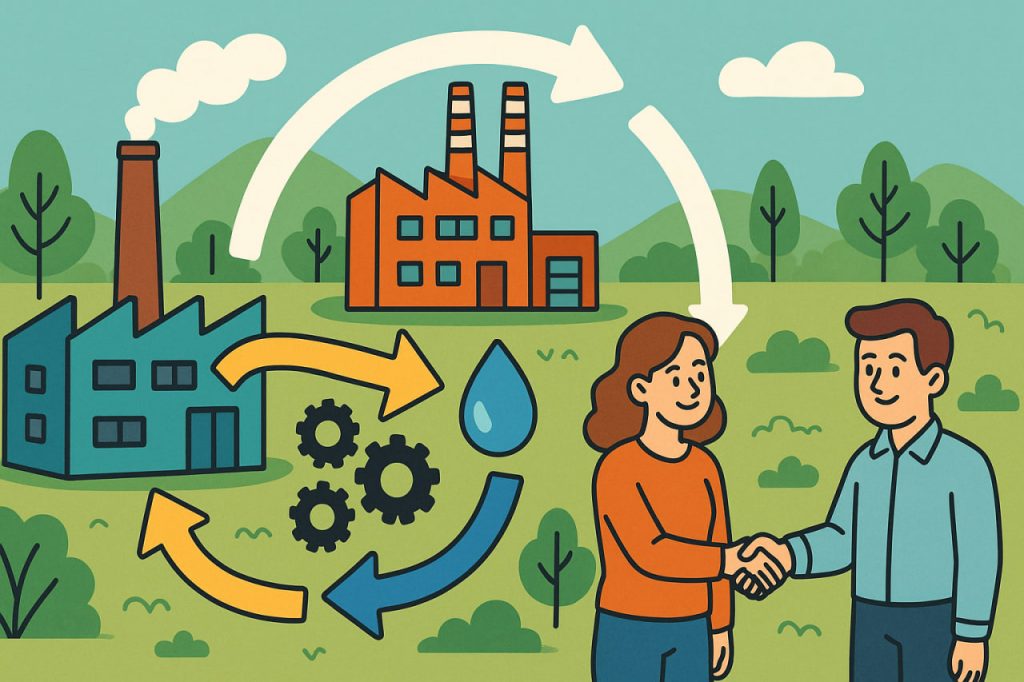
Industrial symbiosis is an innovative approach to resource management in which different companies cooperate by sharing materials, energy, water, and by-products. Instead of treating waste as something to discard, industries use it as a valuable resource for other production processes. This strategy reduces environmental impact, cuts costs, and strengthens regional economic networks. Industrial symbiosis is inspired by natural ecosystems, where nothing goes to waste — every output becomes an input for another organism. When applied to industry, this ecological model creates closed loops that improve efficiency, reduce pollution, and promote sustainable development. Understanding how industrial symbiosis works reveals its potential to transform manufacturing and support a circular economy on a global scale.
How Industrial Symbiosis Works in Practice
At its core, industrial symbiosis connects companies through the exchange of resources. For example, one factory’s heat output may serve as energy for a nearby facility, or waste materials such as wood chips, metal scraps, or packaging may become raw materials for another industry. The goal is to create networks that minimize environmental impact while maximizing efficiency. According to environmental systems expert Dr. Helena Kross:
“Industrial symbiosis thrives when companies see waste not as a burden
but as an opportunity for shared value and innovation.”
These resource exchanges reduce the need for virgin materials and decrease the volume of industrial waste entering landfills or incinerators.
Types of Exchanges in Industrial Symbiosis
Industrial symbiosis can take many forms, depending on the sector and region:
- Material exchange: reuse of by-products such as plastics, metals, ash, slag, or organic waste
- Energy exchange: sharing excess heat, steam, or electricity between facilities
- Water exchange: recycling or cascading water for cooling, cleaning, or processing
- Logistics and infrastructure sharing: joint transport systems, pipelines, storage facilities
These exchanges create a network of interconnected industries that function as a cooperative ecosystem rather than isolated entities.
Environmental and Economic Benefits
Industrial symbiosis significantly reduces environmental pressure by lowering emissions, minimizing resource extraction, and cutting down on industrial waste. It also helps companies save money on raw materials, energy, and waste disposal. Regions that adopt industrial symbiosis often become more competitive and attract sustainable business investments. The Kalundborg Symbiosis in Denmark, one of the most famous examples, reduced CO₂ emissions by hundreds of thousands of tons while saving participating companies millions of dollars annually. As sustainability researcher Dr. Marco Levin notes:
“Industrial symbiosis proves that economic growth and environmental protection
are not opposites — they can progress together when systems are designed intelligently.”
This approach strengthens both local economies and environmental resilience.
Challenges and Barriers to Implementation
Despite its many advantages, industrial symbiosis can be difficult to implement. The main challenges include:
- lack of communication between industries
- absence of shared infrastructure
- concerns over confidentiality or competition
- variation in resource quality and availability
- regulatory or logistical constraints
Establishing trust and coordination among companies is crucial. Governments and industry organizations often support symbiosis initiatives through incentives, planning frameworks, and data-sharing platforms.
Industrial Symbiosis and the Future of Sustainable Manufacturing
Industrial symbiosis plays an essential role in the global transition toward a circular economy. By closing material loops and designing smarter production chains, industries reduce waste and increase efficiency. Digital technologies — such as AI-driven resource mapping, smart sensors, and supply-chain analytics — are expanding symbiosis opportunities. As climate goals become more urgent, industrial symbiosis offers a practical and scalable method for reducing emissions and enhancing environmental stability.
Interesting Facts
- The Kalundborg Industrial Symbiosis in Denmark operates successfully for over 50 years and is a global model for sustainable industry.
- Industrial symbiosis can reduce waste by up to 30–50% in participating regions.
- Excess heat from factories can warm thousands of homes in symbiotic energy networks.
- Some symbiosis networks use industrial CO₂ emissions to grow algae or produce building materials.
- Digital platforms now map industrial by-products in real time, helping companies find resource partners.
Glossary
- Industrial Symbiosis — cooperation between industries that exchange materials, energy, water, or waste to reduce environmental impact.
- By-Product — a secondary material generated during production that can be reused.
- Resource Efficiency — using materials and energy in a way that minimizes waste.
- Circular Economy — an economic model focused on reuse, recycling, and continuous resource loops.
- Cascading Use — using the same resource multiple times in different stages before disposal.