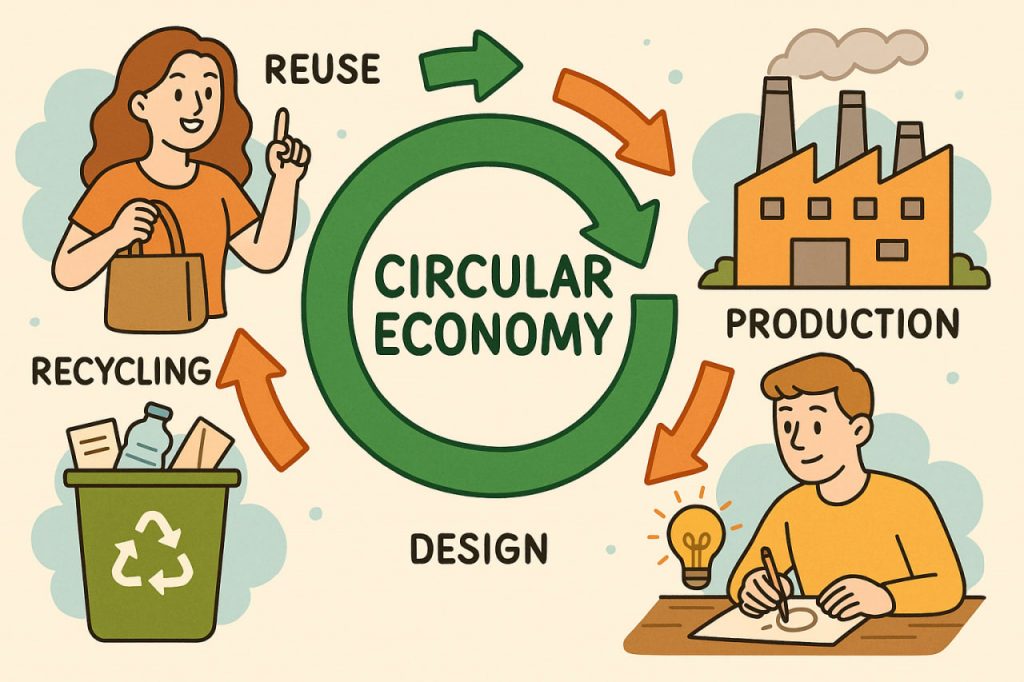
The circular economy is a modern economic model designed to reduce waste, conserve resources, and create long-lasting value by keeping materials in circulation for as long as possible. Unlike the traditional linear system — “take, make, dispose” — the circular economy aims to redesign production and consumption so that resources are reused, repaired, recycled, and regenerated. This shift responds to global challenges such as climate change, pollution, and resource scarcity. By promoting sustainable manufacturing, durable products, and closed-loop systems, the circular economy offers a pathway toward a healthier planet and a more resilient global economy. Understanding how circular principles work helps individuals, businesses, and governments adopt smarter strategies that benefit both society and the environment.
Core Principles of the Circular Economy
The circular economy is built on three foundational ideas: designing out waste, keeping materials in use, and regenerating natural systems. Products are designed to be long-lasting, repairable, and recyclable. Materials are continuously looped back into production cycles instead of being discarded. Natural ecosystems are protected and enriched by reducing pollution and supporting regenerative agriculture. According to sustainability researcher Dr. Olivia Reed:
“Circularity is not just waste management —
it is a complete redesign of how we use materials and how our economy functions.”
These principles guide innovation toward systems that eliminate waste and protect natural resources.
Extending Product Life Through Repair and Reuse
A key aspect of circularity is maximizing the lifespan of products. Repairing, refurbishing, and reusing items reduces the demand for new resources and lowers environmental impact. Clothing repair services, refurbished electronics, and secondhand markets are growing industries supported by consumer interest and environmental awareness. Designing products with replaceable parts — instead of disposable ones — helps reduce waste dramatically. This approach also strengthens local economies by creating repair-focused jobs and services.
Recycling and Material Recovery
Recycling remains an essential component of the circular economy, but it must be efficient and widely accessible. Recycling systems convert discarded materials such as glass, metal, plastic, and paper back into raw resources for manufacturing. Advances in sorting technology, chemical recycling, and material innovation improve recovery rates and allow more complex products to be recycled. However, recycling alone is not enough — it must be combined with product redesign and reduced consumption to achieve true circularity.
Industrial Symbiosis and Resource Efficiency
Circular practices extend beyond consumer goods to industrial systems. Factories and companies can share resources, energy, and by-products through industrial symbiosis, where the waste of one process becomes the input for another. This reduces emissions, saves energy, and creates more efficient supply chains. Many industrial parks are redesigning operations to minimize waste and maximize resource sharing, demonstrating how circular solutions can scale to entire sectors.
Environmental and Economic Benefits
The circular economy helps reduce pollution, conserve raw materials, and protect ecosystems. It also lowers greenhouse gas emissions by making production more efficient and reducing reliance on resource extraction. Economically, circular systems stimulate innovation, create new business models, and support local jobs in recycling, repair, and sustainable manufacturing. As economic strategist Dr. Marcus Lee explains:
“The circular economy strengthens resilience —
it protects both the environment and the stability of global resource systems.”
This dual benefit makes circularity essential for long-term global sustainability.
Challenges and the Path Forward
Despite its advantages, the transition to a circular economy requires major changes in business practices, consumer habits, and government policies. Companies must redesign products, governments must implement supportive regulations, and individuals must adopt responsible consumption patterns. Global cooperation is essential to standardize recycling systems, reduce plastic waste, and promote sustainable materials. As technology evolves and awareness grows, the circular economy continues expanding from concept to practical reality.
Interesting Facts
- Circular economy practices could reduce global waste by up to 50%.
- Only about 9% of all plastic ever produced has been recycled.
- Refurbishing electronics uses 70–90% less energy compared to producing new devices.
- Industrial symbiosis can reduce resource use by up to 30% in some sectors.
- The EU and several countries have adopted national circular economy strategies to reduce pollution and support innovation.
Glossary
- Circular Economy — an economic system focused on reuse, repair, recycling, and resource efficiency.
- Industrial Symbiosis — collaboration between industries where one company’s waste becomes another’s resource.
- Material Recovery — the process of extracting usable materials from discarded products.
- Life Cycle Design — designing products to be durable, repairable, and recyclable.
- Regenerative Systems — processes that restore natural environments rather than depleting them.