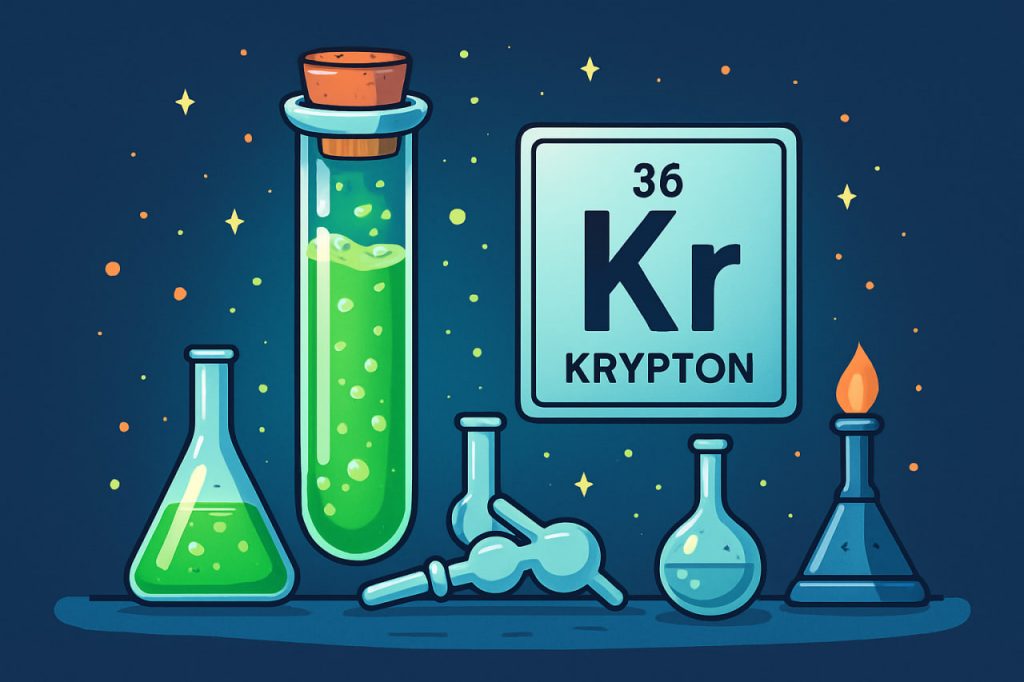
Krypton is a rare, colorless, and odorless noble gas found in Earth’s atmosphere in extremely small amounts. Although it makes up less than one-millionth of the air we breathe, krypton plays an important role in science, technology, and modern industry. As a noble gas, krypton is chemically inert — it does not react easily with other elements. This stability makes it useful in lighting, lasers, spacecraft propulsion, and various scientific instruments. Despite its exotic name, krypton is not dangerous under normal conditions and occurs naturally as part of the atmospheric gases surrounding our planet. Its unusual properties continue to make krypton a subject of interest in chemistry and physics.
Krypton was discovered in 1898 by Scottish chemists William Ramsay and Morris Travers while separating components of liquefied air. They named it “krypton,” meaning “the hidden one” in Greek, because it was difficult to isolate and detect. Today, krypton is obtained through the fractional distillation of liquid air, where it is extracted along with other noble gases such as neon, argon, and xenon. Although krypton is rare, its unique electronic structure allows it to produce brilliant white and greenish light when electrically excited, which has made it valuable in several technological applications.
Physical and Chemical Properties of Krypton
Krypton belongs to the noble gases — helium, neon, argon, krypton, xenon, and radon — which are known for their stability and low reactivity. Under standard conditions, krypton exists as a gas, but it can be cooled into a liquid or solid at extremely low temperatures. Krypton glows with a distinctive pale light when energized, making it useful in lighting technologies. According to materials scientist Dr. Helena Schwab:
“Krypton’s chemical inertness and optical properties
make it ideal for precise, high-performance applications.”
Its atomic structure also plays an important role in laser physics and spectroscopy.
How Krypton Is Used in Modern Technology
Krypton’s most well-known use has been in lighting. Krypton-filled incandescent bulbs last longer and produce brighter light compared to air-filled bulbs. The gas is also used in high-intensity discharge lamps and certain types of camera flashes, especially those requiring bright, instantaneous bursts of light. Krypton is essential in krypton-fluoride (KrF) lasers, which are used in microelectronics manufacturing, scientific research, and medical procedures.
Another important application involves spacecraft propulsion. Some ion thrusters — highly efficient engines used in long-duration space missions — use krypton as a propellant. While xenon is more common, krypton provides a lighter and more affordable alternative for electric propulsion systems used on satellites and small spacecraft.
Where Krypton Exists in Nature
Krypton does not form compounds easily due to its chemical stability, so it exists primarily as a free gas in the atmosphere. Traces of radioactive krypton also form naturally through the decay of certain minerals. Because krypton is so rare, it is not collected directly from the air in large quantities; instead, it is extracted in specialized facilities that separate atmospheric gases into pure components. These purification processes help supply the scientific, industrial, and aerospace sectors with reliable krypton sources.
Scientific Significance of Krypton
In science, krypton plays a role in defining measurement standards. For many years, a specific emission wavelength of krypton-86 was used to set the length of the meter. While this standard has since been replaced by more precise definitions, krypton remains valuable in spectroscopy, plasma research, and advanced optical systems. As physics researcher Dr. Marcus Lee notes:
“Krypton’s spectral lines are extremely sharp and stable,
making it a powerful tool for calibration and optical measurements.”
Its predictable behavior helps scientists study atomic interactions and develop high-precision instruments.
Why Krypton Still Fascinates People
Krypton’s name became widely recognized thanks to popular culture, but its real scientific importance lies in its combination of rarity, stability, and optical properties. Although krypton is not magical or dangerous, it remains a remarkable element whose behavior under electricity reveals beautiful luminous patterns. Its contributions to lasers, lighting, and spacecraft propulsion ensure krypton’s continued relevance in modern technology.
Interesting Facts
- Krypton makes up only 1 part per million of Earth’s atmosphere.
- Krypton emits a bright whitish-green glow when electrified.
- Certain lasers using krypton are powerful enough for microchip fabrication.
- Krypton was once used to define the meter through its spectral lines.
- Ion thrusters on some satellites use krypton as a space propulsion fuel.
Glossary
- Noble Gas — a chemically inert gas with very low reactivity.
- Spectral Line — a specific wavelength of light emitted or absorbed by an element.
- Ion Thruster — a propulsion system that accelerates ions for spacecraft movement.
- Plasma — an energized state of matter consisting of charged particles.
- Emission Glow — light produced when atoms release energy after excitation.