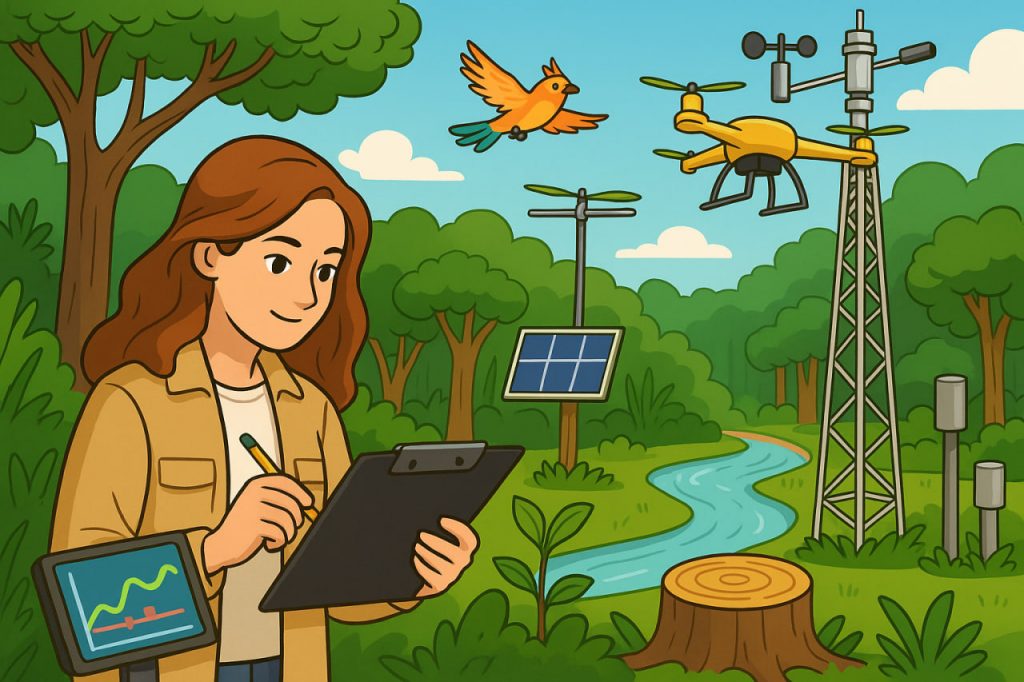
The Amazon rainforest is often called the “lungs of the planet” because it plays a critical role in absorbing carbon dioxide and regulating Earth’s climate. To understand how this immense ecosystem responds to climate change, deforestation, and human activity, scientists create carbon monitoring plots — specially designated research zones where carbon fluxes, vegetation growth, soil composition, and atmospheric conditions are measured with high precision. These carbon polygons, or carbon observation plots, provide essential data on how much carbon the forest stores, how quickly it absorbs greenhouse gases, and how environmental stresses affect these processes over time. Such monitoring is crucial for predicting global climate trends and protecting the rainforest.
Carbon polygons in the Amazon allow researchers to study the dynamic relationship between trees, soil microbes, moisture levels, and seasonal changes. They include sensors, towers, drones, ground measurements, and satellite coordination to build a comprehensive picture of carbon flow. Because the Amazon is extremely diverse — spanning wetlands, dense forests, dry regions, and floodplains — each carbon plot reveals unique insights into how different types of ecosystems contribute to the global carbon cycle. These findings help scientists understand how robust or vulnerable the rainforest is to rising temperatures, forest fires, and land-use changes.
How Carbon Monitoring Plots Work
Carbon polygons combine advanced technology and on-site measurements. Researchers install tall towers equipped with instruments that track carbon dioxide movement in the air. Soil samples help estimate carbon stored underground, while drones and satellites map vegetation density and canopy health. According to climate scientist Dr. Helena Vargas:
“Carbon plots act like stethoscopes for the rainforest —
they let us hear how the forest breathes.”
These continuous measurements allow scientists to observe daily, seasonal, and long-term changes in carbon dynamics.
What Scientists Measure in the Amazon
Each carbon polygon focuses on several key parameters:
- Carbon flux — the exchange of CO₂ between trees, soil, and the atmosphere
- Biomass — total mass of plant material, especially tree trunks and canopy
- Soil carbon — how much carbon is stored underground
- Tree growth and mortality — indicators of forest health
- Temperature and humidity — influencing photosynthesis
- Rainfall and flooding cycles — highly variable in the Amazon
These metrics help determine whether a region of Amazonia acts as a carbon sink (absorbing CO₂) or a carbon source (releasing CO₂).
Why Carbon Polygons Matter
The Amazon has recently shown signs of stress: prolonged droughts, stronger wildfires, and increased tree mortality. Some regions are shifting from sinks to sources of carbon — a concerning trend. Carbon polygons help scientists track these changes in real time. Their data informs environmental policy, conservation planning, and international climate agreements. Reliable carbon measurements are essential to evaluating reforestation efforts, biodiversity programs, and carbon-credit projects.
As environmental researcher Dr. Marcus Levin notes:
“We cannot protect the Amazon without understanding
how its carbon balance is changing.”
Carbon polygons reveal how deforestation, fire, and climate change are reshaping the rainforest’s ability to regulate global climate.
Technologies Used in Carbon Monitoring
Modern carbon plots use a combination of:
- Eddy covariance towers — measure vertical gas exchange
- Lidar scanning — maps forest structure
- Drones and satellites — track canopy, moisture, and vegetation health
- Automated soil sensors — measure respiration and carbon storage
- AI algorithms — analyze millions of data points
These tools allow scientists to produce highly accurate models of forest productivity.
Global Importance of Amazonian Carbon Plots
The Amazon holds up to 10% of all carbon stored in global ecosystems. Small changes in Amazonian carbon flux can significantly influence worldwide atmospheric conditions. Carbon polygons help predict how the forest will behave in future climate scenarios and identify regions most at risk. They also play a key role in international climate finance, where accurate carbon accounting is necessary for fair and effective environmental agreements.
Interesting Facts
- Some Amazonian trees grow over 50 meters tall, storing enormous amounts of carbon.
- A single carbon plot can generate terabytes of climate data each year.
- Certain Amazon regions now emit more CO₂ than they absorb due to fires and droughts.
- Lidar can map forest canopy structure with centimeter-level precision.
- The Amazon absorbs roughly 5% of global CO₂ emissions under stable conditions.
Glossary
- Carbon Sink — an ecosystem that absorbs more CO₂ than it releases.
- Carbon Source — an ecosystem that emits more CO₂ than it absorbs.
- Eddy Covariance Tower — a tall instrument tower that measures carbon exchange in real time.
- Biomass — the total mass of living plant material.
- Lidar — laser-based scanning used to map vegetation and terrain.