Great animal migrations are among the most awe-inspiring natural phenomena on Earth, involving the seasonal movement of millions of animals across vast distances. These journeys are not random wanderings, but precisely timed responses to changes in climate, food availability, and reproductive cycles. From land to sea and sky, migrations connect ecosystems and redistribute energy and nutrients across the planet. Many species depend on migration for survival, despite the immense risks involved. Understanding these movements reveals how deeply life is synchronized with Earth’s natural rhythms. The great migrations demonstrate the resilience, memory, and navigational abilities of animals shaped by evolution.
Why Animals Migrate
Migration is primarily driven by the need to access resources and suitable conditions. As seasons change, food, water, and breeding grounds shift geographically, forcing animals to move to survive. Migration allows species to exploit environments that are temporarily rich while avoiding harsh conditions elsewhere. These journeys are often triggered by subtle environmental cues such as daylight length, temperature, and rainfall patterns. According to zoologist Dr. Helen Morris:
“Migration is not an instinctive gamble,
but a finely tuned survival strategy refined over thousands of generations.”
This strategy maximizes survival and reproductive success despite high energy costs.
Iconic Land Migrations
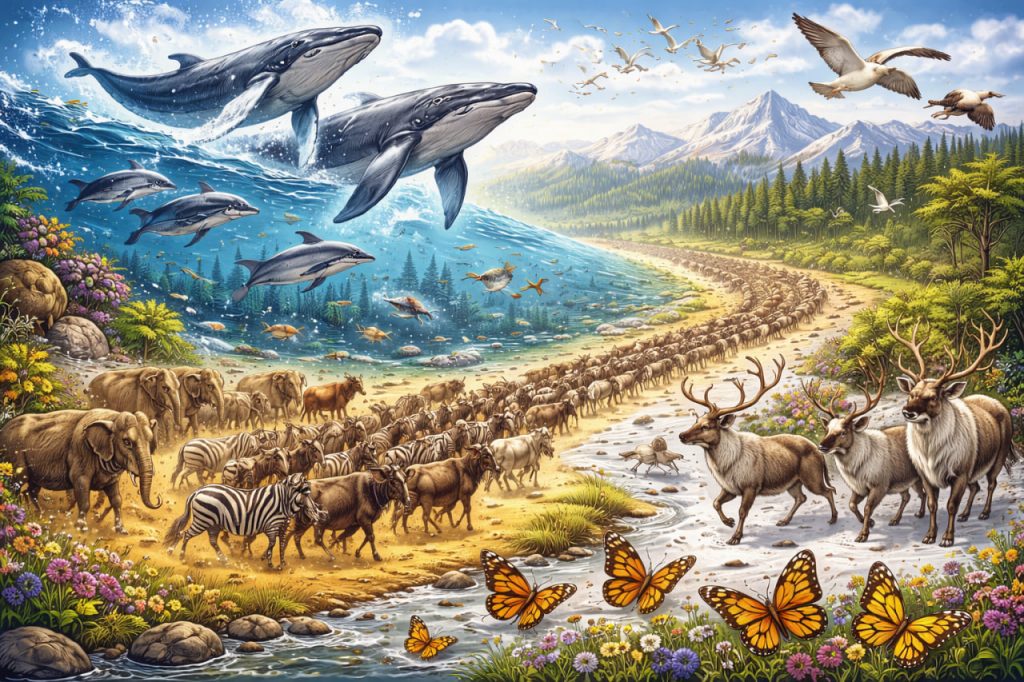
Some of the most famous migrations occur on land, involving massive herds moving in synchronized patterns. The African wildebeest migration sees over a million animals travel across the Serengeti in search of fresh grass and water. Caribou migrate across Arctic tundra, covering thousands of kilometers between seasonal ranges. These movements shape landscapes by grazing vegetation, dispersing seeds, and fertilizing soil. Predators follow these migrations closely, creating dynamic and interconnected ecosystems driven by movement.
Oceanic Journeys Across the Seas
Marine migrations are often even more extreme in scale and duration. Whales travel thousands of kilometers between feeding and breeding grounds, navigating vast oceans with remarkable precision. Sea turtles return to the very beaches where they were born to lay eggs decades later. Fish such as salmon migrate from oceans to freshwater rivers to reproduce, transporting marine nutrients inland. These journeys link oceanic and terrestrial ecosystems, playing a crucial role in nutrient cycling and biodiversity.
Aerial Migrations and Navigation
Bird migrations represent some of the longest and most complex journeys in the animal kingdom. Species like the Arctic tern migrate from the Arctic to Antarctica and back each year, experiencing more daylight than any other animal on Earth. Birds rely on a combination of magnetic fields, stars, the sun, and landscape features to navigate with astonishing accuracy. Insects such as monarch butterflies also perform multi-generational migrations guided by environmental signals. These aerial migrations demonstrate advanced biological navigation systems still not fully understood by science.
Threats to Great Migrations
Despite their resilience, great migrations are increasingly threatened by human activity. Habitat fragmentation, climate change, pollution, and artificial barriers disrupt traditional routes. Changes in climate alter the timing of resource availability, causing mismatches between migration schedules and environmental conditions. Scientists warn that disrupting migrations can destabilize entire ecosystems. Protecting migration corridors and understanding animal movement patterns are essential for conservation and ecological balance.
Interesting Facts
- The Arctic tern travels over 70,000 kilometers each year during migration.
- Wildebeest migrations involve one of the largest land animal movements on Earth.
- Some whales migrate without eating for months.
- Monarch butterflies complete migrations across multiple generations.
- Migrating animals help move nutrients across continents and oceans.
Glossary
- Migration — regular, seasonal movement of animals between regions.
- Navigation — the ability to determine direction and location during movement.
- Migration Corridor — a route regularly used by migrating animals.
- Breeding Grounds — areas where animals reproduce.
- Ecosystem Connectivity — the linking of habitats through animal movement.