Across the natural world, many animals act as skilled architects, building structures that rival human engineering in complexity, efficiency, and durability. These constructions are not random shelters; they are carefully designed solutions to challenges such as climate control, protection, reproduction, and resource management. From intricate underground tunnels to towering mounds and woven nests, animal-built structures actively reshape landscapes and ecosystems. Scientists increasingly recognize these species as ecosystem engineers, organisms whose behavior alters the physical environment in lasting ways. Understanding animal architects reveals how intelligence, instinct, and evolution combine to produce remarkable natural designs. These structures demonstrate that architecture is not uniquely human, but a widespread biological strategy.
Why Animals Build Complex Structures
Animals build structures to survive and reproduce in challenging environments. Shelters regulate temperature, protect against predators, store food, and provide safe spaces for offspring. Over evolutionary time, natural selection refined building behaviors to maximize efficiency while minimizing energy costs. Many species rely on inherited behavioral patterns, while others adjust designs based on local conditions. According to behavioral ecologist Dr. Laura Simmons:
“Animal construction is a form of problem-solving shaped by evolution,
where design success is measured in survival.”
These building strategies often outperform human designs in sustainability and resource efficiency.
Master Builders of the Natural World
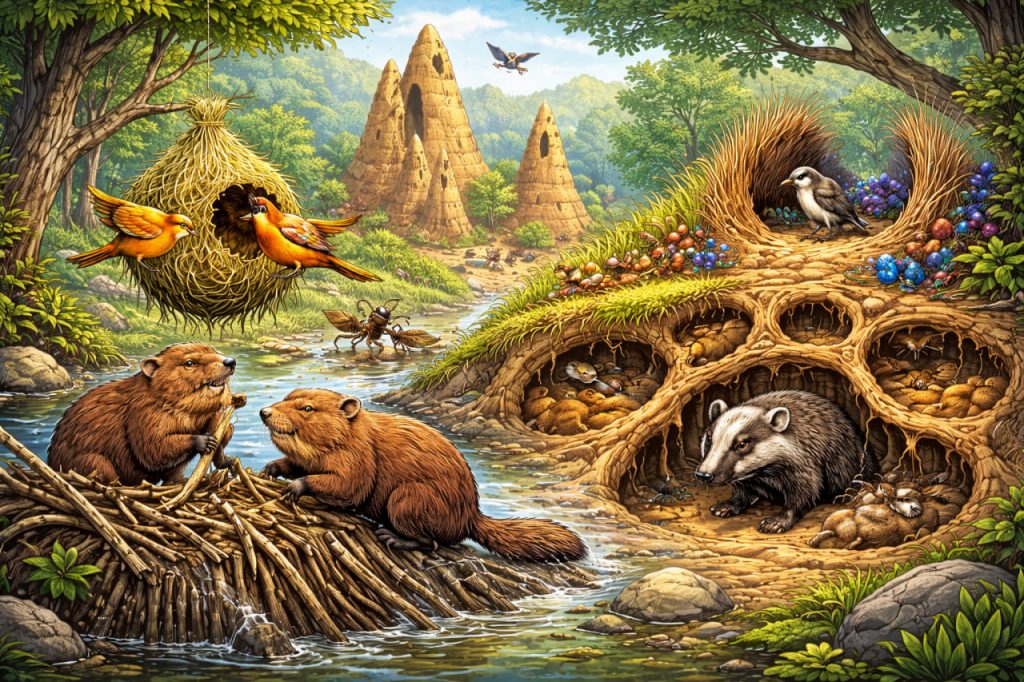
Some animals are especially famous for their architectural skills. Beavers construct dams that redirect rivers, creating wetlands that support countless species. Termites build towering mounds with natural ventilation systems that regulate temperature and humidity. Birds, such as weaverbirds and bowerbirds, create complex nests and display structures using precise patterns and material selection. Ants design vast underground cities with specialized chambers for food, larvae, and waste. Each of these constructions reflects deep biological adaptation and collective coordination.
Engineering Without Blueprints
Unlike humans, animals do not use written plans or drawings, yet their structures follow consistent and effective designs. Construction is guided by simple rules, feedback, and environmental cues. Small individual actions combine into complex collective results, a process known as self-organization. In social insects, no single individual controls the project, yet the final structure functions as an integrated system. This decentralized building process has inspired research in robotics, architecture, and swarm intelligence.
Impact on Ecosystems
Animal-built structures often have effects far beyond their original purpose. Beaver dams slow water flow, reduce erosion, and increase biodiversity. Coral reefs created by tiny animals form massive barriers that protect coastlines. Burrowing animals aerate soil, improve water infiltration, and influence plant growth. These architectural interventions can persist for decades or centuries, shaping entire ecosystems. Scientists study animal architects to understand how biological activity modifies landscapes over long timescales.
Lessons for Human Design
Animal architecture offers valuable lessons for sustainable and adaptive design. Natural structures often use local materials, require minimal energy, and adapt dynamically to environmental changes. Engineers and architects study termite mounds for passive cooling systems and bird nests for lightweight construction techniques. These bio-inspired approaches aim to reduce environmental impact while improving efficiency. Animal architects remind us that effective design does not require advanced tools—only deep integration with the environment.
Interesting Facts
- Beaver dams can be seen from satellite imagery due to their landscape-scale impact.
- Termite mounds maintain stable internal temperatures despite extreme outdoor heat.
- Some birds choose nest materials based on color, flexibility, and insulation.
- Coral reefs built by tiny animals are among the largest biological structures on Earth.
- Animal-built environments can persist long after the builders are gone.
Glossary
- Ecosystem Engineer — an organism that significantly modifies its environment.
- Self-Organization — complex structure formation through simple individual actions.
- Passive Ventilation — natural airflow used to regulate temperature without energy input.
- Burrowing — digging behavior that alters soil structure and chemistry.
- Bio-Inspired Design — human technology influenced by biological systems.