Animal coloration is one of the most visible and fascinating results of evolution. From bold stripes to complex spotted patterns, nature uses color not for decoration, but for survival. Zebras and giraffes are among the most iconic examples of patterned animals, and their appearance has puzzled scientists for centuries. At first glance, such contrasting colors seem to make animals more noticeable, yet in the wild these patterns serve multiple critical functions. Modern research shows that coloration influences protection, communication, temperature regulation, and even resistance to parasites. Understanding why zebras have stripes and giraffes have spots reveals how deeply form and function are connected in the natural world.
Camouflage and Visual Disruption
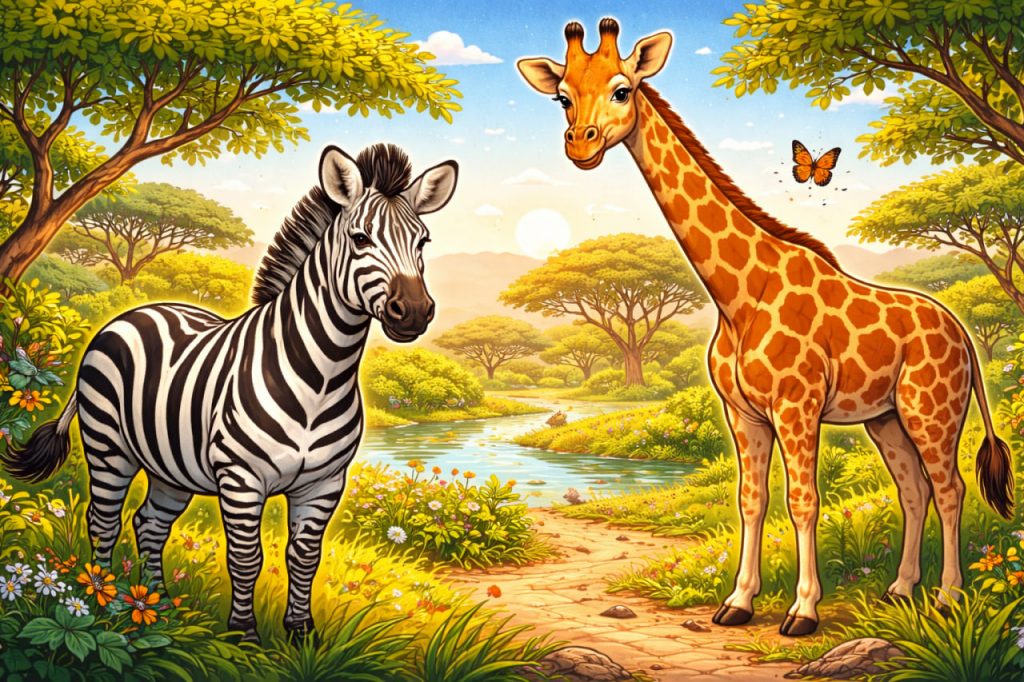
One of the primary functions of animal coloration is camouflage, but not all camouflage involves blending in completely. Zebra stripes create a visual effect known as disruptive coloration, which breaks up the animal’s outline. When zebras move together in a herd, their stripes overlap visually, making it difficult for predators to isolate a single individual. This confusion effect is especially effective against predators that rely on motion and contrast, such as lions. Wildlife biologist Dr. Karen Holt explains:
“Stripes do not hide zebras by making them invisible.
They hide them by making recognition difficult.”
Giraffe spots work differently. Their irregular patches closely resemble patterns of light and shadow found in trees and savannas, allowing giraffes to blend into their environment when standing still.
Temperature Regulation and Heat Control
Coloration also plays a role in thermoregulation, particularly in large mammals living in hot climates. Studies suggest that zebra stripes may help regulate body temperature by creating small air currents near the skin. Black stripes absorb heat, while white stripes reflect it, generating subtle temperature differences that promote cooling. Giraffe spots are darker in areas with higher blood vessel density, which may help release excess heat through the skin. This natural temperature control system is especially important in African environments where overheating poses a serious risk.
Protection Against Insects and Parasites
One of the most intriguing discoveries about zebra stripes relates to biting insects. Research shows that flies, including tsetse flies and horseflies, are less likely to land on striped surfaces. The contrasting black-and-white pattern interferes with the insects’ visual systems, reducing successful landings. This provides zebras with a significant advantage by lowering the risk of disease transmission. While giraffe spots do not repel insects in the same way, their thick skin and tail-swishing behavior help manage parasites. Scientists increasingly recognize insect deterrence as a major evolutionary driver behind zebra striping.
Individual Identification and Social Communication
Patterns also serve as tools for individual recognition within species. Each zebra has a unique stripe pattern, and each giraffe has a distinct arrangement of spots, much like fingerprints in humans. Mothers use these patterns to identify their offspring, and herd members recognize one another visually. Coloration may also signal health and genetic quality, subtly influencing mating choices. In social species, visual identity strengthens group cohesion and reduces conflict.
Evolutionary Adaptation and Environmental Context
The differences between stripes and spots highlight how evolution adapts coloration to specific ecological needs. Zebras evolved in open grasslands where group movement and insect pressure shaped their appearance. Giraffes evolved in wooded savannas, where height, shadowed environments, and solitary feeding favored spotted camouflage. These patterns are not random but finely tuned responses to predators, climate, and habitat. Evolution continues to refine these traits over generations, reinforcing the idea that coloration is a dynamic survival tool rather than a static feature.
Interesting Facts
- No two zebras have identical stripe patterns.
- Giraffe spots help calves blend into the savanna within hours of birth.
- Zebra stripes reduce fly landings by up to 70% in some studies.
- Predators detect motion more easily than color, making stripes highly effective in herds.
- Animal coloration often serves multiple functions simultaneously, not just camouflage.
Glossary
- Camouflage — coloration that helps animals avoid detection by predators or prey.
- Disruptive Coloration — patterns that break up an animal’s outline, confusing observers.
- Thermoregulation — the process of maintaining stable body temperature.
- Parasite Deterrence — adaptations that reduce attacks from insects or parasites.
- Evolutionary Adaptation — traits shaped by natural selection to improve survival and reproduction.