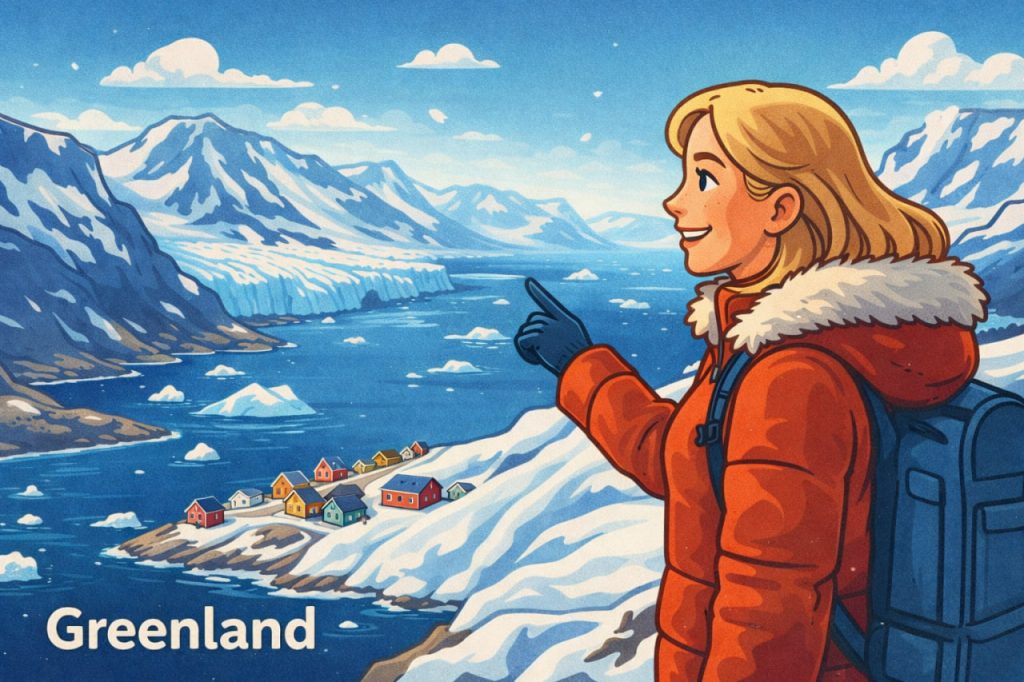
Greenland is the largest island on Earth and one of the most important regions for understanding how our planet’s climate system works. Covered mostly by a massive ice sheet, Greenland plays a critical role in regulating global sea levels, ocean circulation, and Arctic ecosystems. Although often perceived as a remote and frozen land, Greenland is a dynamic environment where geological forces, ocean currents, and atmospheric processes constantly interact. In recent decades, scientists have focused increasing attention on Greenland because changes occurring here reflect broader trends in global warming. What happens on this island does not stay in the Arctic—it influences coastlines, weather patterns, and ecosystems far beyond the polar region. Understanding Greenland means understanding a key component of Earth’s climate balance.
Geography and Natural Features
Greenland’s landscape is shaped by extreme contrasts, from vast ice-covered interiors to rugged coastlines carved by fjords and glaciers. Approximately 80% of the island is covered by the Greenland Ice Sheet, which reaches thicknesses of more than three kilometers in some areas. Along the coast, deep fjords cut into ancient bedrock, providing access for ocean water far inland. These fjords are crucial pathways through which warm ocean currents interact with glaciers, accelerating ice loss in certain regions. Beneath the ice, Greenland hides a complex geology that includes mountains, sediment basins, and areas of elevated geothermal heat. This hidden landscape influences how ice flows and melts, making Greenland far more dynamic than its frozen appearance suggests.
The Greenland Ice Sheet and Climate Change
The Greenland Ice Sheet is one of the largest freshwater reservoirs on the planet and a major contributor to global sea-level rise. As air and ocean temperatures increase, the ice sheet loses mass through surface melting, glacial flow, and melting from below where warm ocean water reaches glacier bases. Climate scientist Dr. Eleanor Brooks explains:
“Greenland acts like a climate amplifier.
Small temperature changes can trigger disproportionately large ice losses.”
When meltwater reaches the base of the ice sheet, it reduces friction and allows glaciers to slide faster toward the ocean. This process accelerates ice discharge and increases the rate at which sea levels rise worldwide. Scientists closely monitor Greenland because its response to warming provides early warnings about the future of other ice-covered regions.
Oceans, Currents, and Ice–Water Interaction
Greenland’s surrounding seas play a crucial role in shaping its climate and ice dynamics. Warm Atlantic water flows northward along the island’s western and southeastern coasts, penetrating deep fjords and melting glaciers from below. At the same time, cold Arctic waters influence sea ice formation and seasonal temperature patterns. These interacting currents affect not only Greenland’s glaciers but also the global ocean circulation system, including the Atlantic Meridional Overturning Circulation. Disruptions in this system could influence weather patterns across Europe and North America. Researchers use autonomous underwater vehicles and satellite data to study these processes, revealing how closely connected Greenland is to the rest of the planet.
Ecosystems and Life in Greenland
Despite its harsh climate, Greenland supports diverse ecosystems both on land and in surrounding waters. Coastal areas host seabirds, seals, whales, and fish species adapted to cold, nutrient-rich waters. On land, mosses, lichens, and hardy shrubs form the foundation of Arctic ecosystems, supporting species such as Arctic foxes and reindeer. Indigenous communities have lived in Greenland for thousands of years, developing deep knowledge of the land, ice, and sea. However, climate change is rapidly altering these ecosystems, affecting migration patterns, food availability, and traditional ways of life. Scientists and local communities work together to monitor environmental changes and adapt to new conditions.
Greenland’s Global Importance
Greenland is far more than a remote Arctic island; it is a critical indicator of planetary change. Ice loss from Greenland contributes directly to rising sea levels that threaten coastal cities and island nations. Changes in freshwater input from melting ice can alter ocean salinity and circulation, with global consequences. In addition, Greenland’s ice sheet preserves valuable records of past climates within its layers, allowing scientists to study Earth’s environmental history stretching back hundreds of thousands of years. Protecting and understanding Greenland is therefore essential for predicting future climate scenarios and preparing societies for the changes ahead.
Interesting Facts
- Greenland is the largest island on Earth, but it is not considered a continent.
- If the Greenland Ice Sheet melted completely, global sea levels would rise by over 7 meters.
- Some Greenlandic fjords extend hundreds of kilometers inland and reach extreme depths.
- Ice cores drilled in Greenland contain climate records dating back more than 100,000 years.
- Despite its name, Greenland was largely ice-covered even during early human settlement.
Glossary
- Greenland Ice Sheet — a massive body of ice covering most of Greenland and storing vast amounts of freshwater.
- Fjord — a deep, narrow coastal inlet formed by glacial erosion and flooded by seawater.
- Glacial Flow — the movement of ice toward the ocean driven by gravity and internal deformation.
- Ocean Circulation — large-scale movement of seawater that redistributes heat and influences climate.
- Ice Core — a cylindrical sample of ice drilled from glaciers or ice sheets to study past climates.