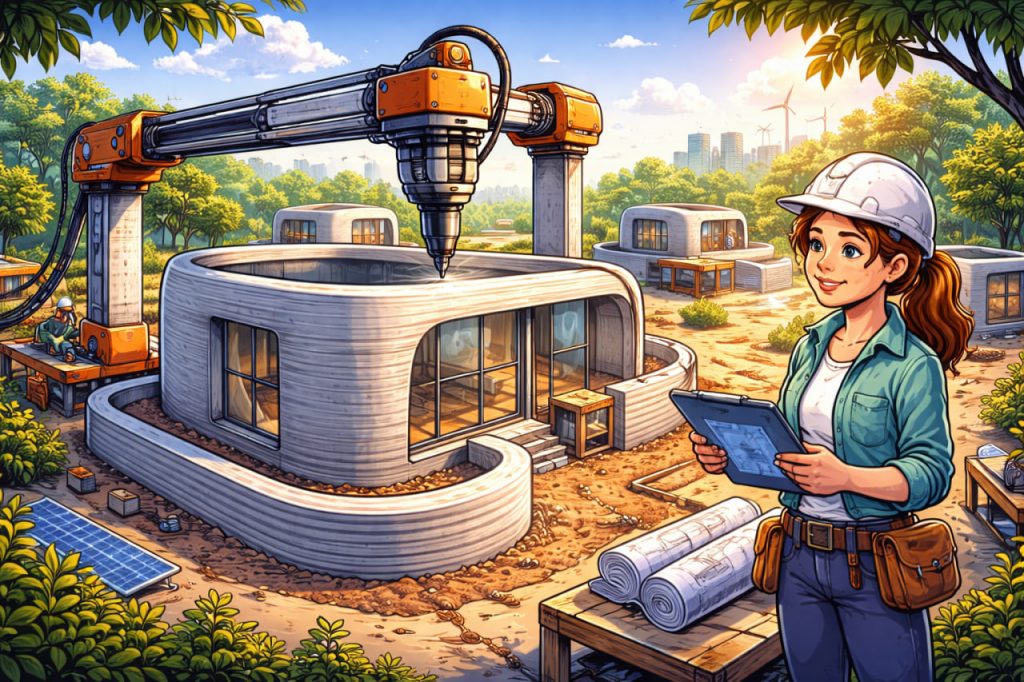
Printed houses are buildings created using 3D construction printing, a technology that deposits material layer by layer according to a digital model. Instead of traditional bricks or blocks, large-scale printers extrude concrete-like mixtures to form walls and structural elements. This approach is transforming how homes can be designed, built, and delivered. What once seemed experimental is now being used in real housing projects around the world. Printed houses promise faster construction, lower costs, and greater design flexibility. Understanding this technology helps explain why it is considered one of the most disruptive innovations in modern construction.
How 3D-Printed Houses Are Built
The construction process begins with a digital architectural model that defines every layer of the structure. A robotic printer then follows this model, extruding building material with high precision. Walls are printed directly on-site or in controlled factory environments, depending on the project. Once the printed structure is complete, traditional components such as windows, roofs, wiring, and plumbing are added. This hybrid approach combines automation with conventional building methods. The result is a solid structure created in a fraction of the time required for traditional construction.
Materials Used in Printed Construction
Most printed houses use specially formulated cement-based mixtures designed to set quickly while maintaining strength. Some projects experiment with clay, recycled materials, or locally sourced components to reduce environmental impact. Material research is a key part of advancing this technology, as durability and safety are critical. Engineers carefully test printed structures to meet building standards and structural requirements. The ability to adjust material composition also allows printed homes to be adapted to different climates and conditions. This flexibility is one of the technology’s strongest advantages.
Benefits of Printed Houses
Printed construction offers several significant benefits. Speed is one of the most notable, with some houses printed in days rather than months. Reduced labor requirements lower costs and improve worker safety by minimizing dangerous on-site tasks. Material efficiency results in less waste compared to traditional construction. The technology also enables customized designs without significant additional expense. These advantages make printed houses especially attractive for affordable housing and emergency shelters.
Sustainability and Environmental Impact
3D-printed houses have the potential to reduce the environmental footprint of construction. Precise material placement minimizes waste, while alternative materials can lower carbon emissions. Printing locally reduces transportation needs and associated pollution. Some designs incorporate energy-efficient shapes that improve insulation and reduce energy use. While challenges remain, printed construction aligns well with sustainable building goals. Environmental researchers see it as a promising step toward more resource-efficient cities.
Challenges and Future Development
Despite its promise, printed housing still faces obstacles. Building regulations, long-term durability, and public acceptance vary widely by region. Large-scale printers require significant initial investment, and skilled operators are essential. Architects and engineers continue to refine designs to improve structural performance and aesthetics. According to construction technology expert Dr. Andrew Collins:
“3D printing will not replace traditional construction overnight,
but it will redefine what is possible in housing design and delivery.”
As technology advances, printed houses are expected to become more common and diverse.
Interesting Facts
- Some printed houses can be built in less than a week.
- 3D printing reduces construction waste by up to 60% in certain projects.
- Printed homes can be customized without major cost increases.
- The technology is being explored for disaster relief housing.
- Future concepts include printing buildings on the Moon and Mars.
Glossary
- 3D Construction Printing — a building method that creates structures layer by layer using automated printers.
- Additive Manufacturing — a process of creating objects by adding material rather than removing it.
- Cement-Based Mixture — specially formulated material used in printed construction.
- Digital Model — a computer-based design that guides the printing process.
- Sustainable Construction — building practices that minimize environmental impact.