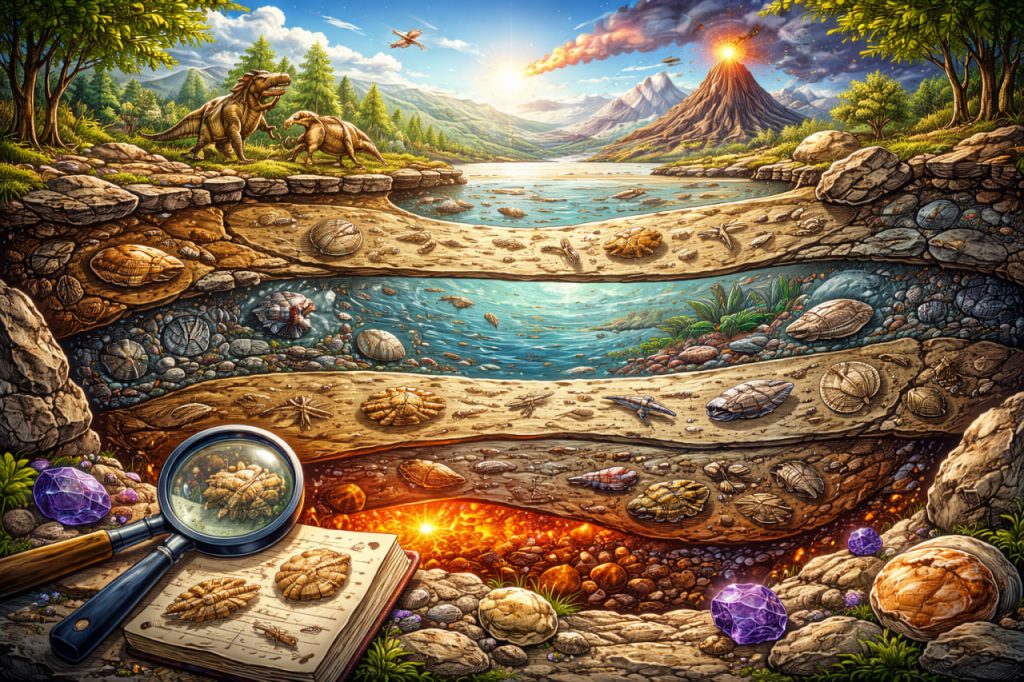
Long before humans learned to write, the Earth had already recorded its own story—layer by layer, crystal by crystal, fossil by fossil. Rocks are not just inert matter beneath our feet; they are archives of planetary memory, preserving evidence of ancient oceans, vanished continents, mass extinctions, and the slow reshaping of the planet. By studying stone, geologists can reconstruct events that occurred billions of years ago, far beyond the reach of written history. Each mineral composition, fracture, and sediment layer tells part of a continuous narrative of change. Understanding Earth’s history through rock allows us to see our planet not as static, but as a dynamic system constantly evolving over immense spans of time.
The Oldest Stones and the Birth of the Planet
The earliest chapters of Earth’s history are preserved in some of the planet’s oldest rocks, dating back more than 4 billion years. These ancient formations reveal how Earth cooled from a molten state, formed a solid crust, and began to separate into core, mantle, and surface layers. Zircon crystals, some of the oldest known minerals, provide clues about early temperatures and the presence of liquid water surprisingly soon after the planet’s formation. These minerals act as microscopic time capsules, locking in chemical signatures from Earth’s infancy. According to geologist Dr. Hannah Lewis:
“Zircons are witnesses to a world that no longer exists.
They tell us Earth was becoming habitable far earlier than once believed.”
Such discoveries reshape our understanding of how quickly planets can stabilize.
Sedimentary Layers as Pages of Time
Sedimentary rocks form when particles settle over time, creating visible layers that act like pages in a geological book. Each layer reflects environmental conditions at the moment it was deposited—whether a shallow sea, desert, river delta, or deep ocean floor. By analyzing grain size, composition, and fossil content, scientists can infer ancient climates and sea levels. These layers also record dramatic events such as volcanic eruptions, asteroid impacts, and sudden climate shifts. The famous boundary marking the extinction of the dinosaurs is preserved as a thin, unusual layer rich in rare elements. Sedimentary rocks thus provide a continuous and readable timeline of Earth’s surface history.
Fossils: Life Preserved in Stone
Fossils represent one of the most direct links between stone and life’s history. When organisms are rapidly buried by sediment, their remains—or traces of their activity—can become preserved as rock hardens around them. Fossils document the gradual evolution of life, from simple single-celled organisms to complex plants and animals. They also reveal periods of rapid diversification and catastrophic mass extinctions. Importantly, fossils show that life has repeatedly adapted to changing conditions, surviving dramatic shifts in climate and geography. This deep-time perspective helps scientists understand both the resilience and vulnerability of life on Earth.
Metamorphic and Igneous Records of Change
Not all rocks form quietly at the surface. Igneous rocks record moments when molten material rose from deep within the planet, cooling to form new crust. Their chemical composition reveals information about Earth’s interior and tectonic activity. Metamorphic rocks, on the other hand, tell stories of intense pressure and heat, often linked to mountain building and continental collisions. These rocks preserve evidence of forces acting deep below the surface, invisible but powerful. Together, igneous and metamorphic rocks complete the geological record by documenting processes that shape Earth from the inside out.
Why Stone History Matters Today
Reading Earth’s history in stone is not only about the past—it also informs the future. Geological records help scientists understand natural climate cycles, the frequency of extreme events, and the long-term behavior of Earth systems. This knowledge is essential for predicting volcanic hazards, earthquakes, and long-term environmental change. By placing modern human activity within the context of billions of years of planetary evolution, geology offers perspective on both the scale of our impact and the limits of Earth’s resilience. Stone reminds us that while civilizations rise and fall quickly, the planet’s story unfolds on a far grander timeline.
Interesting Facts
- The oldest known rocks on Earth are over 4 billion years old.
- Some rock layers represent millions of years of deposition compressed into a few centimeters.
- Fossils have been found of organisms that lived before oxygen was abundant in the atmosphere.
- Certain minerals can only form under extreme pressure, revealing deep-crust processes.
- Meteorite fragments embedded in rock layers help date major impact events.
Glossary
- Geological Time Scale — a system used to divide Earth’s history into distinct intervals.
- Sedimentary Rock — rock formed from accumulated particles deposited over time.
- Igneous Rock — rock formed from cooled molten material.
- Metamorphic Rock — rock transformed by heat and pressure without melting.
- Fossil — preserved remains or traces of ancient life within rock.