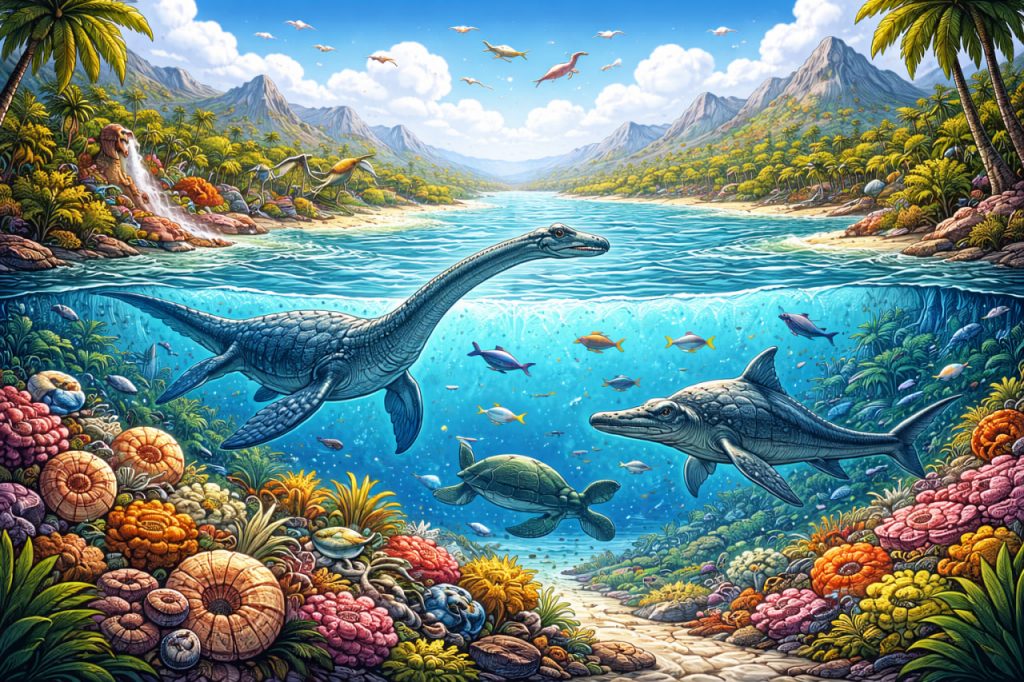
Tethys was a vast ancient ocean that once separated major landmasses and played a crucial role in shaping the modern geography of Earth. Existing for hundreds of millions of years, it occupied the space between the northern supercontinent Laurasia and the southern supercontinent Gondwana. Although Tethys no longer exists as a single ocean, its legacy is preserved in mountain ranges, seas, and geological structures across Europe, Asia, and parts of Africa. By studying Tethys, geologists reconstruct how continents moved, collided, and transformed the planet’s surface. The story of Tethys is a story of plate tectonics on a planetary scale.
What Was the Tethys Ocean
The Tethys Ocean formed during the early stages of continental breakup, when Earth’s landmasses were arranged very differently from today. It was not a static body of water, but a dynamic ocean that expanded, shifted, and gradually disappeared as tectonic plates moved. Over time, pieces of Tethys were consumed by subduction, where oceanic crust sank beneath continental plates. What remains today are fragments such as the Mediterranean Sea, Black Sea, Caspian Sea, and parts of the Indian Ocean. According to geologist Dr. Martin Keller:
“Tethys was not lost —
it was folded into the continents we live on today.”
This perspective highlights how oceans can vanish without truly disappearing.
Tectonic Movements and Continental Collisions
The gradual closure of the Tethys Ocean was driven by the northward movement of Gondwana-derived landmasses, including India and Arabia. As these plates collided with Eurasia, the oceanic crust between them was compressed and destroyed. This process gave rise to some of the world’s most prominent mountain systems, including the Alps, Himalayas, and Zagros Mountains. These ranges contain marine sediments and fossils, clear evidence that they were once part of an ancient seafloor. The disappearance of Tethys demonstrates how oceans and mountains are interconnected through tectonic processes.
Life in the Tethys Ocean
Tethys was rich in marine life and supported extensive ecosystems over vast periods of geological time. Warm, shallow waters along its margins created ideal conditions for reefs, shell-forming organisms, and early marine reptiles. Fossils of ammonites, corals, and other sea creatures are commonly found in regions once covered by Tethys. These fossils help scientists track environmental changes, sea-level fluctuations, and evolutionary trends. The biodiversity of Tethys contributed significantly to the development of modern marine life.
Geological Evidence Preserved Today
Although the ocean itself is gone, its geological fingerprints remain widespread. Sedimentary rocks, ophiolites (sections of ancient oceanic crust), and marine fossils embedded in mountains all point to the former presence of Tethys. Geologists use these clues to reconstruct ancient coastlines and ocean depths. Advances in plate reconstruction models and satellite data have made it possible to visualize how Tethys opened and closed over time. These reconstructions are essential for understanding Earth’s long-term climate and tectonic evolution.
Why Tethys Matters for Earth Science
The history of the Tethys Ocean provides a clear example of how plate tectonics continuously reshapes the planet. It explains why marine fossils can be found at high altitudes and why certain regions are prone to earthquakes and mountain building. Studying Tethys also helps scientists understand past climate systems, as ancient oceans played a major role in heat distribution around the planet. In this way, Tethys remains relevant not only as a geological concept, but as a key chapter in Earth’s ongoing story.
Interesting Facts
- The Tethys Ocean existed for over 300 million years.
- Parts of the modern Mediterranean Sea are remnants of Tethys.
- Marine fossils found in the Himalayas originated in Tethys waters.
- The closure of Tethys helped form several major mountain ranges.
- Tethys influenced global ocean circulation and ancient climates.
Glossary
- Tethys Ocean — an ancient ocean that once separated major supercontinents.
- Plate Tectonics — the movement of Earth’s lithospheric plates over time.
- Subduction — the process by which one tectonic plate sinks beneath another.
- Ophiolite — a fragment of ancient oceanic crust found on land.
- Supercontinent — a massive landmass composed of most or all continental plates.