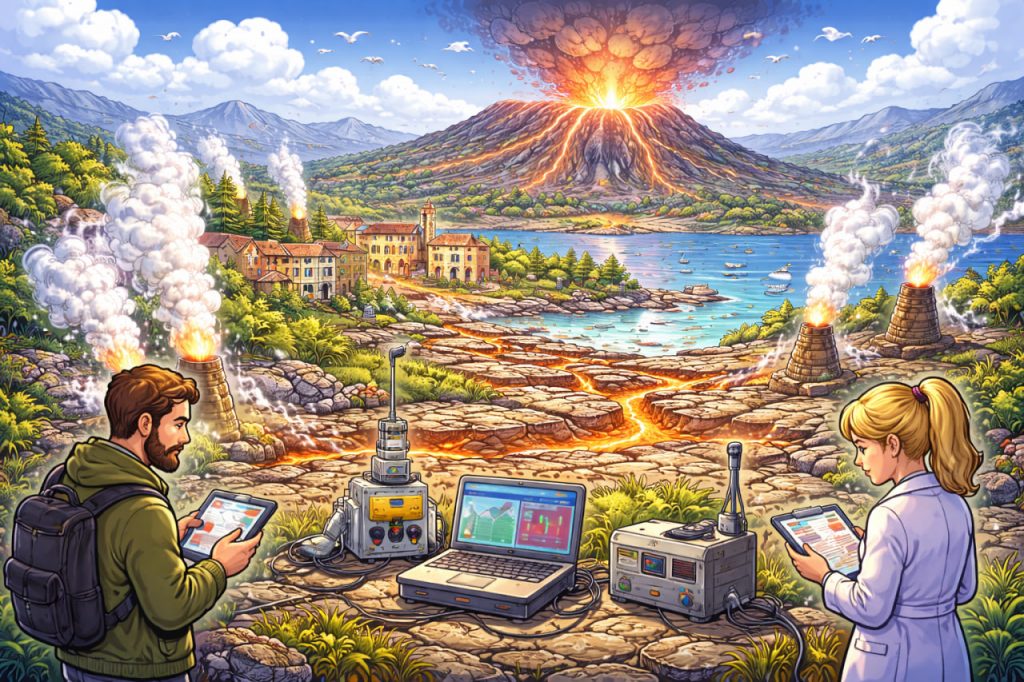
Campi Flegrei is one of the most complex and closely monitored volcanic systems in the world, located near the city of Naples in southern Italy. Unlike a single volcanic cone, it is a vast caldera—a large depression formed by ancient eruptions—containing numerous vents, fumaroles, and geothermal fields. For centuries, Campi Flegrei has alternated between long periods of relative calm and phases of renewed unrest. In recent years, scientists have observed a clear increase in activity, drawing renewed attention to the caldera’s behavior and potential risks. Understanding what this rising activity means requires careful interpretation of geological signals rather than alarmist conclusions.
What Makes Campi Flegrei Unique
Campi Flegrei is fundamentally different from typical volcanoes. Its eruptions are rare but can be extremely powerful, reshaping entire regions. The caldera spans more than 12 kilometers and includes both land and underwater volcanic features. Much of its activity is expressed not through eruptions, but through ground deformation, gas emissions, and seismic unrest. According to volcanologist Dr. Francesca Bianco:
“Campi Flegrei does not speak loudly all the time,
but when it does, the signals must be taken seriously.”
This subtle but persistent behavior makes the caldera especially challenging to interpret.
Bradyseism: Slow Ground Movement
One of the defining features of Campi Flegrei is bradyseism, a phenomenon involving slow uplift and subsidence of the ground. Over the past decades, the caldera floor has risen and fallen by several meters in some areas. In recent years, measurements show a renewed acceleration of uplift, particularly around the town of Pozzuoli. This movement is caused by pressure changes within the hydrothermal and magmatic systems beneath the caldera. While uplift alone does not mean an eruption is imminent, it signals that the underground system is becoming more pressurized.
Increasing Seismic Activity
Alongside ground uplift, Campi Flegrei has experienced a noticeable increase in low-magnitude earthquakes. These seismic swarms are generally shallow and related to fracturing of rocks as fluids and gases move underground. Most of these earthquakes are too weak to cause damage, but their growing frequency is scientifically significant. Seismologists analyze not only how many earthquakes occur, but also their depth, energy, and spatial distribution. Changes in these patterns help researchers understand how stress is evolving within the caldera.
Gas Emissions and Heat Flow
Another important indicator of unrest is the change in gas composition and emission rates, especially carbon dioxide and sulfur-rich gases released through fumaroles. In areas such as Solfatara, scientists have recorded increasing gas flux and higher temperatures. These changes suggest enhanced interaction between deep magmatic heat sources and shallow hydrothermal systems. According to geochemist Dr. Luca De Siena:
“Gas chemistry is one of the clearest windows
into what is happening beneath Campi Flegrei.”
Monitoring these emissions is crucial for distinguishing between hydrothermal unrest and deeper magmatic processes.
What the Recent Activity Does—and Does Not—Mean
Despite the clear increase in activity, scientists emphasize that rising unrest does not automatically indicate an imminent eruption but chances of it rising every year. Campi Flegrei has experienced similar phases in the past without erupting. However, the current level of monitoring is far more advanced, allowing researchers to detect subtle changes earlier than ever before. The primary concern is not panic, but preparedness and understanding. The caldera’s behavior reinforces the need for continuous observation, clear communication with the public, and realistic risk assessment.
P.S. I believe that everyone who is in the potential red zone around the volcano should be relocated to safer areas right now, because when the eruption begins, those who are in the epicenter may not have time to do anything…
Interesting Facts
- Campi Flegrei last erupted in 1538, forming Monte Nuovo.
- The caldera contains over 20 volcanic centers.
- Ground uplift in some areas has exceeded 3 meters since the 20th century.
- Most recent earthquakes are very shallow, often less than 3 km deep.
- The caldera extends partially under the sea, complicating monitoring.
Glossary
- Caldera — a large volcanic depression formed after massive eruptions.
- Bradyseism — slow vertical movement of the Earth’s surface.
- Fumarole — an opening that emits volcanic gases and steam.
- Seismic Swarm — a cluster of small earthquakes occurring close in time and space.
- Hydrothermal System — circulation of heated fluids beneath the surface.