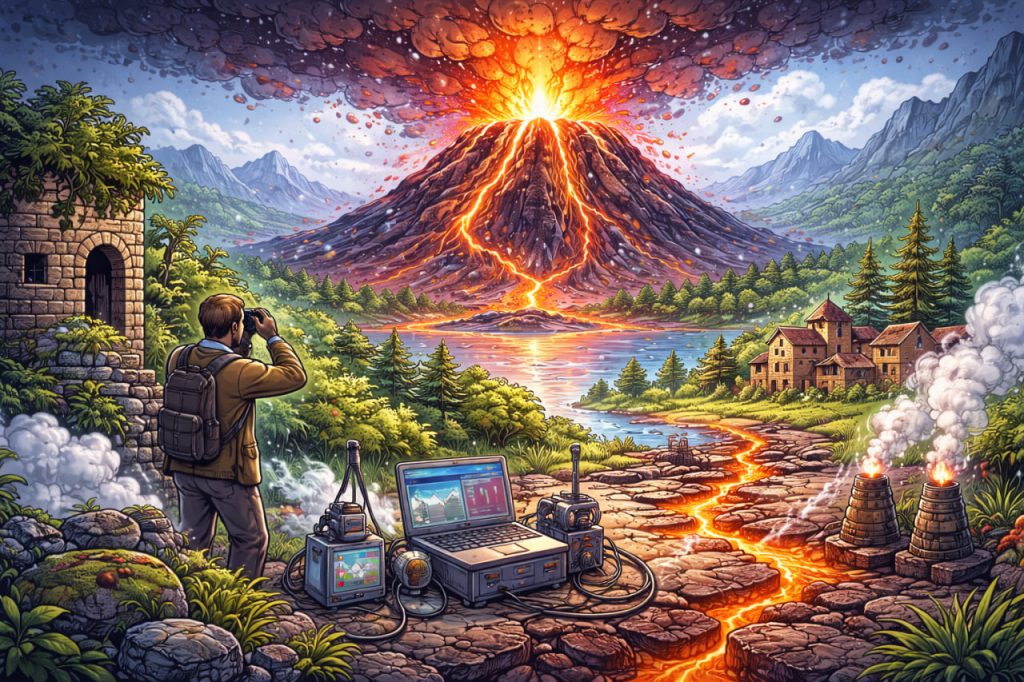
For a long time, volcanoes were classified into simple categories: active, dormant, or extinct. An extinct volcano was assumed to be permanently inactive, its magma supply cut off and its geological story finished. However, modern geology has revealed that this assumption is not always correct. Some volcanoes believed to be extinct have unexpectedly shown signs of renewed activity after thousands or even millions of years. These surprising cases have led scientists to use an informal but striking term: “zombie volcanoes.” Studying them challenges long-held ideas about volcanic life cycles and forces researchers to rethink how Earth’s interior behaves over geological time.
What Is a Zombie Volcano
A zombie volcano is not a scientific classification, but a descriptive term used when a volcano previously considered extinct shows renewed magmatic or seismic activity. This activity may include magma intrusion, gas emissions, ground deformation, or even small eruptions. What makes these volcanoes unusual is the long period of apparent inactivity before signs of revival appear. In many cases, there were no historical records or recent geological indicators suggesting that activity could return. According to volcanologist Dr. Martin Alvarez:
“Zombie volcanoes remind us that ‘extinct’ often means ‘quiet for a very long time,’
not ‘dead forever.’”
This distinction has important implications for hazard assessment.
Why Volcanoes Can Reactivate
Volcanoes are connected to deep and complex magma systems that can evolve slowly over time. Even if surface activity stops, magma may continue to accumulate at depth or new pathways may open due to tectonic stress. Changes in crustal pressure, fault movement, or mantle heat flow can reactivate these systems. In some regions, magma reservoirs migrate laterally or vertically, feeding old volcanic structures long after they were assumed inactive. This means that a volcano’s apparent silence does not always reflect what is happening deep underground.
Examples of Zombie Volcano Behavior
Several volcanoes around the world have surprised scientists by showing unexpected signs of activity. In some cases, seismic swarms and ground uplift have occurred beneath volcanoes with no known eruptions in recorded history. Elsewhere, new lava domes or gas emissions have appeared in regions thought to be volcanically inactive. These events are rare, but they demonstrate that volcanic systems can operate on timescales far longer than human observation. Each case provides valuable data for improving volcanic monitoring techniques.
Why Zombie Volcanoes Matter
Zombie volcanoes pose a unique challenge because communities near them may not consider volcanic hazards in their planning. Infrastructure, cities, and tourism often develop around long-quiet volcanic landscapes. When unexpected activity occurs, warning systems and emergency plans may be unprepared. From a scientific perspective, these volcanoes help refine models of magma storage, crustal dynamics, and long-term volcanic evolution. They also highlight the importance of continuous monitoring, even in regions considered low-risk.
Rethinking the Concept of “Extinct”
The idea of an extinct volcano is increasingly viewed as a probability statement, not an absolute one. While many volcanoes are unlikely to erupt again, geology rarely deals in certainties. Earth’s internal processes operate over millions of years, far exceeding human timelines. Zombie volcanoes serve as a reminder that planetary systems are dynamic and that long periods of quiet do not guarantee permanent stability.
Interesting Facts
- Some volcanoes have reactivated after being quiet for hundreds of thousands of years.
- Most zombie volcanoes show warning signs long before any eruption.
- Ground uplift of just a few centimeters can signal magma movement.
- Many “extinct” classifications were made before modern monitoring existed.
- Zombie volcanoes are rare but scientifically extremely valuable.
Glossary
- Zombie Volcano — an informally named volcano that shows renewed activity after being considered extinct.
- Magma Intrusion — movement of molten rock into the Earth’s crust without eruption.
- Seismic Swarm — a cluster of small earthquakes indicating underground movement.
- Ground Deformation — surface changes caused by pressure from below.
- Volcanic Hazard — potential risk associated with volcanic activity.