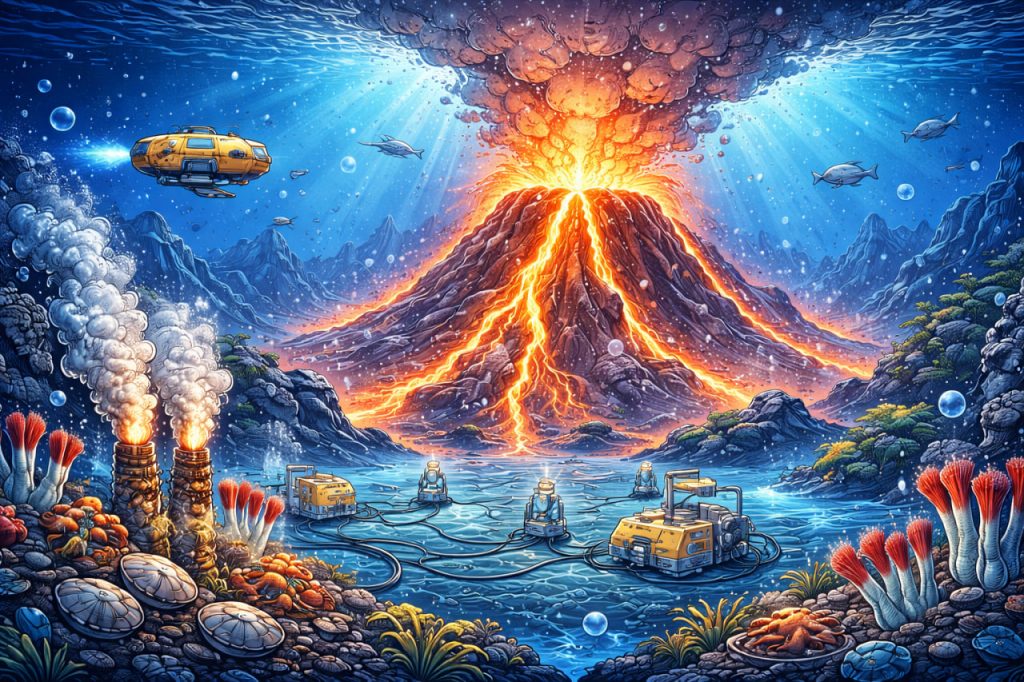
Axial Seamount is one of the most studied and active underwater volcanoes on Earth, hidden beneath the surface of the Pacific Ocean. Located along the Juan de Fuca Ridge, it rises more than a kilometer above the seafloor yet remains invisible from the surface. Unlike explosive land volcanoes, Axial Seamount erupts quietly, releasing lava flows and reshaping the ocean floor without dramatic ash clouds or earthquakes felt on land. Its accessibility to modern instruments has turned it into a natural laboratory for studying how volcanoes work beneath the ocean. Understanding Axial Seamount helps scientists better predict volcanic activity and learn how Earth releases internal heat.
Where Axial Seamount Is Located
Axial Seamount lies about 480 kilometers off the coast of Oregon, directly on a mid-ocean ridge where tectonic plates slowly move apart. This location is crucial because magma can rise easily through the thinning crust. The volcano sits at a geological crossroads where mantle material, tectonic motion, and seawater interact continuously. Its summit caldera is roughly 8 kilometers wide, with cracks and lava flows spreading outward along the ridge. According to marine geologist Dr. Robert Embley:
“Axial Seamount is the best place on Earth
to observe an underwater volcano in action.”
Its position makes it far more active than most submarine volcanoes.
How Underwater Eruptions Work
Unlike volcanoes on land, Axial Seamount erupts under immense water pressure, which suppresses explosive behavior. Lava emerges as pillow lavas, bulbous formations created when molten rock cools rapidly in seawater. These eruptions can last days or weeks, gradually adding new layers to the seafloor. Although earthquakes often precede eruptions, they are usually small and localized. The process is slow but persistent, making underwater volcanism one of the primary ways Earth creates new oceanic crust.
Monitoring the Volcano in Real Time
Axial Seamount is unique because it is continuously monitored by a network of seafloor sensors, pressure gauges, and seismic instruments. These tools allow scientists to track magma movement, ground inflation, and earthquake patterns in real time. Researchers have discovered that the volcano swells measurably as magma accumulates beneath it, then deflates after eruptions. This behavior makes Axial Seamount one of the few volcanoes whose eruptions can be predicted with reasonable accuracy. Such monitoring represents a major step forward in volcanology.
Life Around Axial Seamount
Despite its harsh environment, Axial Seamount supports rich ecosystems powered not by sunlight, but by hydrothermal vents. These vents release mineral-rich fluids that nourish bacteria, which form the base of unique food webs. Tube worms, crabs, and other specialized organisms thrive in these conditions. Studying these ecosystems helps scientists understand how life can exist in extreme environments and offers clues about how life might exist on other worlds with subsurface oceans.
Why Axial Seamount Matters
Axial Seamount plays a key role in understanding how Earth releases internal heat and builds new crust. It also helps scientists refine models for volcanic forecasting, even for land-based volcanoes. Because underwater volcanoes are far more common than land volcanoes, studying Axial Seamount provides insights into the dominant volcanic processes shaping the planet. Its combination of accessibility, activity, and advanced monitoring makes it one of the most important volcanic sites on Earth.
Interesting Facts
- Axial Seamount has erupted multiple times since the 1990s.
- It is located directly on a mid-ocean ridge, not near a continent.
- The volcano can inflate by several centimeters before an eruption.
- Most of Earth’s volcanic activity happens underwater, not on land.
- Axial Seamount is monitored continuously by seafloor observatories.
Glossary
- Seamount — an underwater mountain formed by volcanic activity.
- Mid-Ocean Ridge — a tectonic boundary where new oceanic crust forms.
- Pillow Lava — rounded lava formations created underwater.
- Hydrothermal Vent — an opening that releases heated, mineral-rich water.
- Caldera — a large volcanic depression formed after magma withdrawal.