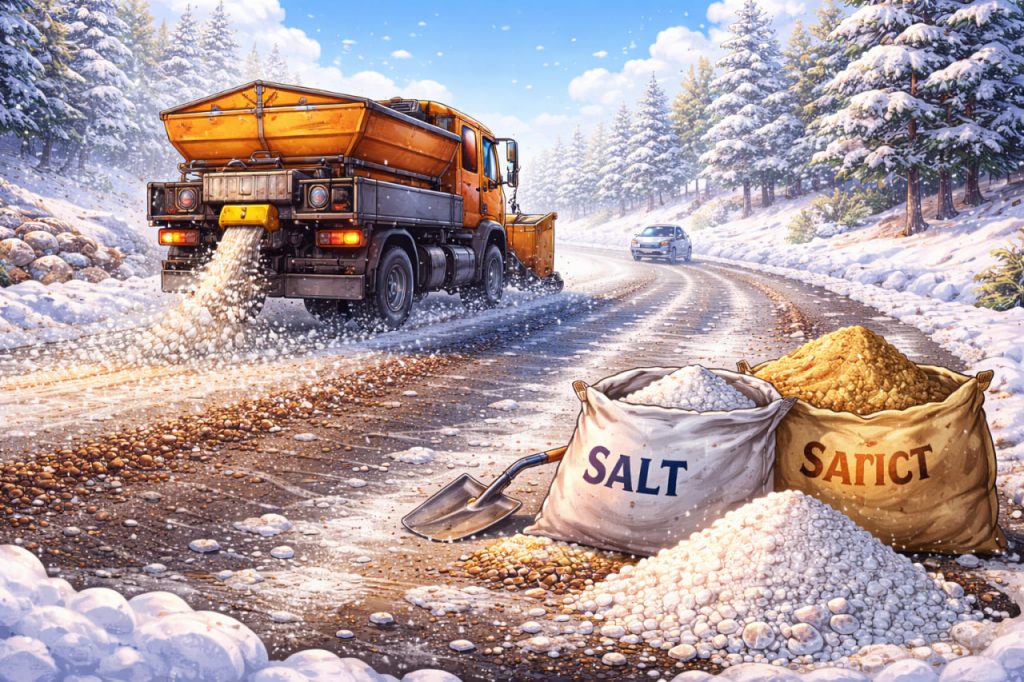
In winter conditions, icy roads become one of the most serious hazards for both drivers and pedestrians. To reduce accidents and maintain mobility, road services commonly spread salt, sand, or a combination of both on icy surfaces. Although this practice is widespread and familiar, the reasons behind it are often misunderstood. Salt and sand work in very different ways, and each is used to solve a specific physical problem caused by ice. Understanding how and why they work explains why these materials remain central to winter road safety.
How Salt Melts Ice
Salt is used primarily because it lowers the freezing point of water. When salt comes into contact with ice, it dissolves in the thin layer of liquid water always present on the surface, forming a salt solution. This solution freezes at a lower temperature than pure water, causing the ice to melt even when air temperatures are below 0°C. The process is most effective at moderately cold temperatures and becomes less efficient in extreme cold. According to materials scientist Dr. Paul Reynolds:
“Salt doesn’t heat the ice —
it changes the rules under which water freezes.”
This chemical effect makes salt especially useful for preventing ice formation before it fully develops.
Why Sand Does Not Melt Ice
Unlike salt, sand does not melt ice. Instead, it improves safety by increasing friction between tires or shoes and the icy surface. Sand particles create a rough texture, allowing better grip and reducing slipping. This makes sand particularly useful in very low temperatures where salt is ineffective. Because it works mechanically rather than chemically, sand provides immediate traction but does not remove ice itself.
Why Salt and Sand Are Often Combined
Many regions use a mixture of salt and sand to balance effectiveness and safety. Salt helps break down ice and prevent refreezing, while sand provides traction during and after melting. This combination is especially valuable during fluctuating temperatures, when melting and refreezing cycles are common. Using both materials allows road services to adapt to changing weather conditions and maintain safer surfaces over longer periods.
Environmental and Practical Considerations
Despite their effectiveness, salt and sand have drawbacks. Excessive salt use can damage vehicles, concrete, and roadside vegetation, and it may affect soil and water systems. Sand, while environmentally less reactive, can clog drainage systems and create dust once roads dry. For these reasons, many municipalities carefully regulate application rates and explore alternative materials. The goal is to balance road safety with long-term environmental impact.
Why These Methods Are Still Used
Despite newer technologies and alternative de-icing agents, salt and sand remain widely used because they are reliable, affordable, and well understood. Their behavior under winter conditions has been studied for decades, allowing predictable results when applied correctly. While no solution is perfect, salt and sand continue to be among the most effective tools for managing icy roads and reducing winter-related accidents.
Interesting Facts
- Salt can melt ice even below 0°C, but not in extreme cold.
- Sand improves traction without changing ice chemistry.
- Roads are often treated before snow falls to prevent ice bonding.
- Overuse of salt can accelerate corrosion of vehicles and bridges.
- Different regions adjust mixtures based on local climate.
Glossary
- Freezing Point Depression — lowering the temperature at which water freezes.
- Traction — grip between a surface and tires or footwear.
- De-Icing — removal or prevention of ice formation.
- Refreezing — melted water turning back into ice.
- Friction — resistance between two surfaces in contact.