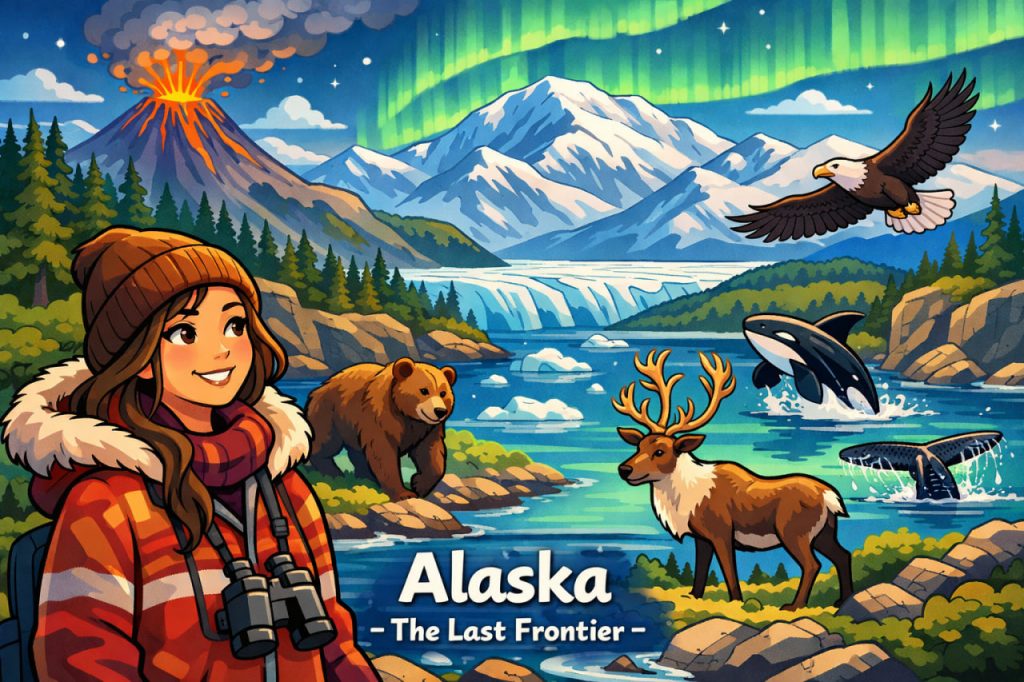
Alaska is one of the most extraordinary regions on Earth, known for its vast landscapes, extreme climates, and powerful natural forces. Covering an area larger than many countries, it represents a rare place where glaciers, volcanoes, tundra, and dense forests coexist almost untouched by large-scale human development. Alaska plays a crucial role in global climate systems, Arctic ecosystems, and biodiversity, while also holding deep cultural and historical significance. Despite its remoteness, changes occurring in Alaska often serve as early indicators of global environmental shifts. Scientists, explorers, and indigenous communities have long observed how this land responds to warming temperatures, tectonic activity, and oceanic change. Understanding Alaska means understanding how nature behaves when it is given space, time, and extreme conditions.
Geography and Natural Extremes
Alaska’s geography is defined by scale and contrast, ranging from icy Arctic coastlines to temperate rainforests and towering mountain ranges. It is home to Denali, the highest peak in North America, as well as thousands of glaciers that store massive amounts of freshwater. The state contains more coastline than the rest of the United States combined, shaping powerful interactions between land, ocean, and atmosphere. Volcanic activity is also a defining feature, with dozens of active volcanoes forming part of the Pacific Ring of Fire. According to geologist Dr. Marcus Hale:
“Alaska compresses almost every major Earth process into one region —
tectonics, glaciation, volcanism, and climate interaction operate side by side.”
These natural extremes make Alaska a living laboratory for Earth sciences.
Climate, Ice, and Rapid Change
Alaska is warming two to four times faster than the global average, making it one of the most climate-sensitive regions on the planet. Rising temperatures accelerate glacier retreat, thaw permafrost, and destabilize coastlines. As frozen ground melts, it releases greenhouse gases and undermines infrastructure built on once-solid terrain. Coastal erosion threatens entire villages, forcing difficult decisions about relocation. Climate scientist Dr. Elaine Foster explains:
“What happens in Alaska does not stay in Alaska.
The Arctic acts as a feedback engine that influences global weather patterns.”
These changes highlight why Alaska is central to understanding future climate scenarios.
Wildlife and Ecosystems
Alaska supports some of the most intact ecosystems remaining in the Northern Hemisphere. Its lands and waters are home to brown bears, wolves, caribou, moose, whales, and millions of migratory birds. Seasonal cycles govern life here, with long, dark winters and intense summers shaping animal behavior and plant growth. Marine ecosystems along Alaska’s coast are among the most productive on Earth, sustained by cold, nutrient-rich waters. However, warming oceans and shifting ice conditions are altering migration routes and food availability. Scientists closely monitor these ecosystems because even subtle changes can ripple through entire food webs.
Indigenous Peoples and Cultural Heritage
For thousands of years, Alaska has been home to diverse Indigenous peoples, including Inupiat, Yupik, Aleut, Tlingit, Haida, and Athabaskan communities. Their cultures, languages, and knowledge systems are deeply connected to the land and sea. Traditional ecological knowledge provides insights into long-term environmental patterns that modern science is only beginning to quantify. Indigenous communities often observe environmental changes first, as their livelihoods depend directly on stable ecosystems. Preserving this cultural heritage is essential not only for social justice, but also for advancing climate and environmental research.
Alaska’s Global Importance
Beyond its borders, Alaska influences sea level rise, atmospheric circulation, and ocean currents. Melting glaciers contribute directly to rising seas, while changes in Arctic ice affect weather far beyond the polar regions. Alaska also plays a strategic scientific role, hosting observatories, research stations, and long-term monitoring projects. As the planet warms, data from Alaska helps refine climate models and improve global predictions. Protecting its ecosystems while responsibly managing resources remains one of the great challenges of the 21st century.
Interesting Facts
- Alaska contains over 100,000 glaciers, more than the rest of the United States combined.
- Some areas experience 24 hours of daylight in summer and near-total darkness in winter.
- Alaska has more active volcanoes than any other U.S. state.
- The state is so large that it spans four time zones geographically.
- Permafrost underlies nearly 85% of Alaska’s land surface.
Glossary
- Permafrost — ground that remains frozen for at least two consecutive years.
- Tundra — a cold, treeless biome with low-growing vegetation and frozen subsoil.
- Glacier — a large, slow-moving mass of ice formed from compacted snow.
- Ring of Fire — a region of intense tectonic and volcanic activity surrounding the Pacific Ocean.
- Arctic Amplification — the phenomenon where polar regions warm faster than the global average.