The northern lights and light pillars are two of the most striking atmospheric optical phenomena, often observed in cold, high-latitude regions. Although they may sometimes appear together in winter skies, they arise from completely different physical processes. Auroras originate far above Earth, driven by interactions between the Sun and the planet’s magnetic field, while light pillars form much closer to the ground through the reflection of light by ice crystals. Both phenomena demonstrate how invisible physical forces—charged particles, magnetic fields, and crystal geometry—can produce vivid visual displays. Understanding their mechanisms reveals the complex relationship between space weather and Earth’s atmosphere. Despite their beauty, these lights are not illusions but precise outcomes of well-understood physics.
The Physics Behind the Northern Lights
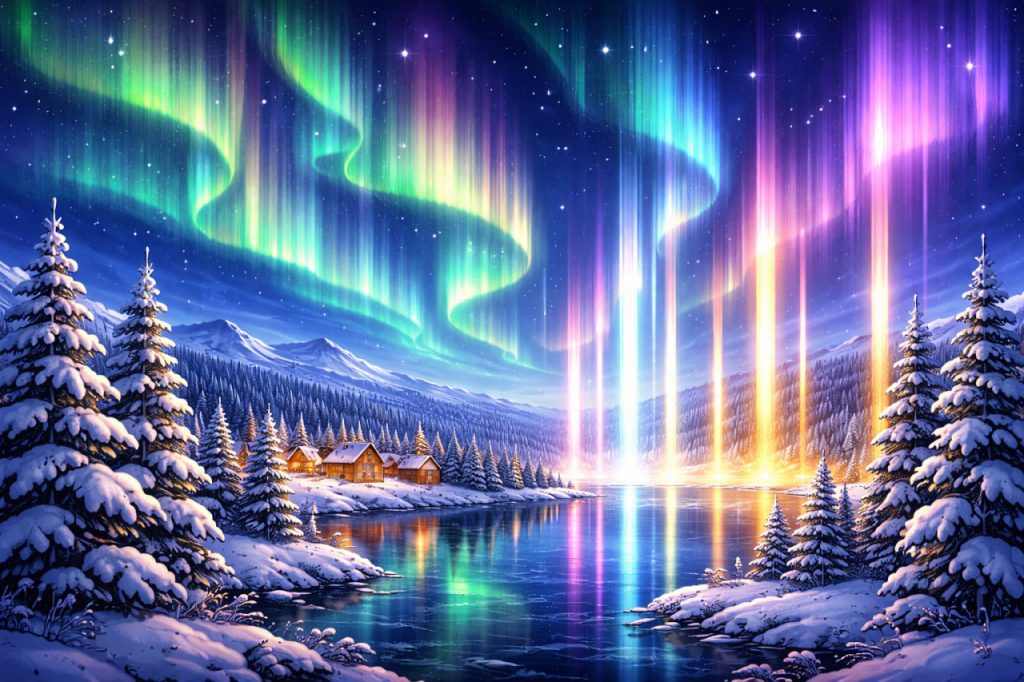
Auroras occur when charged particles from the solar wind enter Earth’s magnetosphere and are guided toward the polar regions. As these particles collide with atoms and molecules in the upper atmosphere, they transfer energy that is released as light. Different atmospheric gases produce different colors, creating the familiar green, red, and violet hues. Auroras typically occur at altitudes between 90 and 500 kilometers above Earth’s surface. According to space physicist Dr. Elena Morozova:
“Auroras are visible fingerprints of solar activity,
showing how space and atmosphere remain deeply connected.”
Their shape and intensity depend on solar storms, magnetic conditions, and atmospheric composition.
Why Auroras Move and Change Shape
Auroras are not static; they ripple, pulse, and drift across the sky. This motion reflects rapid changes in Earth’s magnetic field and in the flow of charged particles along magnetic field lines. Curtains, arcs, and spirals form as particle streams shift and interact. These dynamic patterns help scientists study magnetospheric processes that cannot be observed directly. Each auroral display is unique, shaped by constantly changing space-weather conditions.
What Are Light Pillars
Light pillars are vertical columns of light that appear to extend above or below bright light sources, such as the Sun, Moon, or artificial lights. Unlike auroras, light pillars are caused by reflection, not emission. They form when flat, hexagonal ice crystals are suspended in cold, calm air and align horizontally. Light reflecting off their flat surfaces creates the illusion of a glowing vertical beam. Light pillars usually form at temperatures well below freezing and are most common during winter nights.
Natural and Artificial Light Pillars
Light pillars can be produced by both natural and human-made light sources. Solar and lunar pillars appear during sunrise or sunset, while artificial pillars often form above streetlights, buildings, or industrial areas. The color of the pillar depends entirely on the light source itself. Despite their dramatic appearance, light pillars are optical effects occurring within the lower atmosphere, often just a few hundred meters above the ground.
Key Differences Between Auroras and Light Pillars
Although they may look superficially similar, auroras and light pillars differ in origin, altitude, and physical mechanism. Auroras involve energetic particles and atmospheric excitation high above Earth, while light pillars are purely optical reflections close to the surface. Auroras are influenced by solar activity, whereas light pillars depend on local weather conditions and ice crystal formation. Recognizing these differences helps observers correctly identify what they see in the night sky.
Scientific and Cultural Significance
Both auroras and light pillars have inspired myths, art, and scientific curiosity for centuries. Auroras were once interpreted as omens or supernatural signs, while light pillars were often mistaken for distant fires or celestial structures. Today, they serve as reminders of how natural laws produce extraordinary beauty. Scientists continue to study these phenomena to better understand space weather, atmospheric optics, and climate-related changes in polar regions.
Interesting Facts
- Auroras can occur simultaneously in both hemispheres during strong solar storms.
- Green is the most common auroral color due to oxygen emissions.
- Light pillars require very calm air to keep ice crystals aligned.
- Artificial light pillars have become more common with increased urban lighting.
- Auroras can be detected by satellites long before they become visible to the eye.
Glossary
- Aurora — light emitted in the upper atmosphere due to charged particle collisions.
- Solar Wind — a stream of charged particles released by the Sun.
- Magnetosphere — the region around Earth dominated by its magnetic field.
- Light Pillar — a vertical column of light formed by reflection from ice crystals.
- Atmospheric Optics — the study of light interactions within Earth’s atmosphere.