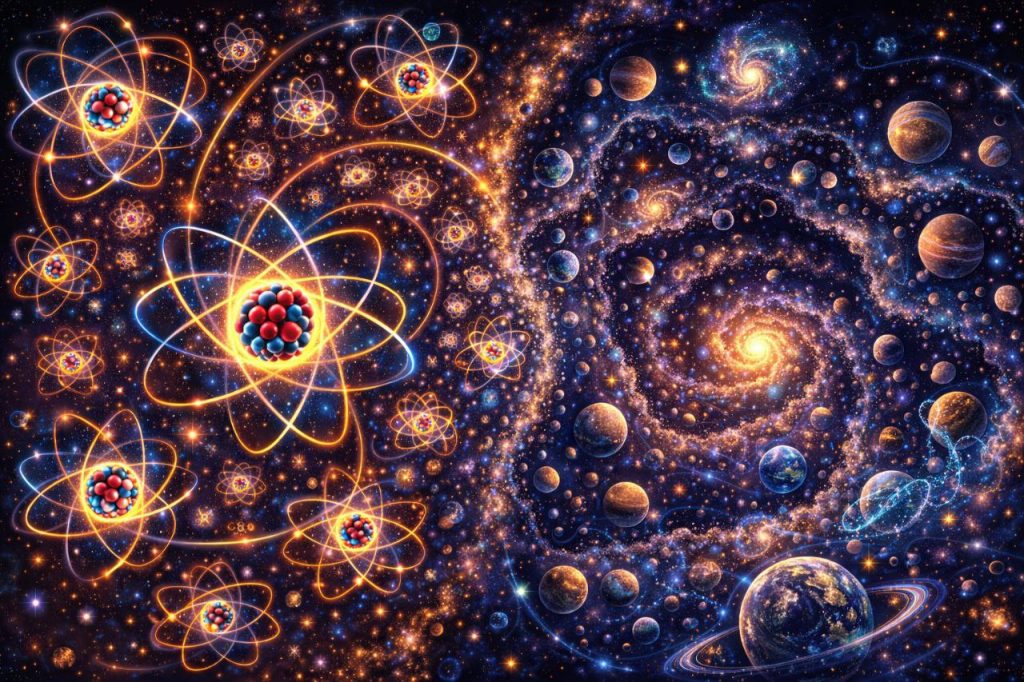
Fractality in nature describes a fundamental pattern in which similar shapes repeat across different scales, from the microscopic to the cosmic. Unlike simple geometric forms, fractal structures retain their complexity no matter how closely they are observed. This property allows nature to build highly efficient, adaptive systems using relatively simple rules. Fractals appear in plants, landscapes, biological systems, and even physical processes such as clouds and lightning. Scientists study fractality not only for its beauty, but because it reveals how natural systems organize themselves. Understanding fractality helps explain why nature often looks irregular yet ordered at the same time.
What Makes a Structure Fractal
A fractal structure is defined by self-similarity, meaning its parts resemble the whole at different scales. This similarity does not have to be exact; in nature, it is often statistical rather than perfectly geometric. Fractals also tend to follow simple growth rules that produce complex outcomes. Because of this, fractal systems can expand, branch, or adapt without requiring centralized control. According to mathematician Dr. Alan West:
“Fractals show how complexity can emerge from simplicity,
using repetition instead of design.”
This principle explains why fractals are so common in natural processes.
Fractals in Plants and Living Organisms
Plants provide some of the clearest examples of fractality. The branching of trees, the structure of ferns, and the patterns of leaves all show repeating forms at different scales. This design maximizes exposure to sunlight, airflow, and nutrient distribution while minimizing material use. Inside the human body, fractal patterns appear in blood vessels, bronchial tubes, and neural networks. These structures allow efficient transport and communication throughout complex organisms. Fractality thus supports both growth and function in living systems.
Fractality in Landscapes and Geology
Natural landscapes often appear chaotic, yet many follow fractal rules. Coastlines, mountain ranges, river networks, and erosion patterns display repeating irregularity across scales. No matter how closely a coastline is measured, new details continue to emerge. This property explains why measuring natural boundaries is inherently scale-dependent. Geologists use fractal analysis to understand terrain formation, fault systems, and sediment distribution. Fractality helps explain how large geological features arise from small, repeated processes over time.
Atmospheric and Physical Fractals
Fractal patterns also dominate atmospheric phenomena. Clouds, snowflakes, lightning bolts, and turbulence all exhibit fractal geometry. These patterns result from nonlinear processes governed by energy flow and instability. Lightning, for example, follows branching paths that optimize electrical discharge through air. Cloud formations repeat similar shapes at vastly different sizes, from small puffs to massive storm systems. Studying these fractals improves weather modeling and climate analysis.
Why Fractality Is Efficient
Fractality allows natural systems to balance efficiency, flexibility, and resilience. Repeating patterns enable systems to scale without redesign. Damage to one part of a fractal system often does not destroy the whole, increasing robustness. This is why biological and ecological systems frequently rely on fractal organization. Engineers and scientists increasingly draw inspiration from natural fractals when designing networks, materials, and algorithms.
Fractals as a Universal Principle
Fractality suggests that nature operates through universal patterns rather than isolated designs. Similar mathematical rules appear in biology, physics, and geography, hinting at deep connections between different natural systems. Fractals blur the line between order and randomness, showing that complexity does not require chaos. By studying fractality, scientists gain insight into how nature builds complexity from repetition. It is a reminder that nature often favors patterns that grow rather than patterns that are planned.
Interesting Facts
- Many natural fractals are statistical, not perfectly identical.
- Human lungs increase surface area dramatically using fractal branching.
- Coastlines appear longer when measured at smaller scales due to fractality.
- Fractals help explain patterns in clouds, lightning, and snowflakes.
- Some fractal rules apply across biology, geology, and physics.
Glossary
- Fractal — a structure that shows self-similarity across different scales.
- Self-Similarity — the repetition of patterns within patterns.
- Scale — the level of magnification or size at which a structure is observed.
- Branching — a growth pattern where structures divide repeatedly.
- Nonlinear Process — a process where small changes can produce large effects.