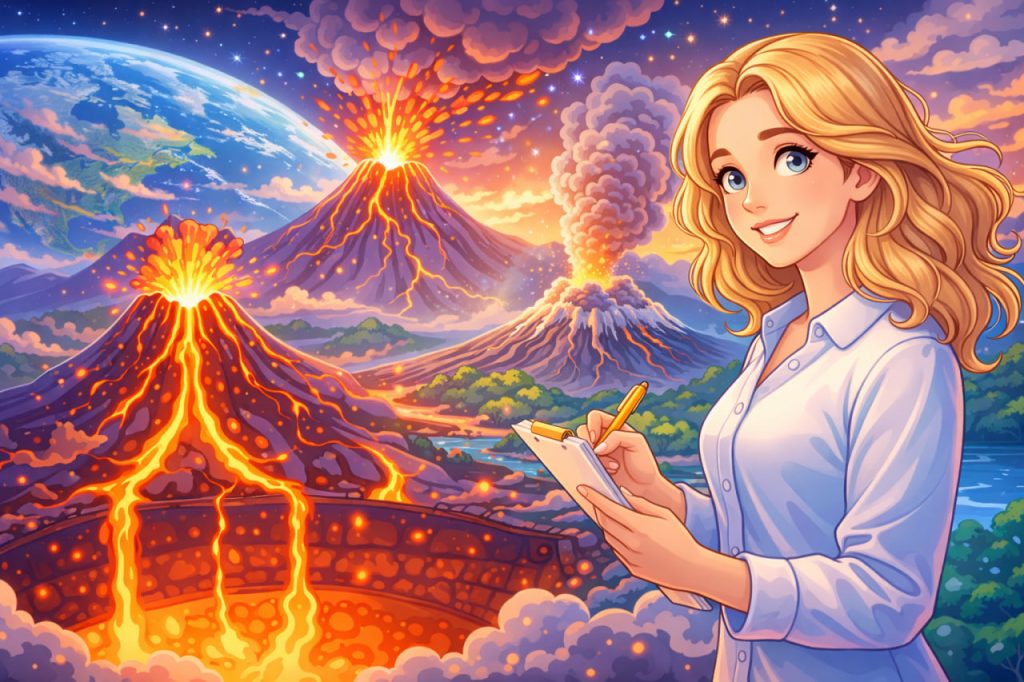
Volcanism is one of the fundamental processes shaping Earth’s surface and interior. Through volcanic activity, heat and material from deep within the planet reach the surface, influencing landscapes, atmosphere, and life itself. Volcanoes are not random anomalies but expressions of Earth’s internal dynamics. They play a crucial role in regulating planetary cycles, from the formation of continents to the composition of the atmosphere. Understanding volcanism helps explain how Earth evolved into a habitable world and why it remains geologically active today.
What Causes Volcanism
Volcanism originates from heat stored inside Earth’s mantle and core. This heat causes rock to melt, forming magma that is less dense than the surrounding solid material. As magma rises, it accumulates in chambers beneath the surface. When pressure becomes too great, magma escapes through fractures in the crust, resulting in volcanic eruptions. Most volcanic activity occurs along tectonic plate boundaries, though some volcanoes form above mantle hotspots. These processes reflect Earth’s ongoing internal energy flow.
Types of Volcanoes
Volcanoes vary widely in shape, size, and behavior. Shield volcanoes produce broad, gentle slopes formed by fluid lava flows. Stratovolcanoes are steeper and often more explosive, built from alternating layers of lava and ash. There are also fissure eruptions, where lava emerges from long cracks rather than a central cone. Each type reflects differences in magma composition and gas content. This diversity shows how volcanism adapts to geological conditions.
Volcanism and the Earth’s Atmosphere
Volcanoes have played a major role in shaping Earth’s atmosphere. Early volcanic eruptions released gases such as water vapor, carbon dioxide, and nitrogen, contributing to the formation of oceans and air. Even today, volcanic emissions influence atmospheric chemistry. While eruptions can temporarily cool the planet by injecting particles into the atmosphere, they also release greenhouse gases over long timescales. Volcanism therefore connects deep Earth processes with climate dynamics.
Impact on Life and Ecosystems
Although volcanic eruptions can be destructive locally, they also create new environments. Lava flows eventually break down into fertile soils rich in minerals. Many ecosystems thrive on volcanic landscapes once conditions stabilize. Throughout Earth’s history, volcanism has both challenged and supported life. It has driven mass extinctions in extreme cases, but also enabled biological renewal. Life on Earth has evolved alongside volcanic activity.
Volcanism as a Planetary Feature
Volcanism is not unique to Earth. Other planets and moons show evidence of volcanic or cryovolcanic activity. This suggests that internal heat and material circulation are common features of planetary bodies. On Earth, active volcanism indicates that the planet is still geologically alive. The balance between heat generation and heat loss maintains this activity over billions of years. Volcanism is thus a sign of a dynamic planet rather than a static one.
Why Volcanism Matters Today
Modern science monitors volcanoes to reduce risks to human populations. By studying seismic signals, gas emissions, and ground deformation, scientists can better understand volcanic behavior. Beyond hazard management, volcanism offers insight into Earth’s interior, plate tectonics, and long-term planetary evolution. It reminds us that the ground beneath our feet is not inert, but part of a living geological system. Volcanism continues to shape Earth’s past, present, and future.
Interesting Facts
- Most volcanic activity occurs beneath the oceans, unseen by humans.
- Volcanic soils are among the most fertile on Earth.
- Large eruptions can temporarily cool the global climate.
- Volcanism helped create Earth’s early atmosphere and oceans.
- Active volcanism indicates Earth is still geologically dynamic.
Glossary
- Volcanism — the movement of magma from Earth’s interior to the surface.
- Magma — molten rock beneath Earth’s surface.
- Lava — magma that reaches the surface.
- Mantle — the layer of Earth beneath the crust.
- Hotspot — a region where heat rises independently of plate boundaries.