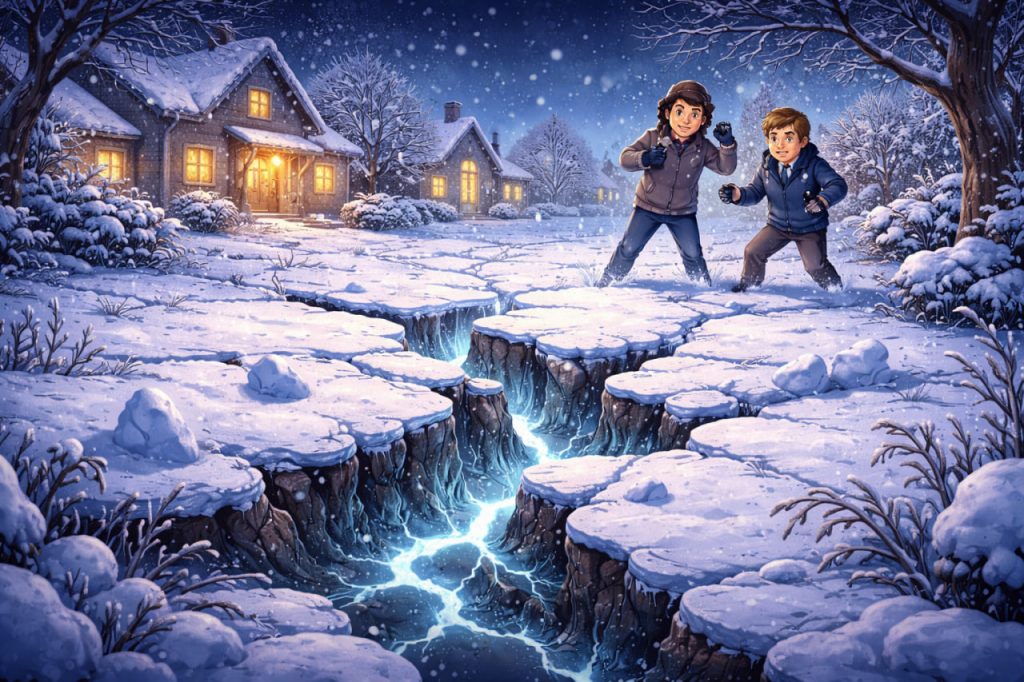
A frost quake, also known as a cryoseism, is a rare natural phenomenon that can sound and feel like a small earthquake, despite having a completely different origin. Unlike tectonic earthquakes, frost quakes are caused not by moving plates, but by rapid temperature changes near Earth’s surface. They occur most often in very cold climates during sudden cold snaps. The loud booming noises and ground vibrations they produce can be startling, especially because they happen without warning. Understanding frost quakes helps distinguish harmless surface events from true seismic activity.
How Frost Quakes Form
Frost quakes form when temperatures drop rapidly, causing water trapped in soil or rock to freeze quickly. As water freezes, it expands, generating strong pressure within the ground. This pressure builds until the surrounding material cracks suddenly. The abrupt release of energy produces a shockwave that can travel through the ground and air. Because the process happens quickly and close to the surface, it often creates loud sounds similar to explosions or thunder. The key trigger is rapid freezing, not prolonged cold.
Why They Are Different from Earthquakes
Unlike earthquakes, frost quakes are not related to faults or tectonic stress. They occur at shallow depths, usually within the top layers of soil or rock. As a result, they do not produce seismic waves that travel long distances through the Earth. Standard seismographs often fail to detect them, or record only very weak signals. Frost quakes also tend to be isolated events rather than part of a series. Their effects are local and short-lived.
When and Where Frost Quakes Occur
Frost quakes are most common in regions with cold winters and fluctuating temperatures. They often occur after rain or snowmelt, when the ground is saturated with water before a sudden freeze. Flat areas with shallow soil and limited insulation from snow cover are especially vulnerable. Snow acts as a thermal blanket, slowing heat loss; thin snow cover increases the likelihood of rapid freezing. Most frost quakes happen at night, when temperatures drop fastest.
Sounds and Sensations
People who experience frost quakes often report sharp cracking noises, booms, or rumbling sounds. These may be accompanied by brief ground shaking or vibrations felt through buildings. Because the event is sudden and unexpected, it can be mistaken for an explosion or structural failure. However, frost quakes rarely cause serious damage. Minor cracks in soil, pavement, or foundations may occur, but widespread destruction is extremely unlikely.
Potential Impact on Structures
While generally harmless, frost quakes can occasionally affect man-made structures. Small cracks may appear in foundations, walls, or underground pipes, especially if materials are already weakened. These effects are usually cosmetic rather than structural. Unlike tectonic earthquakes, frost quakes do not threaten large-scale infrastructure. Their limited energy and shallow origin keep impacts localized.
Scientific Importance
Frost quakes provide insight into how temperature changes influence ground mechanics. They help scientists study freeze–thaw processes, soil behavior, and the interaction between climate and geology. As climate patterns shift and temperature extremes become more variable, interest in cryoseismic activity is increasing. Monitoring frost quakes contributes to understanding surface-level geological responses to environmental change.
How to Distinguish a Frost Quake
A frost quake typically occurs during extreme cold following wet conditions, without aftershocks or prolonged shaking. There is no associated seismic activity recorded over a wide area. The absence of structural damage and the timing during cold snaps are key indicators. Recognizing these signs can reduce unnecessary concern and emergency responses.
Interesting Facts
- Frost quakes occur near the surface, not deep underground.
- They are triggered by rapid freezing, not long-term cold.
- Snow cover can reduce the likelihood of frost quakes.
- They often happen at night, when temperatures drop fastest.
- Most frost quakes leave little to no lasting damage.
Glossary
- Frost Quake (Cryoseism) — ground cracking caused by rapid freezing of water in soil or rock.
- Freeze–Thaw Cycle — repeated freezing and melting of water in the ground.
- Thermal Contraction — shrinking of materials due to temperature decrease.
- Seismograph — an instrument that records ground motion.
- Surface Cracking — shallow fractures caused by environmental stress.